
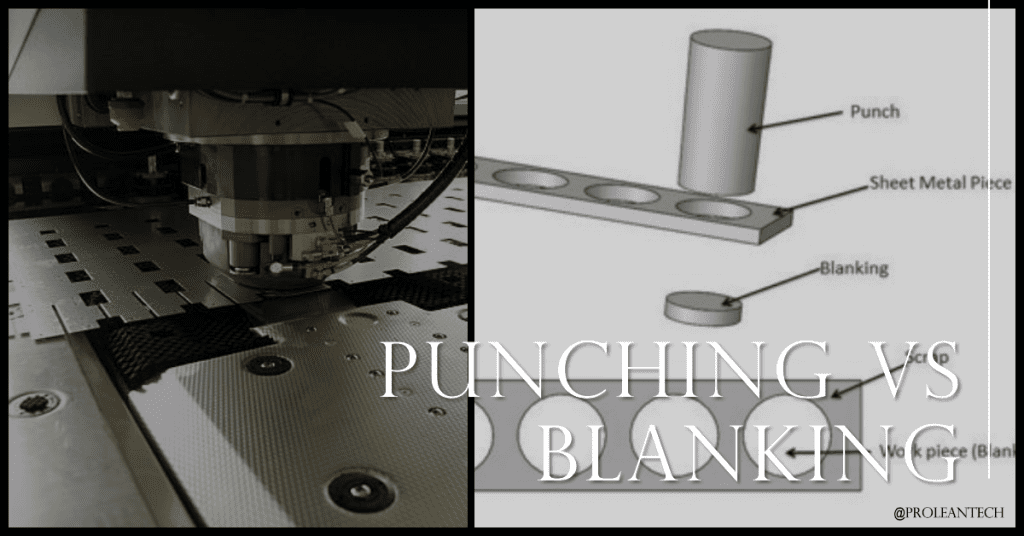
Sheet Metal Punching and blanking are two common techniques used in metal forming. Punching creates holes using a punch press while blanking cuts metal into specific shapes using a die. The decision to use one technique over the other depends on factors such as the type of metal being used, the precision required, and the desired outcome. For instance, punching is often used for creating holes in sheet metal, while blanking is more commonly used for creating parts from sheet metal. Despite their differences, both techniques are extensively used by manufacturers worldwide.
This article delves into the intricate workings of punching and blanking, painting a comprehensive picture of their applications and limitations.
The Underlying Mechanics: Understanding Punching and Blanking
In order to make a choice between punching and blanking, one must first understand the mechanics of each process. These processes, while related, operate on fundamentally different principles.
Punching is a process in which a hole is created in the workpiece. This is achieved by applying a shearing force to the material. A tool, known as the punch, is forced through the material and into a die, which is a specially designed tool that supports the workpiece on the opposite side.
The Mechanics of Punching
The process of punching is carried out as follows:
- The workpiece is placed over the die, which is designed to support the workpiece and provide a place for the punch to push into.
- The punch is then forced through the workpiece. The sharp edge of the punch shears the material, creating a hole.
- The slug, the piece of material removed by the punch, is discarded.
The Mechanics of Blanking
Blanking is a process that cuts a desired shape out of a material. The blank, or cut-out part, is kept and usually processed further.
The process of blanking is conducted as follows:
- Similar to punching, the workpiece is placed over a die. However, in this case, the die is shaped to match the desired blank.
- The punch, which is also shaped like the desired part, is forced through the material.
- The blank is separated from the rest of the workpiece. The remaining material, often referred to as the web, is usually discarded or recycled.
Here’s a table that outlines the key differences in the mechanics of punching and blanking:
| Process | Mechanics | Result |
|---|---|---|
| Punching | The punch is forced through the workpiece into a die, creating a hole. | The hole is the desired result, and the slug is discarded. |
| Blanking | The punch, shaped like the desired part, is forced through the material, separating the blank from the rest of the workpiece. | The blank is the desired result, and the web is discarded or recycled. |
Evaluating the Strengths and Limitations: Punching Vs Blanking
The Strengths of Punching
- Speed: Punching machines can create holes quickly, making them ideal for large-scale production.
- Versatility: Punching can create holes of various shapes and sizes, providing flexibility for diverse designs.
- Rough Edges: Punching can often leave burrs or rough edges that require additional processing.
- Material Thickness: The effectiveness of punching decreases as material thickness increases.
Limitations of Punching
- One of the limitations of punching is that it can leave burrs or rough edges that require additional processing. Another limitation is that its effectiveness decreases as the thickness of the material increases.
- Rough Edges: Punching can often leave burrs or rough edges that require additional processing.
- Material Thickness: The effectiveness of punching decreases as material thickness increases.
The Strengths of Blanking
- Precision: Blanking can produce parts with high precision, making it suitable for operations requiring exactness.
- Efficiency: Since the cut-out part is the desired product, blanking reduces material waste.
The Limitations of Blanking
- Speed: Blanking is generally slower than punching, which could impact production time for large-scale operations.
- Complexity: Blanking is typically used for simpler shapes. Producing complex shapes may require multiple stages or additional processes.
Below is a table summarizing the strengths and limitations of punching and blanking:
Identifying the Right Process for Your Project
Choosing the right process for your metal forming needs depends on various factors, including the material, complexity, quantity, and the desired level of precision. Here, we provide a detailed guide to help you make an informed decision.
Factors to Consider when Choosing Between Punching and Blanking
- Material: The thickness and hardness of the material can influence the choice. Punching may struggle with thicker or harder materials, whereas blanking can handle a variety of thicknesses and hardness levels.
- Quantity: Punching might be preferable for large quantities due to its speed. However, the slower but more accurate blanking process could be the better choice if precision is crucial.
- Complexity: Punching might be the best choice for complex shapes as it can produce a variety of hole shapes and sizes. Blanking is typically better for simpler, less intricate shapes.
- Finishing: If the edges require a high-quality finish, blanking might be the preferred method, as punching can leave rough edges.
Here is a table providing a brief guide to choosing the right process:
| Factor | Punching | Blanking |
|---|---|---|
| Material | Best with thinner or softer materials | Can handle a range of thicknesses and hardness levels |
| Quantity | Suitable for large quantities | Preferred for smaller quantities where precision is key |
| Complexity | Can create a variety of hole shapes and sizes | Better for simpler, less intricate shapes |
| Finishing | May leave rough edges | Typically leaves cleaner edges |
Try Ancastings Now!
Accuracy Comparison: Punching Vs Blanking
Both punching and blanking are metal-forming processes that offer varying levels of accuracy. Here, we delve into the comparison between the two in terms of accuracy.
Accuracy in Punching
Punching is a versatile process that can create various shapes and sizes of holes. However, the accuracy of punching can be influenced by several factors:
- Material Thickness: The accuracy of punching can decrease with thicker materials. The force required to punch a hole can cause distortion in thicker workpieces.
- Burrs: Punching often leaves burrs or rough edges, which require additional finishing processes to remove.
Accuracy in Blanking
Blanking is known for its precision and the high quality of its edges. Key aspects contributing to blanking’s accuracy include:
- Clean Edges: Blanking typically leaves cleaner edges compared to punching. This reduces the need for additional finishing processes.
- Precision: Blanking can produce parts with high precision, making it suitable for operations requiring exactness.
Applications Comparison
The applications of punching and blanking vary widely across different industries, reflecting their unique capabilities and characteristics.
Applications of Punching
Punching is typically used when numerous holes are required in a workpiece. It is frequently used in industries such as:
- Construction: For creating holes in steel beams or plates.
- Automotive: For making holes in car body parts or components.
- Electronics: For producing ventilation holes in metal casings
Applications of Blanking
Blanking is commonly used when a high degree of precision is required in the final product. It is commonly used in industries like:
- Electronics: For creating precise components, such as connectors or terminal pins.
- Automotive: For producing high-precision parts like gaskets or washers.
- Aerospace: For manufacturing components that require high precision and clean edges.
The Ancastings Edge: Mastering Punching and Blanking
When it comes to delivering high-quality, efficient, and versatile metal forming services, Ancastings stands out in the industry. With expertise in both punching and blanking processes, we provide tailored solutions to meet the unique needs of each project.
Our punching and services are renowned for their speed and versatility. Equipped with advanced CNC machinery, they can punch a range of shapes and sizes, adapting to the unique needs of each project. Whether it’s a large-scale production run or a custom design, we deliver with excellence.
Furthermore, our blanking services excel in delivering high precision and superior edge quality. By minimising material waste and maximising efficiency, they ensure cost-effective products for their clients. So, contact us for any sheet metal service!
Conclusion
While punching and blanking are distinct processes, they both play crucial roles in the world of metal forming. Understanding the nuances of each can help manufacturers make informed decisions about the best technique to use for their specific projects. And with companies like Ancastings providing top-tier punching and blanking services, manufacturers can enjoy both processes’ best aspects without compromise.
FAQs
What is the main difference between punching and blanking?
The main difference is in the desired end product. In punching, the hole is the desired product, while in blanking, the cut-out part is the desired product.
Which is faster, punching or blanking?
Punching is generally faster than blanking, making it more suitable for high-volume production runs.
What types of materials can be used in punching and blanking?
Both processes can be used with a wide range of materials, including various metals like steel, aluminum, brass, and copper, as well as plastics and composites. The choice of material depends on the specific requirements of the project.
What role does Ancastings play in punching and blanking?
Ancastings offers top-tier punching and blanking services. With advanced CNC-controlled machinery and a team of skilled technicians, Ancastings provides superior quality, precision, and efficiency in every project, whether it involves punching, blanking, or both.