
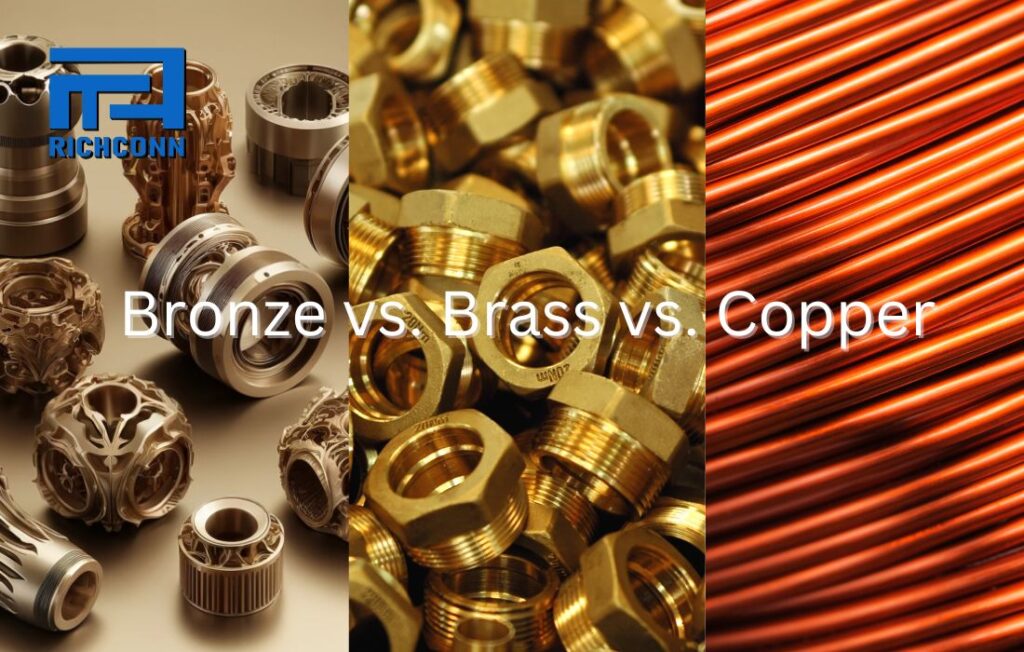
Bronze, brass, and copper look so much alike that even people who work with metal every day sometimes mix them up. All three carry a reddish tint, all three resist rust, and all three turn up in everything from ship propellers to circuit boards. But specify the wrong one for a machined part, and you’ll find out quickly how different they really are — a brass fitting corrodes in seawater where bronze would last decades, and a bronze busbar wastes energy that copper would carry with ease.
At Ancastings, material selection questions come up in almost every quoting conversation we have with engineers and buyers. This guide covers what we walk customers through: what each metal actually is, how they compare on the properties that matter, what they cost relative to each other, and how to pick the right one for your application.
The Short Answer
If you only need the one-paragraph version, here it is:
- Copper is a pure metal — the base element the other two are built on. Choose it when electrical or thermal conductivity is the priority: wiring, busbars, heat sinks, heat exchangers.
- Brass is copper alloyed with zinc. It’s the easiest of the three to machine, the lowest in cost, and the go-to for fittings, valves, connectors, and decorative hardware.
- Bronze is copper alloyed with tin — or with aluminum, silicon, or nickel in modern variants. It’s the pick for wear resistance and harsh environments: bearings, bushings, gears, and marine components.
Which one is “strongest” or “best” depends entirely on the specific alloy — a question we’ll answer properly below, because the honest answer is more useful than the simple one.
What Is Copper?
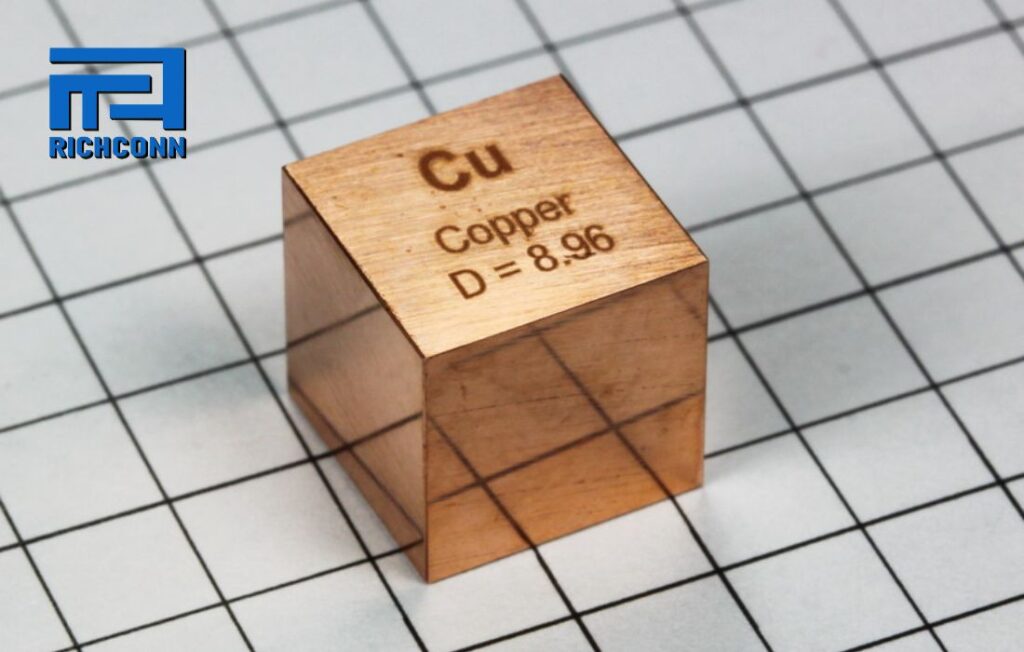
Copper is a naturally occurring elemental metal — Cu on the periodic table — and one of the few metals humans can use more or less as it comes out of the ground. Its history stretches back over 10,000 years, and its salmon-red color in a fresh cut is unmistakable. Left outdoors, it slowly develops the blue-green patina you see on old roofs and the Statue of Liberty. That patina isn’t decay — it’s a protective layer that shields the metal underneath from further corrosion.
Two properties set copper apart from every common engineering metal except silver: electrical and thermal conductivity. Pure copper is the benchmark other metals are measured against — 100% IACS (International Annealed Copper Standard) by definition. Brass manages roughly a quarter of that; most bronzes, less still.
The trade-off is softness. Pure copper is malleable and ductile — easy to form into wire and tube, but too soft for structural or high-wear parts, and notoriously “gummy” to machine because it smears rather than shears cleanly under a cutting tool.
Common copper grades
- C110 (Electrolytic Tough Pitch): The standard commercial copper — 99.9% pure, 100–101% IACS conductivity. Used for busbars, wiring, and general electrical work.
- C101 (Oxygen-Free): Higher purity for high-vacuum electronics and applications where hydrogen embrittlement is a concern.
- C145 (Tellurium Copper): A small tellurium addition transforms machinability — around 85% of free-cutting brass — while keeping roughly 90% of pure copper’s conductivity. This is what we recommend when a customer needs a complex machined part that still has to conduct.
- C182 (Chromium Copper): Heat-treatable to nearly triple the strength of pure copper, at around 80% IACS. Common in resistance-welding electrodes and high-strength connectors.
Typical applications: electrical wiring and busbars, heat sinks and heat exchangers, plumbing tube, EV battery interconnects, RF components, and food-grade equipment — copper is naturally antimicrobial, which is why it appears in touch surfaces and brewing equipment.
What Is Brass?
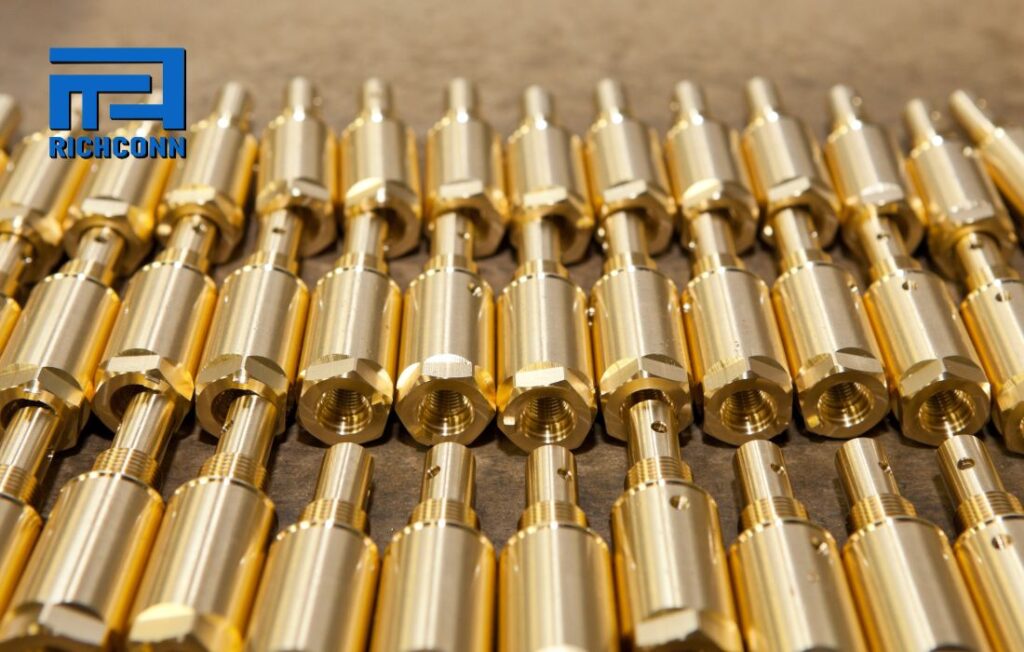
Brass is an alloy of copper and zinc — typically 60–70% copper with the balance zinc, though the ratio varies widely by grade. More zinc pushes the color from reddish-gold toward bright yellow and raises strength; more copper deepens the color and improves corrosion resistance. Small additions of lead, tin, or arsenic tune specific properties.
Brass earns its place in machine shops for one reason above all: machinability. Free-cutting brass (C360) is the material against which all other metals’ machinability is rated — it’s the literal 100% benchmark. It cuts fast, breaks chips cleanly, holds tight tolerances, and leaves an excellent surface finish straight off the machine. For high-volume turned parts, that translates directly into lower cost per piece — often enough to offset any difference in raw material price against steel or aluminum alternatives.
Brass’s weak point is a corrosion mechanism called dezincification — in certain water conditions, zinc leaches out of the alloy and leaves behind a porous, weakened copper structure. Naval brass and arsenical brasses were developed specifically to resist it, which is worth remembering if your parts will see seawater or aggressive water chemistry.
Common brass grades
- C360 (Free-Cutting Brass): The most widely machined metal in the world. Fittings, valve components, fasteners, connector bodies, gears.
- C260 (Cartridge Brass): 70/30 copper-zinc with excellent cold-forming properties — deep-drawn parts, ammunition casings, hardware.
- C464 (Naval Brass): Tin-modified to resist dezincification and seawater corrosion. Marine hardware, propeller shafts, condenser plates.
- C385 (Architectural Bronze): Despite the trade name, this is metallurgically a brass — a copper-zinc-lead alloy used in extrusions for railings, trim, and storefronts. A good example of why trade names can’t be trusted for material identification.
Typical applications: plumbing fittings and valves, electrical connectors and terminals, musical instruments (the acoustic properties are genuinely excellent), locks and hinges, gears for light-duty mechanisms, and decorative hardware where the warm gold color does the selling.
What Is Bronze?
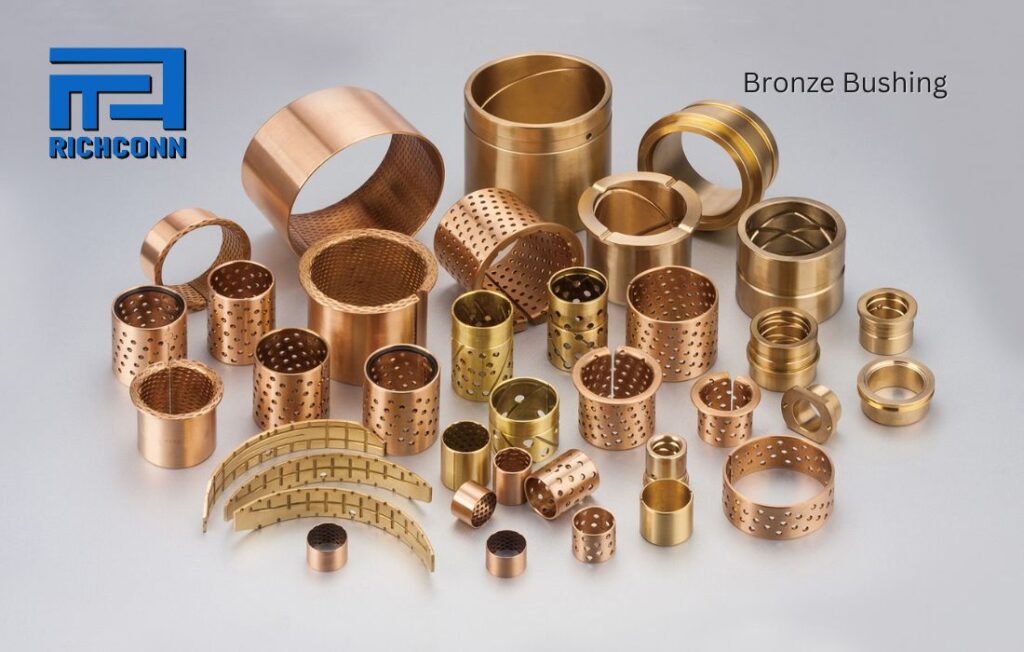
Bronze is the oldest engineered alloy in human history — copper hardened with tin, first smelted around 3500 BC and important enough to name an age after. Modern “bronze” is a broader family: alongside classic tin bronzes sit aluminum bronzes, silicon bronzes, phosphor bronzes, and manganese bronzes, each built on copper with different alloying strategies.
What unites them is a combination of wear resistance, corrosion resistance, and load capacity that neither copper nor brass can match. Bronze forms a hard, stable oxide layer on exposure — even in saltwater — and its low friction against steel makes it the default material for bearings and bushings: bronze wears slowly and sacrificially, protecting the more expensive steel shaft running inside it.
Color-wise, bronze reads duller and browner than brass’s bright yellow — closer to an old penny than to gold. Aluminum bronze is the exception that trips people up, with a golden tone that can pass for brass at a glance.
Common bronze grades
- C932 (Bearing Bronze, SAE 660): The workhorse leaded tin bronze for bushings, washers, and bearing surfaces. Moderate strength, excellent lubricity, easy to machine for a bronze (around 70% of C360).
- C954 (Aluminum Bronze): A different animal entirely — tensile strength in the 585–620 MPa range, comparable to medium-carbon steel, with outstanding seawater corrosion resistance. Gears, valve stems, wear plates, marine propulsion components.
- C510 (Phosphor Bronze): Tin bronze with a trace of phosphorus, prized for fatigue resistance and springiness. Electrical spring contacts, connectors, instrument components.
- C655 (Silicon Bronze): Excellent weldability and corrosion resistance — marine fasteners, architectural elements, welded assemblies.
Typical applications: bearings and bushings, worm gears, ship propellers and marine hardware, pump and valve internals, oil-and-gas components, and — thanks to the fact that bronze doesn’t spark when struck — non-sparking tools for explosive environments.
Bronze vs Brass vs Copper: Property Comparison Table
The table below uses representative values for the most common engineering grade of each metal, because comparing “bronze” to “brass” in the abstract produces the contradictions you’ll find on half the internet. Values vary with temper and specific alloy — treat these as typical, not guaranteed.
| Property | Copper (C110) | Brass (C360) | Bearing Bronze (C932) | Aluminum Bronze (C954) |
|---|---|---|---|---|
| Composition | ≥99.9% Cu | ~61.5% Cu, 35.5% Zn, 3% Pb | ~83% Cu, 7% Sn, 7% Pb, 3% Zn | ~85% Cu, 11% Al, 4% Fe |
| Tensile strength | 220–345 MPa | 340–470 MPa | 240–310 MPa | 585–620 MPa |
| Yield strength | 70–310 MPa | 125–310 MPa | ~125 MPa | 240–275 MPa |
| Hardness (Brinell) | ~50–95 | ~100–150 | ~65 | ~160–170 |
| Electrical conductivity (% IACS) | 100–101% | ~26% | ~12% | ~13% |
| Density (g/cm³) | 8.89–8.94 | 8.50 | 8.93 | 7.45 |
| Melting range | 1083 °C | 885–900 °C | 855–980 °C | 1025–1040 °C |
| Machinability (C360 = 100%) | ~20% | 100% | ~70% | ~60% |
| Corrosion resistance | Good (patina-forming) | Good; dezincification risk in some waters | Very good | Excellent, incl. seawater |
| Relative cost | Highest | Lowest | Mid | Mid-high |
A few things this table makes obvious — and that a vaguer comparison would hide:
“Which is strongest, brass or bronze?” depends on which bronze.
Aluminum bronze C954 outmuscles every common brass by a wide margin. But free-cutting brass C360 is actually stronger in tension than bearing bronze C932. Anyone who tells you flatly that “bronze is stronger than brass” is comparing the best bronze against an average brass. The accurate ranking: aluminum bronzes at the top, common brasses in the middle, bearing bronzes and pure copper below.
Melting points run opposite to what many guides claim.
Brass melts lowest (zinc pulls the melting range down), copper highest at 1083 °C, with most bronzes in between. If you’ve read elsewhere that bronze has the highest melting point of the three — that’s one of the most commonly repeated errors on this topic.
Conductivity isn’t close.
Copper carries roughly four times the current of brass and eight times that of most bronzes for the same cross-section. For anything electrical or thermal, the other two aren’t really alternatives — they’re compromises you accept only when you need their mechanical properties more.
How the Differences Play Out in Practice
Strength and hardness
Pure copper is the softest of the group — that’s the price of its conductivity and formability. Alloying is what buys strength: zinc strengthens copper into brass, and tin or aluminum strengthens it into bronze. At the top end, heat-treated aluminum bronzes reach strength levels that compete with steel while shrugging off corrosion that would destroy it. If your part carries load, transmits torque, or takes impact, you’re choosing among bronzes and high-strength brasses, not copper.
Corrosion resistance
All three resist rust for the simple reason that none contains meaningful iron. The differences show up in which environments each survives:
- Copper handles atmosphere and fresh water well, protected by its patina.
- Brass does fine in air and clean water but is the most vulnerable of the three in seawater and aggressive water chemistry unless you specify a dezincification-resistant grade like naval brass.
- Bronze — particularly aluminum and silicon bronzes — is the standard for marine service. There’s a reason ship propellers have been bronze for over a century.
Machinability
This one matters more to your part cost than most buyers realize. Machining time is a major driver of the price of any CNC part, and the spread here is enormous: brass C360 cuts five times faster than pure copper. Copper’s gumminess means slow feeds, sharp tooling, and careful chip management; leaded brasses and bronzes practically machine themselves. When a customer needs copper-level conductivity in a geometrically complex part, we often steer them toward tellurium copper C145 — most of the conductivity, a fraction of the machining headache, and usually a lower total part cost. [内链→ Ancastings copper/precision machining 服务页,确认URL]
Weldability
Roughly the reverse of machinability. Oxygen-free and deoxidized coppers weld well; silicon bronze is famously weld-friendly (it’s a common TIG filler for copper alloys); but the same lead that makes C360 brass and C932 bronze cut so beautifully makes them poor candidates for welding — lead causes hot cracking. Zinc adds another problem for brass: it boils off as toxic fumes under the arc. If your design requires welded joints, flag it early — it changes the sensible alloy choice.
Weight
The differences are modest but occasionally decisive. Copper is densest at ~8.9 g/cm³; common brasses sit around 8.5; aluminum bronze is the lightweight of the family at ~7.5 — lighter than brass despite being far stronger, which is part of why it’s attractive in marine and aerospace hardware.
Magnetism
None of the three is magnetic in any practical sense — a property shared by non-ferrous metals generally, and a quick field test: if a magnet grabs it, it isn’t copper, brass, or bronze. (A few bronze grades with significant iron content, like C954, may show a barely detectable pull — nothing like steel.)
What About Cost?
Relative pricing is consistent even as absolute metal prices move:
Copper is the most expensive. It’s the pure metal, and global demand from wiring, electronics, and energy infrastructure keeps it that way. Alloys cost less partly because zinc and other additions are cheaper than the copper they displace.
Brass is the least expensive — zinc is cheap, and brass’s fast machining compounds the savings at the finished-part level. For a machined component, material price and machining time both favor brass, which is why it dominates high-volume turned parts.
Bronze sits in between, usually above brass. Tin costs considerably more than zinc, and specialty bronzes (aluminum, phosphor, nickel-aluminum) carry further premiums. The price is justified where wear life or marine durability is on the line — a bronze bushing that lasts four times as long as the alternative is cheap insurance.
One caveat worth knowing: for the finished part, machining time can matter as much as raw material. A gummy copper part with long cycle times can cost more to produce than a bronze part cut from pricier stock. When we quote, we look at both — sometimes the “more expensive” material yields the cheaper part.
How to Tell Them Apart in Seconds
Three quick field checks, in increasing order of reliability:
Color
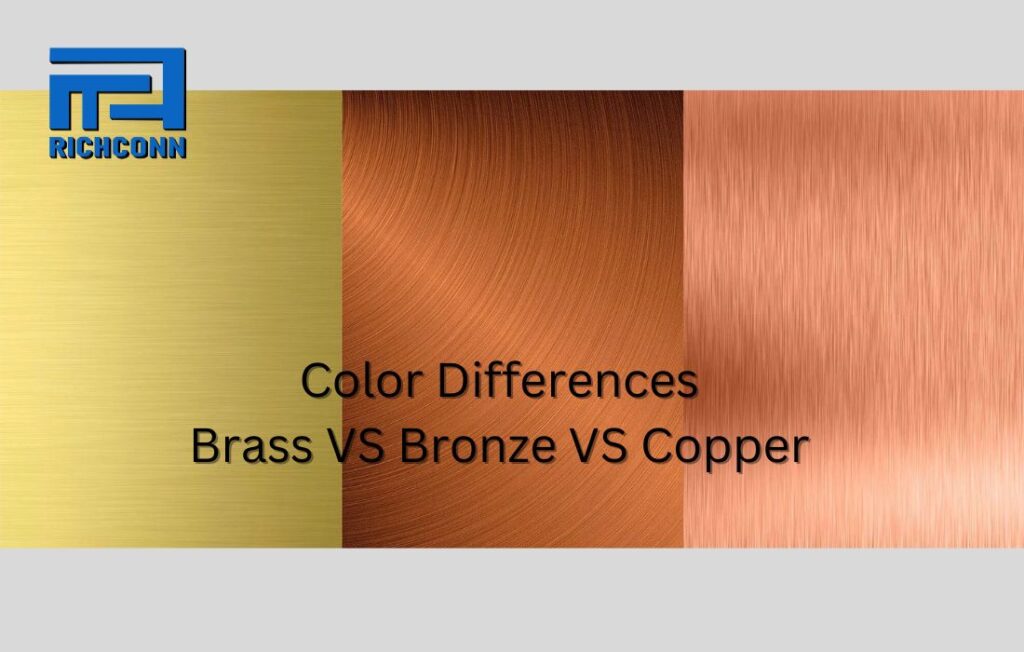
Look at a clean, unoxidized surface. Copper is distinctly reddish — salmon to rose. Brass is yellow to gold, brighter with higher zinc content. Bronze is a muted, brownish gold — think old coin rather than new trumpet. Caution: aluminum bronze mimics brass, and aged patinas hide everything, so color alone can mislead.
Sound
Tap the piece lightly with something hard. Copper gives a dull, muted thud — soft metals damp vibration. Brass rings brighter and higher. Bronze produces a clear, resonant ring that sustains — the reason bells and cymbals have been bronze for millennia.
Markings
The reliable method. Industrial stock is usually stamped or documented with a UNS designation: C1xxxx–C15xxx ranges are coppers, C2xxxx–C4xxxx are brasses, C5xxxx and C6xxxx are mostly bronzes, and C8xxxx/C9xxxx are cast alloys. When the application matters, trust the certificate, not your eye — and if there’s no paperwork, a spark-free non-magnetic reddish metal still needs positive identification (XRF analysis) before it goes into anything critical.
Which Should You Choose?
Strip away the metallurgy and the decision usually resolves to one dominant requirement:
Choose copper when conductivity is the job.
Busbars, terminals, heat sinks, heat spreaders, RF housings. Nothing else in this family comes close, and for these applications the extra material cost is simply the cost of doing the job right. If the part is complex to machine, consider tellurium copper before compromising on a lower-conductivity alloy.
Choose brass when you need economical precision.
Fittings, valve bodies, connectors, inserts, gears, and any high-volume turned component where machinability drives cost. Add the requirement “and it should look good” — brass is the only one of the three regularly chosen for its appearance — and the case gets stronger. Just specify naval or DZR grades if the part will live in seawater or hot water systems.
Choose bronze when the part has to survive.
Sliding contact, heavy loads, saltwater, abrasive environments — bearings, bushings, gears, pump internals, marine hardware. Within bronze, let the duty pick the grade: C932 for general bearing service, C954 when you need real strength, phosphor bronze for springs and contacts, silicon bronze when you’ll be welding.
And when the answer isn’t obvious — a part that needs decent conductivity and wear resistance, or strength and a specific finish — that’s exactly the conversation to have with your machining partner before drawings are finalized. Material substitutions are cheap on paper and expensive after tooling.
Machining Copper Alloys: What We See on the Shop Floor
A few practical notes from machining these materials daily at Ancastings:
- Brass is as forgiving as machining gets — high speeds, excellent finishes, tight tolerances with no drama. If your design can use C360, your per-part price will thank you.
- Pure copper demands technique. Razor-sharp tooling, adjusted feeds, and good chip evacuation — otherwise it smears, work-hardens, and tears. It’s routine work for shops that handle it regularly, and a source of scrapped parts for shops that don’t.
- Bronzes machine well but abrasively. Aluminum bronze in particular is hard on tooling; we plan tool life accordingly on longer runs.
- Tolerances are achievable across all three — we regularly hold ±0.01 mm level tolerances on copper-alloy parts — but the right grade makes hitting them faster and cheaper.
If you’re weighing copper vs brass vs bronze for a specific component, send us the drawing — we’ll quote it in the candidate materials side by side so you can see the real cost difference, not the theoretical one. Our engineers review every quote manually, and material selection advice is part of that review, not an upsell.
Frequently Asked Questions
Usually, but not always — it depends on the grades you’re comparing. Aluminum bronze (C954) is far stronger than any common brass, with tensile strength approaching medium-carbon steel. But everyday bearing bronze (C932) is actually weaker in tension than free-cutting brass (C360). Compare specific alloys, not family names.
Yes. Copper is the pure base metal and carries the highest price of the three. Brass is the cheapest because zinc costs far less than copper; bronze falls in between, closer to the top for specialty grades like aluminum or phosphor bronze.
Bronze, decisively — aluminum bronze and silicon bronze in particular resist seawater corrosion for decades, which is why propellers and underwater hardware are bronze. Standard brass is the worst of the three in seawater due to dezincification; if brass must be used, specify naval brass (C464).
No — all three are non-ferrous and effectively non-magnetic. A magnet is a quick way to rule out steel when identifying an unknown reddish metal.
Brass, and it isn’t close. Free-cutting brass C360 is the 100% reference point for machinability ratings. Leaded bronzes like C932 rate around 70%; pure copper rates around 20% and requires specialized technique. For conductive parts that need heavy machining, tellurium copper (C145) offers a practical middle path.
They corrode, but they don’t rust — rust is specifically iron oxide, and none of these contains meaningful iron. Copper forms a green patina, brass and bronze form stable oxide layers. In most environments these surface films protect rather than degrade the metal.
Sometimes — for static, dry, low-load parts, often yes. For anything involving sliding wear, sustained load, or saltwater, brass is a false economy: the part cost saved up front gets repaid in replacement cycles. If budget pressure is real, tell your supplier the operating conditions and ask for the cheapest grade that survives them — that’s a better question than “can we use brass.”