
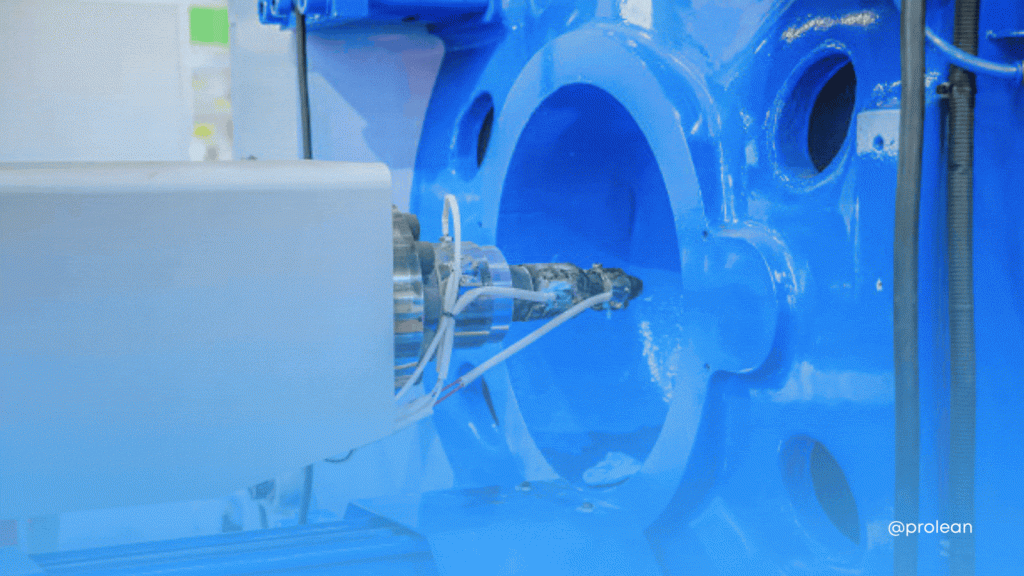
Rotational molding also known as roto molding is an advanced molding technique, used to make hollow parts without the application of pressure. It’s a casting process in which the molds are cheap hence, the process is economical even for small-quantity productions. This technology offers designers great versatility since it is capable of generating practically any form and is used in such diverse products as water tanks, and kayaks. Although custom roto molding has been in the market for more than a century, it is still popular among manufacturers because of the efficiency and quality production of products in many industries.
What Is Rotational or Roto Molding?
Rotational molding, roto molding, roto casting, or roto mold involves large machines that shape products according to the mold required for chemical containers or plastic slides for children. This method is often compared with blow molding but this method has an added advantage of being cheaper and more flexible.
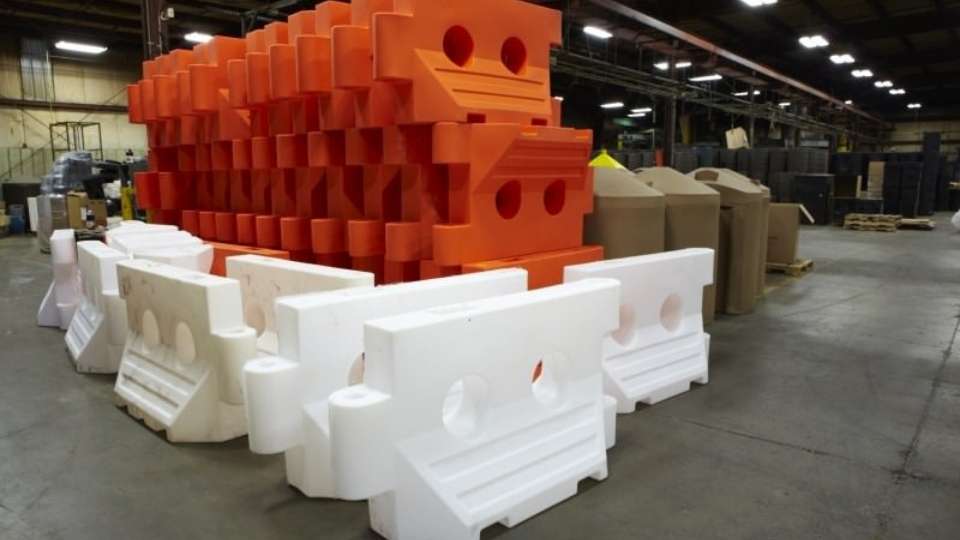
Industrial roto molding
Rotational molding is a process of molding in which a hollow mold containing powdered plastic, typically polyethylene is heated and rotated in multiple directions. When the mold turns around the heat melts the plastic and applies it on the inside surface of the mold uniformly. Once the material has bonded properly the mold is then cooled for the plastic to set and the final part is then ejected.
Even though roto molding is slower than most high-pressure processes, in which the molds are rotated around eight times per minute, and the production takes up to three hours. The process is highly effective in producing hollow, seamless products in one piece. Polyethylene is the most frequently used material because of its low cost, high heat resistance, and high strength when cooled, however, some injection molding companies may use other materials such as; silicone, ABS, or acrylic but this is not very frequent for most uses.
Try Ancastings Now!
Rotational or Roto Molding: Process Overview
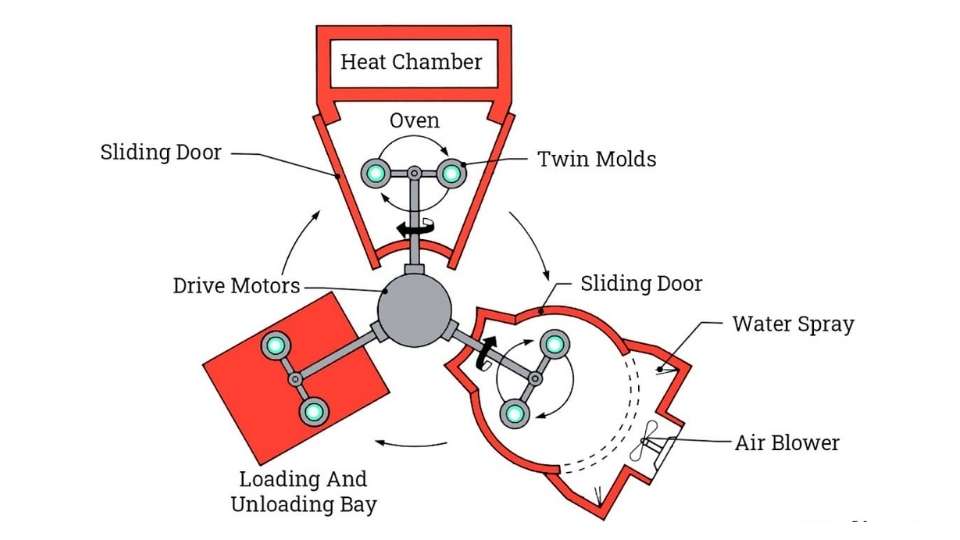
The process is simple; however, it can be rather complex in actuality. It starts with putting plastic powder into a hollow mold which is normally made out of cast aluminum or sheet steel. The mold is then closed and rotated on two axes while the mold is being heated in an oven. When the plastic powder is heated it spreads all over the inside of the mold in the required manner. After complete melting, the mold is transported to a cooling area where it cools through the blowing of air and a fine water mist. On attaining the required temperature, the mold is opened, and the frozen part is taken out.
Roto molding process
In its basic form, rotational molding is not a difficult process; however, because there is no direct control of pressure as is the case with high pressure processes such as injection molding, the process is relatively intricate. Some common parameters that can affect the molding process include the temperature of the environment, relative humidity, type of mold, material used, and quality of the powder used.
Related To: Rapid Injection Molding
Common Polymers in Rotational Molding
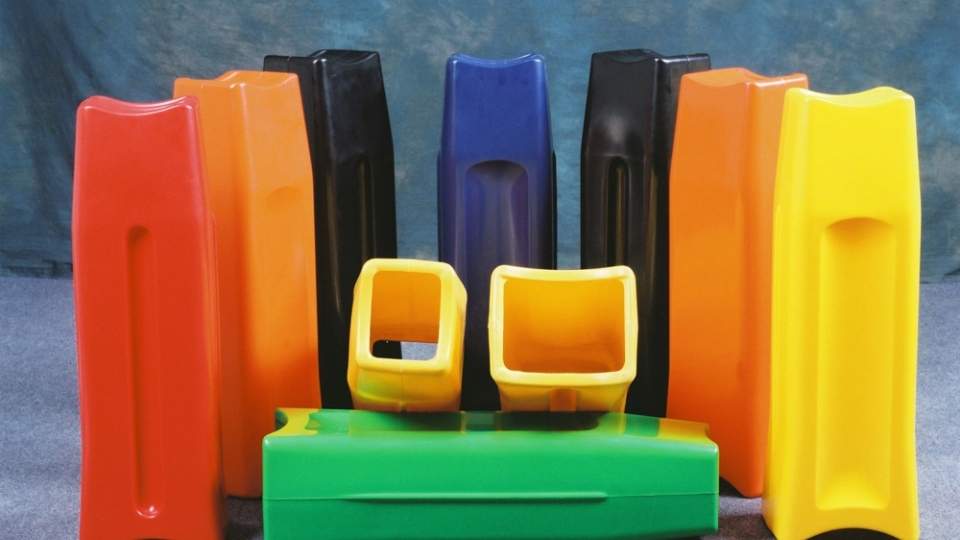
Resins for roto molding
Various materials used in rotational molding, their features, forms, and key selection considerations are mentioned below table;
| Material | Features | Presence Forms | Selection Considerations |
| Polyethylene | Low cost, easy processing, good chemical resistance | Powder form | Must resist oxidation, high thermal stability, good flow characteristics |
| Polypropylene | Versatile, good chemical, heat, and fatigue resistance | Powder form | Must have high thermal stability and flow easily without pressure |
| Polyvinyl Chloride (PVC) | Strong, rigid, modifiable mechanical properties | Granular form | Must resist oxidation, compatible with additives for desired properties |
| Nylon | Tough, good thermal and chemical resistance | Granular form | Requires high thermal stability and resistance to oxidation |
| ABS (Acrylonitrile Butadiene Styrene) | High impact resistance, good surface finish | Granular form | Should offer good thermal stability and high-impact strength |
Types of Machines Used For Roto Molding
The standard rotational molding machines comprise an arm or cradle in which the mold is placed, and the ovens and coolers. The major difference between the two machines lies in the direction in which the mold moves during the molding process. There are several types of rotational molding machines:
Clamshell Machine: A mold and cooler in one unit where the molding process and the cooling process occur in the same station. The mold and the resin are fed through the front panel which is locked during the heating process. After molding the mold is cooled and swings out for unloading, and it then swings away from the oven.
Turret/Carousel Machine: The turret machine is a round structure with 3-6 arms rotating around a central axis with a mold attached to each arm. These molds are conveyed through loading, heating, cooling, and unloading zones. Independent arms enable different sizes and thicknesses of molds to be used at the same time, however, the machine is more complicated and requires more attention in terms of maintenance.
Shuttle Machine: Shuttle machines employ independent arms for moving the molds from the loading area, heating chamber, and unloading area with a cooling section in between. This method saves time since the molds are switched between cooling and injection periods without any time being wasted.
Swing Machine: These machines have their arms that transport molds to the heating or cooling sections. They are best suited to parts that require more time to cool and de-mold. Swing machines can have up to four arms in case one arm needs to work continuously.
Vertical Wheel Machine: Like a Ferris wheel with passengers in seats, molds are placed in cradles which also go through the loading, heating, cooling, and unloading zones as the wheel revolves. Most often, this type of machine is used on small to medium-sized of the required parts.
Rock and Roll Machine: These machines turn molds 360 degrees as well as move from side to side to develop skinny, elongated objects such as kayaks. They have two arms where one arm rotates at the same time with the other arm swaying from side to side to balance the distribution of the plastics.
Open Flame Machine: These are one of the oldest types of machines that utilize direct flames to create open-ended products.
Key Considerations When Designing Parts for Rotational Molding
When designing parts for rotational molding, there are specific factors to keep in mind that may not be relevant in other manufacturing methods:
- Draft angles: The use of draft angles in the design of the product enables easy release of the parts from the molds after the heating, rotating, and cooling process.
- Wall thickness: The thickness of the walls of the product under consideration has a direct bearing on the heat transfer process as well as the time taken to cool. Polyethylene for example used in rotational molding the ideal thickness is usually between 0.125 and 0.25 inches.
- Large flat surfaces: That is why it is better to divide large flat areas using steps or recesses to avoid material distortion. Parallel walls must be of equal thickness throughout the molding process to prevent thinning out of the walls.
- Material flow at corners: Some of the challenges that are attributed to rotational molding are; It is hard to obtain sharp edges since the material gathers at corners and forms an uneven layer. This means that the corners should be as round as possible with fewer angles as compared to sharp corners.
- Aesthetics and fine details: It can also be seen that when small features or design improvements are tried out then the final product will look much better, which is crucial for customers.
- Costs: However, the initial cost of purchasing the equipment and molds required in rotational molding might be high but they are relatively cheaper in the long run. Rotational molding is much cheaper than blow molding, particularly in terms of tooling and maintenance costs. For example, manufacturing 50-gallon trash cans through rotational molding would require $20000 for tooling and $1000 per year for maintenance. Compared to blow molding the same product would require $210,000 for the tooling and $5000 yearly to maintain. (Read more about China Injection Molding)
Try Ancastings Now!
Rotational Vs. Injection Molding: Key Differences
Are rotational, and injection molding are same techniques? Well, it’s a bit complicated to determine. So, let’s figure out some of both processes.
Table: Rotational Molding Vs. Injection Molding
| Parameter | Injection Molding | Rotational Molding |
| Process | High-pressure injection of molten material into molds | Rotating heated mold to shape powdered resin |
| Raw Materials | Wide range (e.g., PE, PS, ABS, nylon, acrylic) | Primarily, limited to polyethylene (PE) |
| Complexity | Easier to control with fewer defects | More complex with risks like uneven gaps |
| Cycle Time | Shorter (2 minutes to 1 hour) | Longer (up to 3 hours per cycle) |
| Volume Production | Ideal for high-volume production | Suitable for low-volume, custom parts manufacturing |
| Waste & Post-Processing | Minimal waste with little post-processing needed | More waste with additional surface treatments |
Blow Molding vs. Rotational Molding: An Analysis of Their Distinctions
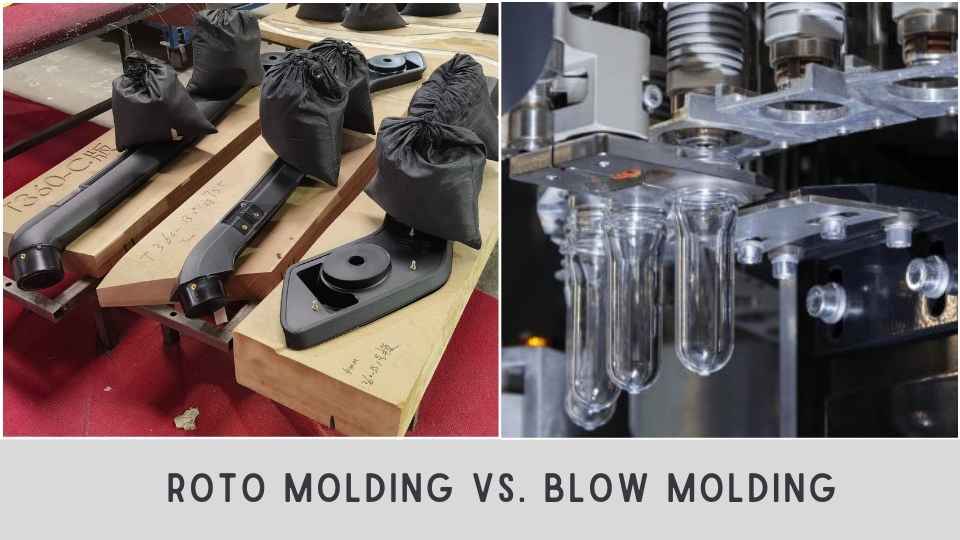
Roto molding vs. blow Molding
Blow molding vs. rotational molding are relatively closer to each other but keep different operational differences; Some are mentioned below;
- Cost Comparison: Blow molding has been found to have a relatively higher initial cost of tooling than rotational molding. However, blow molding is more economical after a certain quantity or number of parts that are produced annually are over 3000 units. Although the initial investment of blow molding is relatively high as compared to injection molding, the cost of high output is relatively low.
- Speed Comparison: Blow molding is much faster than rotational molding when it comes to cycle time. Blow molding has cycle times of less than a minute making it much faster than rotational molding that can take more than 30 minutes per cycle. This is because blow molding is faster than injection molding hence more economical for large-scale production.
- Production Volume Comparison: Blow molding also has much shorter cycle times than rotational molding, and this results in higher throughputs. Blow molding machines can manufacture approximately seventy parts per hour while rotational molding machines can manufacture only about two parts per hour.
- Materials Comparison: In both processes, normally, the same polymer types are used. The most used materials in rotational molding are Low-Density Polyethylene (LDPE), Linear Low-Density Polyethylene (LLDPE), High-Density Polyethylene (HDPE) and Crosslinked Polyethylene (PEX). In contrast, blow molding process materials such as Polypropylene (PP), Polyethylene Terephthalate (PET), Polyvinyl Chloride (PVC), LDPE, and HDPE to fabricate products to fit for use in several applications.
Table: Blow Molding Vs. Rotational Molding
| Attribute | Blow Molding | Rotational Molding |
| Tooling Cost | $200,000 (one-time) | $150,000 (annual) |
| Part Cost | Approximately $22 per piece | Approximately $35 per piece |
| Wall Thickness | Variable, often thinner | Uniform, generally thicker |
| Production Speed | Typically faster, up to 70 parts/hr | Slower, about 2 parts/hr |
| Material Waste | Minimal | Potentially higher |
| Complexity Handling | Limited, better for simple shapes | High, accommodates complex designs |
Advantages of Rotational Molding
Rotational molding is quite different from the other manufacturing processes and hence it has its advantages which are as follows: Here’s a breakdown of its key advantages:
Cost-Effective Tooling
Rotational molding is quite famous for its low cost of tooling as compared to other methods. In this case, this process does not apply high pressure and therefore the molds are relatively inexpensive. This aspect of it makes it ideal for use in low-volume production runs or in instances where one is not so sure of the market demand.
Flexibility in Design
The process is best suited to the creation of complex shapes. It is also very easy to create features such as stiffening ribs, molded inserts, and a variety of surface textures in rotational molding. Such flexibility enables designers to come up with unique designs, which may not be possible using other molding techniques.
Consistent Wall Thickness
Another advantage of rotational molding is the fact that it can create parts with equal thickness on all sides. It also makes it possible for the corners and edges of the product to be well supported and thus increases the strength and durability of the final product. In contrast to blow molding where corners may be made of relatively weak material, rotational molding does not have this problem as material is distributed evenly.
Low Equipment Costs
In general, rotational molding machines are comparatively cheap when compared to other molding techniques. This makes it an ideal solution for many manufacturers as it will help them look for cheap ways of manufacturing their products. The required investment is comparatively small and this means that the overall cost of producing the goods is relatively low.
Size flexibility and production flexibility.
Rotational molding allows for a broad range of products in terms of size, from single parts to big structures. Also, it is possible to produce more than one product at a time, thus making the process more effective and less expensive.
Should You Choose Rotational Molding for Your Project?
Selecting rotational molding therefore depends on the requirements of production. This method is suitable for organizations with less than 3,000 parts per annum for their projects. Apart from this volume, the costs of tooling maintenance and replacements reduce the economy of the process. Blow molding may be more suitable for high-volume production, and may therefore be more cost-effective for large-scale production.
Applications of Rotational Molding
The versatile molding technology can be used to manufacture a diverse array of products across various sectors: The flexibility of the technology makes it possible to produce a wide range of rotational molding products
in different industries:
- Storage Tanks: Capable of producing large tanks for water and chemicals with sizes going up to 50,000 liters.
- Material Handling: These include bins, boxes, pallets, and insulated coolers which are used in the transportation and storage of the products.
- Environmental Products: These are some of the items like the litter bins, traffic cones, bollards, and road signs; which are essential in the management of the urban environment.
- Marine Products: Specializes in the production of floats, buoys, and pontoons for water use purposes.
- Automotive Components: Produces strong products such as truck mudguards, fuel tanks, and toolboxes.
- Recreational Gear: Some of the products include kayaks, canoes, and boats because these give a realization of the strength as well as the elasticity of the material.
- Outdoor Products: Offers garden planters, water butts, and garden furniture which makes the outside area more useful and attractive with nice furniture.
- Playground Equipment: Protects the toys and the play structure to be safe for children to play on as well as to last long.
Innovative Applications
Nevertheless, there is ample evidence that rotational molding is still exploring new design areas other than the traditional ones. There is today a growing call for a stylish luxury decorative touch that comprises interior and exterior artworks, lighting, and superior quality decorative accessories.
Try Ancastings Now!
Summary
Ancastings, a China-based molding company gives a broad description of the process of rotational molding in summarizing its development. It’s beyond doubt that the rotomolding industry has evolved and developed in the last few decades in a very big way. A process that was once considered to be shrouded in some sort of mystique has developed into a highly complex process, which can deliver a level of product quality that other molding processes cannot offer.
How to Get Fast Production of Solid, Complex Plastic Parts From Ancastings
Rotational molding should be used whenever a company wants to produce strong and complicated plastic parts at a fast pace since it is effective in handling complex shapes and producing high-quality and smooth products. While at Ancastings we offer part pricing for rotational molded products, we also give DFM suggestions that would make your project a success. Being your valued partner in custom plastic and mechanical parts, Ancastings aims to assist you from the stage of prototyping to the production of finished products. Call us now for your design submission and learn more about our complete solutions to rotational molding.