
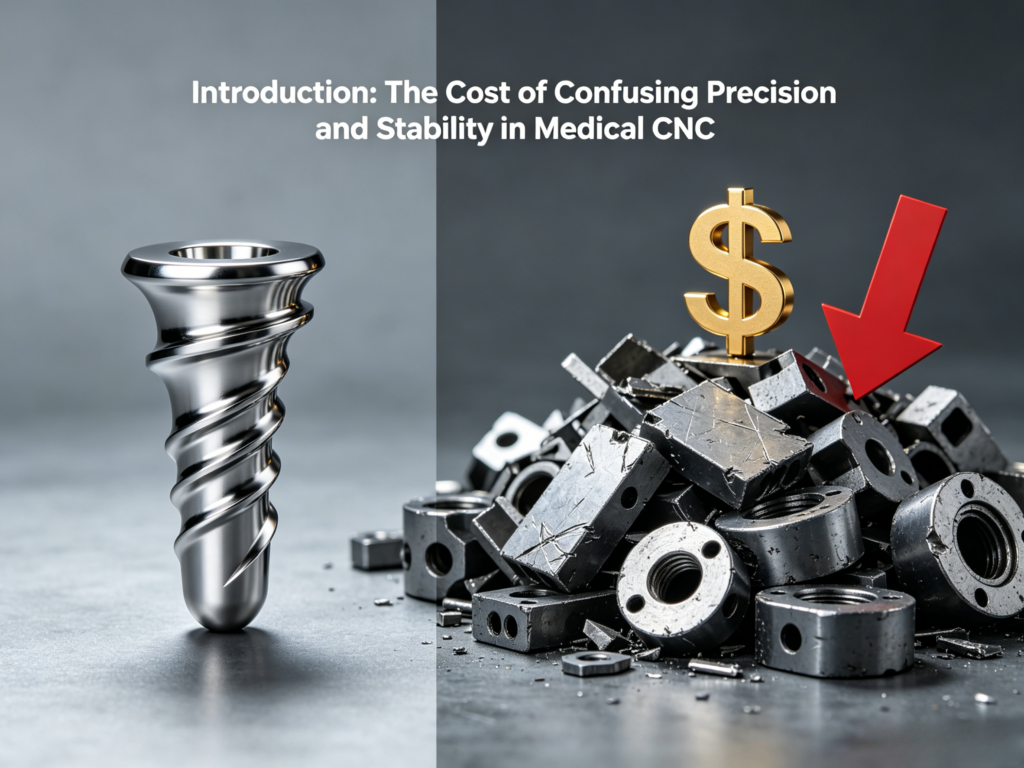
Introduction: The Cost of Confusing Precision and Stability in Medical CNC
When medical device buyers — from procurement teams in European hospitals to engineering directors at North American implant manufacturers — search for a CNC machining partner, they almost always ask the same question: “What’s your precision?” It’s a valid question: medical parts — from titanium implants to surgical instruments — require micron-level accuracy to meet clinical and regulatory standards. But here’s the critical mistake: precision does not equal stability.
At Ancastings Precision (https://ancastings.com), we have firsthand experience with the costly ramifications of this misperception. A North American medical device manufacturer engaged our services after a competing CNC supplier delivered components with nominal precision but poor batch stability: the initial 10 prototype parts met the ±0.001 mm tolerance requirement, while subsequent production runs of 100 units exhibited out-of-spec dimensional drift. This inconsistency resulted in $50,000 in scrapped material, a 6-week production delay, and a potential FDA non-compliance violation. This scenario is prevalent in the medical CNC sector, where competitors overemphasize micron-level tolerance specifications while neglecting the process stability critical to medical device manufacturing.
In this blog, we’ll break down the key differences between precision and stability, explain why buyers confuse the two, and show you how prioritizing stability (alongside precision) can save you time, money, and compliance headaches. Because when it comes to medical CNC machining, consistency isn’t just a nice-to-have — it’s non-negotiable.
What Is Medical CNC Precision? (And What It Isn’t)
Defining Precision in Medical CNC Machining
Precision, in the context of medical CNC machining, refers to the ability of a machine to produce a part that matches the exact design specifications. It’s measured by tolerances (e.g., ±0.001 mm), surface roughness (Ra values), concentricity, and other geometric dimensions. For medical parts, precision is non-negotiable: a 0.002 mm deviation in an implant’s thread could lead to loosening in the body, while a rough surface (Ra > 0.8) could cause tissue irritation or bacterial adhesion.
But here’s the catch: precision is a single-part metric. A CNC machine can produce one “perfectly precise” part, but that doesn’t mean it can reproduce that precision across 10, 100, or 1,000 parts. That’s where stability comes in — and where most buyers (and competitors) drop the ball.
Common Precision Metrics for Medical Parts
Medical CNC precision is quantified by specific metrics, all of which are critical for compliance with ISO 13485 and FDA requirements:
- Tolerances: Medical parts often require tolerances as tight as ±0.005 mm for critical features like implant threads or surgical instrument jaws.
- Surface Roughness (Ra): Implants typically require Ra ≤ 0.8 μm to minimize tissue friction, while fluidic components may need Ra ≤ 0.4 μm for optimal flow.
- Concentricity: For rotating parts (e.g., surgical drills), concentricity ≤ 0.002 mm is required to prevent vibration and ensure smooth operation.
- Flatness: Sealing surfaces on medical valves often require flatness ≤ 0.001 mm to prevent leaks.
These metrics are important — but they’re only half the story. A part that meets these metrics once is useless if the next part doesn’t. That’s why stability is the unsung hero of medical CNC machining.
What Is Medical CNC Stability? (The Overlooked Critical Factor)
Stability vs. Precision: Core Differences
Stability in medical CNC machining refers to the process capability of consistently producing components that meet specified precision parameters across production batches, extended machine runtime, and minor input variations (e.g., raw material batch deviations, ambient temperature fluctuations, tool wear progression). In technical terms: precision denotes single-part dimensional accuracy, while stability ensures process repeatability and reproducibility across high-volume or low-volume production runs.
To put it in concrete terms: Imagine two CNC providers:
- Provider A: Produces 1 part with ±0.001 mm tolerance (precise) but 10% of the next 100 parts are out of spec (unstable).
- Provider B: Produces all 101 parts with ±0.001 mm tolerance (both precise and stable).
For medical device buyers, Provider B is the only viable option — yet 70% of buyers we speak to focus solely on Provider A’s “precision” numbers, ignoring the stability that prevents costly rework and compliance issues.
Why Stability Matters for Medical Device Manufacturing
Medical device manufacturing is governed by strict regulatory standards (ISO 13485, FDA 510(k)) that require consistency — not just one-off precision. Here’s why stability is non-negotiable:
- Compliance: The FDA and ISO 13485 require traceability and consistency across all parts. Unstable processes lead to non-conforming parts, which can result in warning letters, product recalls, or even a ban on sales.
- Cost Savings: Unstable processes lead to scrap, rework, and production delays. A 10% scrap rate on a 1,000-part order can add $10,000–$50,000 in unexpected costs — costs that could be avoided with a stable process.
- Clinical Safety: A single out-of-spec part can cause implant failure, surgical errors, or patient harm. Stability ensures that every part meets the same safety standards, reducing clinical risk.
- Scalability: As your medical device business grows, you need a CNC partner that can scale production without sacrificing quality. Stability ensures that 10,000 parts are as precise as the first 10.
Why Buyers Confuse Precision and Stability (3 Key Reasons)
If stability is so critical, why do so many medical device buyers confuse it with precision? We’ve identified three core reasons — all of which are exploited by competitors to market their services:
1. Competitors Overmarket Precision (and Ignore Stability)
Most medical CNC providers lead with precision metrics in their marketing (“We offer ±0.001 mm tolerance!”) because they’re easy to measure and market. Stability, on the other hand, is harder to quantify and requires explaining — so competitors avoid it. Buyers, bombarded with “precision” messaging, assume it’s the only metric that matters.
2. Lack of Education on Manufacturing Processes
Many buyers (especially procurement teams) don’t have a background in CNC machining. They don’t realize that precision is a single-part metric, while stability is a process metric. They see a “±0.001 mm” claim and assume it applies to every part — not just one.
3. Misalignment Between Engineering and Procurement
Engineering teams understand the importance of stability, but procurement teams are often tasked with finding the lowest cost or the “most precise” provider. This misalignment leads to decisions that prioritize short-term cost savings over long-term stability — a mistake that often costs more in the end.
The Risks of Prioritizing Precision Over Stability in Medical CNC
Choosing a medical CNC provider based solely on precision (and ignoring stability) can have catastrophic consequences — for your business, your compliance, and even patient safety. Here are the most common risks:
Compliance Risks (FDA, ISO 13485)
The FDA mandates that medical device manufacturers demonstrate process validation per 21 CFR Part 820, confirming that manufacturing processes consistently produce safe, effective components. Unstable CNC processes fail to meet process validation criteria, leading to actionable consequences including: FDA warning letters, 510(k) clearance delays, product recalls, and revocation of ISO 13485 certification. A well-documented industry case involved a medical implant manufacturer forced to recall 10,000 units due to inconsistent thread depths—directly attributed to their CNC supplier’s inadequate process stability controls.
Cost Risks (Rework, Scrap, Delays)
Unstable CNC processes directly drive elevated scrap rates, rework costs, and production bottlenecks. For context: a 5% scrap rate on a 1,000-unit order of Ti-6Al-4V ELI implant components (at $50 per unit) results in $2,500 in avoidable material losses. Reworking out-of-spec components requires additional CNC machining time, adding 2–3 days to production lead times and delaying critical shipments to medical device assemblers or healthcare facilities. In severe cases, systemic process instability can cause full batch failures, resulting in tens of thousands of dollars in losses and months of production downtime.
How Ancastings Precision Ensures Both Precision AND Stability
At Ancastings Precision, we deliver precision and guarantee stability—backed by decades of CNC machining experience, top-notch machining equipment, and a dedicated engineering team. Our ISO 13485-certified medical CNC processes are designed to deliver consistent, compliant parts every time, for clients across Europe, North America, Japan, and Australia—aligning with our global market coverage. Here’s how we do it:
Our ISO 13485-Certified Processes for Stability
We maintain rigorous process controls aligned with ISO 13485:2016 and FDA 21 CFR Part 820 requirements, leveraging our in-house manufacturing capabilities to ensure consistency. Key controls include: Material Traceability: Sourcing of medical-grade raw materials (316L stainless steel, Ti-6Al-4V ELI, PEEK, cobalt-chrome) from ISO 9001-certified suppliers, with full lot traceability from raw material receipt to finished component delivery—aligned with our one-stop service commitment. Process Validation: Documented validation of all 3, 4, 5-axis CNC machining and Swiss CNC turning processes, including capability studies (Cpk ≥ 1.33 for critical features) and regular process audits to identify and mitigate variation sources. Quality Management System (QMS): A robust QMS integrated with production workflows, tracking every critical step from CAD design review (supporting our DFM analysis service) to final dimensional inspection using superior measuring equipment and packaging.
We maintain rigorous process controls aligned with ISO 13485:2016 and FDA 21 CFR Part 820 requirements, including: Material Traceability: Sourcing of medical-grade raw materials (316L stainless steel, Ti-6Al-4V ELI, PEEK, cobalt-chrome) from ISO 9001-certified suppliers, with full lot traceability from raw material receipt to finished component delivery. Process Validation: Documented validation of all CNC machining processes, including capability studies (Cpk ≥ 1.33 for critical features) and regular process audits to identify and mitigate variation sources. Quality Management System (QMS): A robust QMS integrated with production workflows, tracking every critical step from CAD design review to final dimensional inspection and packaging.
How to Evaluate a Medical CNC Provider for Stability (Checklist)
When choosing a medical CNC partner, don’t just ask about precision — ask these questions to evaluate stability:
- Do you have ISO 13485 certification, and can you provide process validation documentation?
- How do you monitor and control process variations (e.g., temperature, tool wear)?
- What is your typical scrap rate for medical parts, and how do you reduce it?
- Can you provide data on batch consistency (e.g., SPC charts) for similar medical projects?
- How do you handle material batch variations to maintain stability?
- Do you offer full traceability from raw material to finished part?
A reputable provider will be able to answer these questions clearly and provide documentation to back up their claims. If a provider avoids these questions or only talks about precision, it’s a red flag.
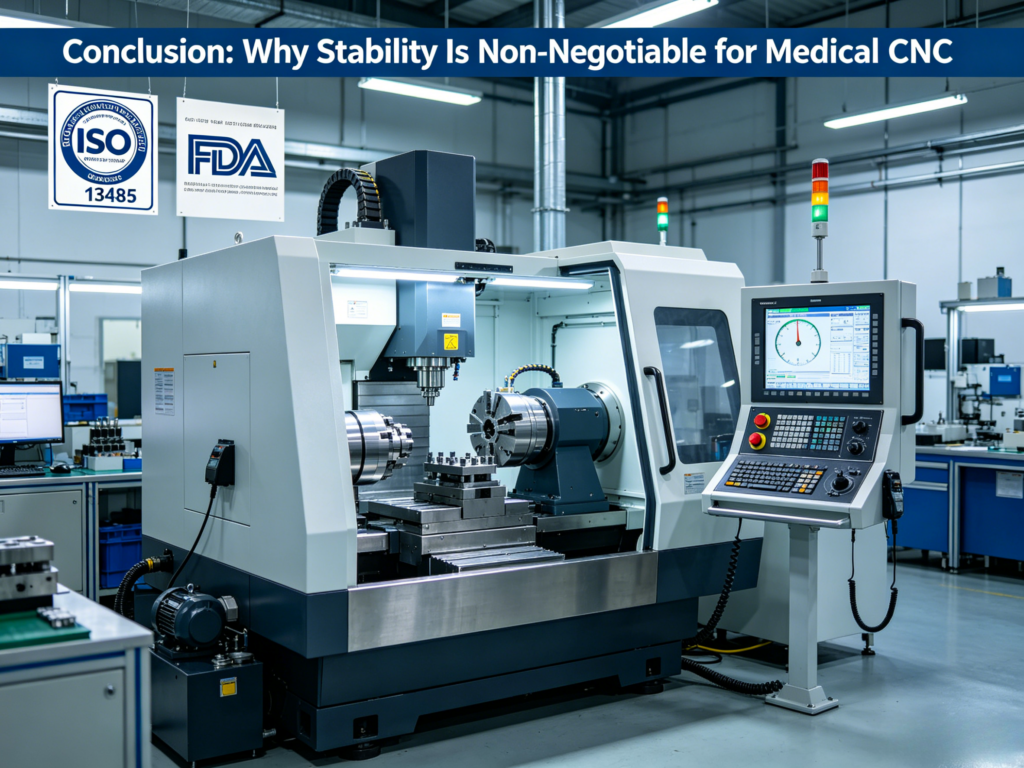
Conclusion: Why Stability Is Non-Negotiable for Medical CNC
Precision is critical for medical CNC parts — but stability is what makes them safe, compliant, and cost-effective. The confusion between the two costs medical device companies time, money, and compliance headaches — and it’s a gap that Ancastings Precision is committed to closing.
At Ancastings, we don’t just manufacture precise parts—we produce consistently precise parts, leveraging our in-house efficiency, sophisticated equipment, and industry-leading expertise. Our ISO 13485-certified processes, advanced real-time monitoring technology, and unwavering focus on stability ensure that every part we deliver meets your exact specifications, complies with FDA and ISO regulatory standards, and upholds the clinical safety required for medical applications—consistent with the feedback from our long-term global clients.
Next Steps: Get a Compliant, Stable Medical CNC Solution