Introduction
The medical industry always prioritizes extreme precision, safety and regulatory compliance for every component used in surgery, patient treatment, diagnostic devices and implants. Even tiny dimensional errors can affect equipment performance and patient safety. That’s why medical CNC machining has become the core manufacturing solution for healthcare sectors across Europe, North America, Japan and Australia.
Medical CNC machining refers to custom precision component production via computer numerical control, specially tailored for medical and healthcare scenarios. Unlike general CNC services, medical-grade manufacturing follows strict industry regulations, uses only biocompatible raw materials, and maintains micron-level tolerances that ordinary workshops cannot meet.
For medical engineers and purchasing managers, it is essential to understand the applicable standards, qualified materials and real industry applications of medical CNC machining. At Ancastings Precision, we focus on custom medical CNC machining for prototyping, small-batch trial production and mass serial production, serving medical clients in Europe, North America, Japan and Australia with compliant, high-precision parts.
This article covers the core features, mainstream standards, common materials, typical applications and supplier selection tips of medical CNC machining.
What Makes Medical CNC Machining Different From General CNC Machining
Medical CNC manufacturing follows an independent set of production rules, completely different from conventional industrial machining.
Strict Regulatory Restrictions
All medical parts must pass local and international certification before entering the market. Formal medical CNC manufacturers adopt complete quality control, batch traceability and audit-ready production records, while ordinary factories do not have such standardized processes.
Biocompatible Material Requirements
Only non-toxic, tissue-friendly and corrosion-resistant materials can be used for medical components contacting human skin, blood or organs. Regular industrial materials are not allowed in medical production due to potential safety risks.
Ultra-Tight Dimensional Tolerances
Medical implants and surgical tools require high fitting accuracy and long-term structural stability. Medical CNC machining stably maintains ultra-tight tolerances, far stricter than the loose dimensional range of ordinary mechanical parts.
Clean Production and Professional Packaging
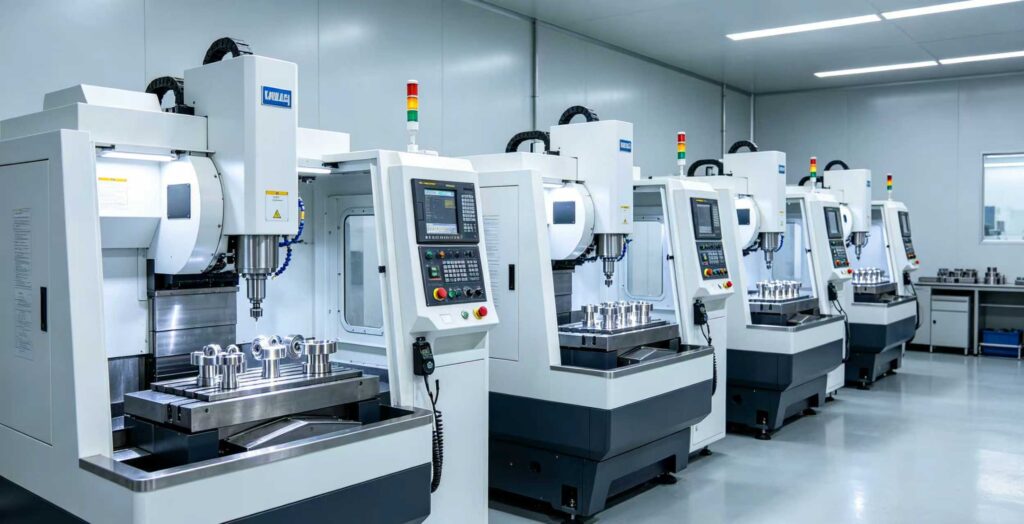
Medical parts need dedicated cleaning, surface treatment and dust-proof sterile packaging to avoid contamination. Professional suppliers set up independent production areas for medical orders to ensure cleanliness throughout the process.
Core Industry Standards for Medical CNC Machining
To sell medical devices in Europe, North America, Japan and Australia, components must comply with unified international and local standards.
ISO 13485 Certification
ISO 13485 is the authoritative quality management standard for the medical industry, covering product design, production processing, risk control and full lifecycle traceability. Manufacturers with ISO 13485 certification can steadily produce qualified medical parts.
FDA Compliance for North America
Products entering the US market need to meet FDA guidelines on material safety, biocompatibility and production traceability. Suppliers must provide complete material certificates and inspection records for official audits.
CE Marking for European Market
EU medical devices require CE marking, and all CNC machined components must meet EU health and safety regulations to support the final product’s CE certification smoothly.
JIS and TGA Compliance
Japan follows strict JIS material standards and precise processing specifications. Australia’s TGA also requires full material traceability and quality documents. Experienced medical CNC suppliers can well match these regional requirements.
Common Biocompatible Materials for Medical CNC Machining
Material selection directly determines the safety and service life of medical parts. The following materials are widely recognized and applied in medical CNC processing.
Medical Grade Stainless Steel
316L and 304 stainless steel are the most mainstream options for surgical instruments and reusable medical hardware. They feature good corrosion resistance, high strength and easy sterilization, suitable for long-term clinical use.
Titanium & Titanium Alloys
Titanium is the preferred material for orthopedic implants, bone plates and prosthetic parts. It is lightweight, high-strength, well compatible with human bone tissue, and resistant to corrosion from body fluids.
Medical PEEK
PEEK is a high-performance thermoplastic, commonly used in spinal implants and precision diagnostic parts. It is lightweight, heat-resistant, easy to machine into complex structures, and safe for long-term human contact.
Medical Aluminum & Engineering Plastics
Medical aluminum is mostly used for diagnostic equipment shells and structural frames, not for direct implantation. Delrin, Nylon and UHMW plastics are widely used for non-invasive medical structural parts and connectors.
Main Applications of Medical CNC Machining
Medical CNC machining runs through the entire medical industry chain, covering multiple core scenarios.
Surgical Instruments
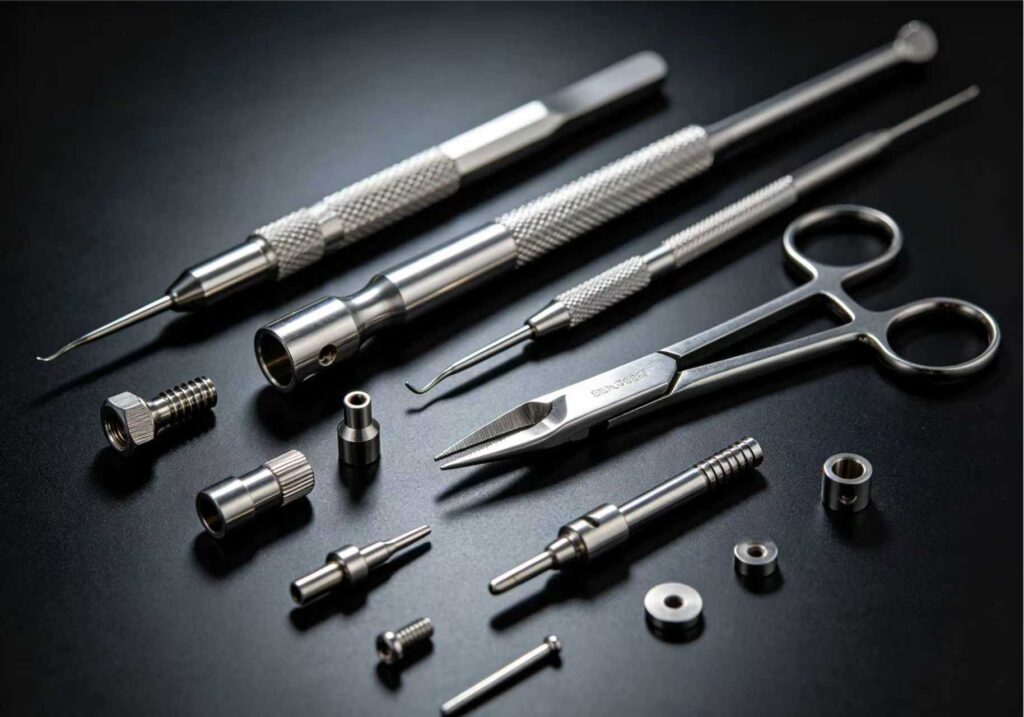
Various forceps, scalpel handles, clamps and surgical accessories all rely on precision CNC processing, requiring smooth surface finish, high assembly accuracy and repeated sterilization resistance.
Orthopedic & Dental Implants
Bone plates, joint accessories, dental implants and abutments need customized CNC machining according to human anatomy, with extremely high requirements on tolerance and biocompatibility.
Diagnostic & Laboratory Equipment
MRI, ultrasound and blood testing equipment contain a large number of CNC precision structural parts and sensor shells, whose machining accuracy directly affects detection data stability.
Disposable Medical Components
Catheter connectors, procedural fittings and single-use structural parts are produced in batches by medical CNC machining, with strict control of cleanliness and dimensional consistency.
Tolerance & Surface Finish Requirements
Medical projects demand much higher tolerance standards than ordinary mechanical parts. Reliable medical CNC suppliers can stably control micron-level precision for implants and high-precision medical components.
Surface finish is equally critical: smooth polishing effectively avoids bacterial growth and tissue friction, and supports high-temperature sterilization. Common treatments include precision polishing, passivation and medical-grade anodizing. All finished parts will go through strict dimension inspection, material verification and appearance quality check before delivery.
How to Select a Qualified Medical CNC Supplier
Choosing the right manufacturer shortens your product development cycle and reduces regulatory risks.
Prioritize suppliers with complete medical certification and full material traceability reports. Confirm they have rich experience in both medical prototyping and mass production, and can provide official inspection documents and batch records. Meanwhile, choose a manufacturer familiar with the market rules of Europe, North America, Japan and Australia, to avoid compliance and customs document problems.
Why Choose Ancastings Precision as Your Medical CNC Partner
Ancastings Precision specializes in custom medical CNC machining for global medical clients. We adopt standardized medical production workflows, use certified biocompatible materials, and strictly control dimensional tolerance and surface finish.
We are experienced in machining stainless steel, titanium, PEEK and medical aluminum, covering surgical instruments, orthopedic parts, diagnostic equipment and custom medical components. We provide complete material certificates, inspection reports and compliance documents to support your global market certification.
Whether you need prototype trial production or long-term mass orders, we offer stable precision, reasonable lead time and professional technical support.
Conclusion
Medical CNC machining is a highly standardized, safety-oriented manufacturing service, not simple ordinary precision processing. From industry standards and material selection to tolerance control and application scenarios, every detail is closely related to medical safety and market compliance.
Cooperating with a certified and experienced medical CNC supplier can greatly reduce your development and regulatory risks. For medical CNC machining projects targeting Europe, North America, Japan and Australia, Ancastings Precision provides one-stop customized processing solutions with reliable quality and full compliance support.