

In the fast-evolving world of robotics, precision CNC machining plays a critical role in ensuring that robots perform reliably. Whether it’s medical robots assisting in complex surgeries or industrial robots optimizing manufacturing processes, the demand for high-quality, durable robot parts is higher than ever. However, there’s a troubling statistic that continues to persist: 90% of CNC suppliers struggle to produce robot parts that meet the industry’s stringent standards.
The problem isn’t a lack of technology or equipment, but rather a failure to understand and address the unique challenges associated with machining robot parts. Unlike generic CNC components, robot parts require exceptional precision, specific material properties, and consistent performance. These demands are often overlooked by suppliers, creating a gap between what the market needs and what suppliers can deliver.
At Ancastings Precision, we’ve spent over a decade specializing in CNC machining for robotics. We’re committed to delivering the highest quality parts and solutions that meet the unique demands of the robotics industry. In this article, we will explore the hidden challenges that most CNC suppliers face and how we overcome them to provide real value to our clients across Europe, North America, Japan, and Australia.
Why Most CNC Suppliers Fail with Robot Parts
Robot parts are far more than just “precision components.” They are integral to machines that require micron-level accuracy, corrosion resistance, and structural integrity to operate safely and efficiently. Unfortunately, many CNC suppliers approach robot part machining as they would any generic component, missing these key pain points that make robot parts particularly difficult to produce.
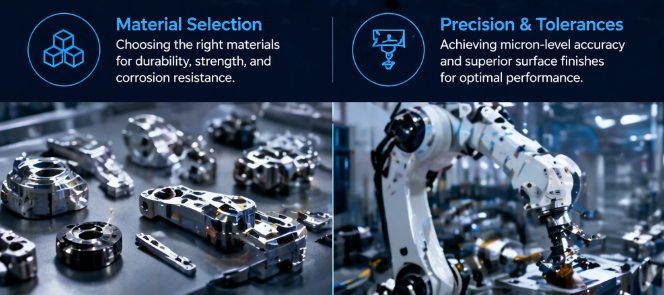
1. Material Selection: Why Generic Materials Don’t Cut It
One of the most common mistakes among CNC suppliers is the use of standard metals and plastics for robot parts. In the robotics industry, the environment is often far more challenging than what typical materials are designed for. Robots frequently operate in harsh environments, exposed to high stress, fluctuating temperatures, corrosive elements (such as saltwater for underwater robots), and repetitive motion. These factors can lead to rapid material degradation if the wrong materials are used.
For instance, regular aluminum or carbon steel may suffice for simpler parts, but they fall short when it comes to robot components that need to endure high stress, resist corrosion, and maintain structural integrity over extended periods. These materials can corrode, weaken, or break down, leading to premature failures and downtime.
Take, for example, the joints in a medical robot. These parts need to be biocompatible, resistant to corrosion, and capable of withstanding thousands of repetitive movements without failure. A generic aluminum alloy might corrode when exposed to disinfectants commonly used in medical environments, while low-quality steel could wear out quickly due to the constant motion, thus putting patient safety at risk.
At Ancastings Precision, we understand the importance of material selection for robot parts. That’s why we use advanced materials that are tailored to the specific demands of the robotics industry. We use marine-grade 316L stainless steel for corrosion resistance, titanium (Grades 2 and 5) for high strength and biocompatibility, and 6061/7075 aluminum for lightweight, high-performance components in industrial robots. For non-structural parts, we use engineering plastics like PEEK and EPX 150, which offer exceptional chemical resistance and tight tolerances.
The right material choice ensures that each part can perform optimally, without failing prematurely due to environmental stressors. This attention to material selection is one of the key factors that sets us apart from other CNC suppliers in the robotics field.
2. Precision Matters: Tolerances and Surface Finishing
When it comes to robotics, precision is not just important—it’s essential. Robot parts require exact tolerances and smooth surface finishes to ensure seamless integration, precise movement, and long-term reliability. Unfortunately, most CNC suppliers fail to meet the strict precision standards needed for robot parts. This failure is often due to a focus on speed and cost reduction at the expense of quality—or a lack of the equipment and expertise required to achieve micron-level precision.
Even the smallest deviation in tolerance can cause significant issues. For example, a tolerance deviation of just 0.005mm in a gear or bearing can cause friction, vibrations, and premature wear, leading to costly repairs and operational downtime. Standard CNC machines may be able to meet a surface roughness (Ra) of 0.8μm or higher and flatness of ±0.005mm, which may be acceptable for generic parts, but these standards fall short for high-precision robot components.
For high-precision applications, robot parts require a surface roughness of Ra ≤0.4μm (or even Ra ≤0.2μm for critical components) and flatness within ±0.003mm. At Ancastings Precision, we address these challenges with advanced CNC equipment and a commitment to quality control. We utilize 3-, 4-, and 5-axis CNC machines, and our temperature-controlled workshop helps minimize thermal deformation during machining. We also employ Coordinate Measuring Machines (CMM) to verify that every part meets the required tolerances and surface finish.
These rigorous processes ensure that each robot part is manufactured to the highest standards, which is critical for performance, reliability, and safety.
Ready to Partner with a CNC Supplier That Gets Robot Parts Right?
If you’ve experienced the frustration of working with CNC suppliers who deliver subpar robot parts—parts that fail prematurely, don’t meet your precision requirements, or lack application-specific engineering—it’s time to work with a partner who truly understands the demands of the robotics industry. At Ancastings Precision, we don’t just machine parts; we deliver solutions that add value to your business, reduce costs, and ensure your robots perform at their best.
We have a proven track record of success with clients across multiple industries, including medical robotics, industrial robotics, and more. Our team works closely with each client to ensure that their parts are produced to the highest standards, and we’re committed to meeting or exceeding the most demanding requirements in the robotics field.
Visit our website at ancastings.com to learn more about our CNC machining services for robotics, or contact our team today to discuss your project needs. Let’s work together to build reliable, high-performance robot parts that ensure your robots perform as intended.
Contact Us