
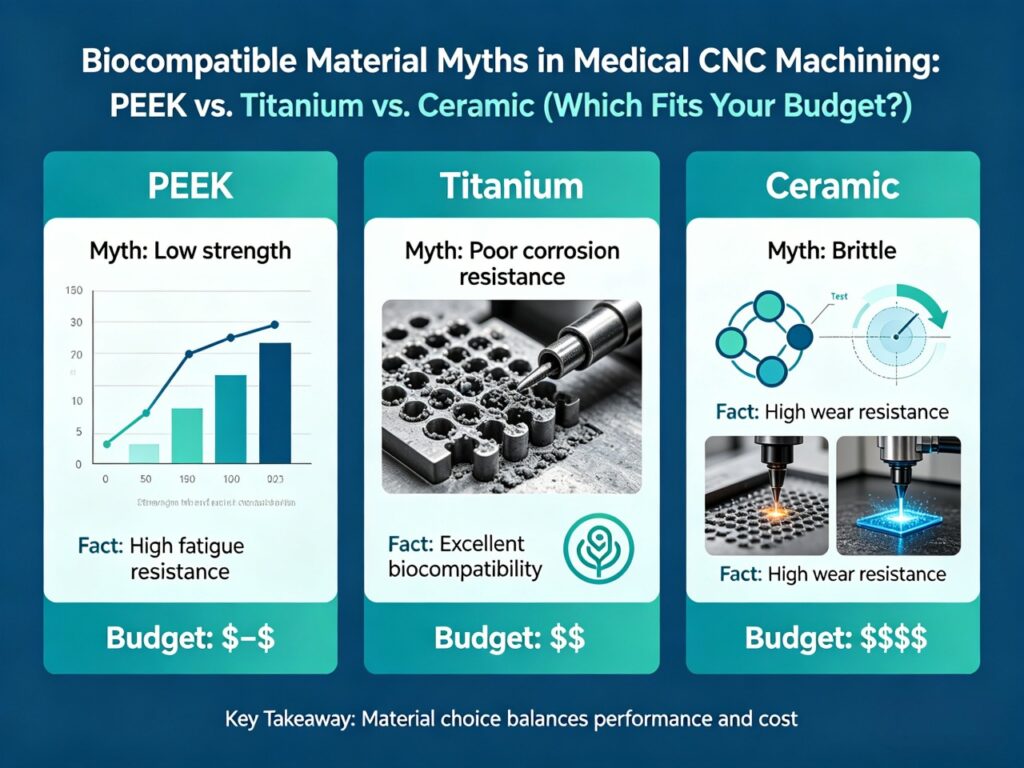
In the precision-centric landscape of medical CNC machining, the selection of biocompatible materials serves as a critical decision-making cornerstone that directly impacts patient safety, regulatory compliance, component performance, and overall project profitability. Medical device manufacturers, R&D engineers, and procurement professionals across Europe, North America, Japan, and Australia frequently grapple with the challenge of selecting among three industry-standard biocompatible materials: PEEK (polyetheretherketone), Grade 5 Ti-6Al-4V titanium alloy, and medical-grade structural ceramics. Each material boasts unique performance advantages, inherent limitations, and distinct cost profiles, rendering the selection process far from straightforward—especially when balancing technical specifications with budgetary constraints.
Myth #1: Titanium Is the Universal “Gold Standard” for All Medical CNC Parts
Grade 5 Ti-6Al-4V titanium alloy has long been regarded as the gold standard for medical implants, owing to its exceptional biocompatibility and superior mechanical strength. Its unique material properties—including non-toxicity, non-immunogenicity, and reliable osseointegration (the ability to form a direct structural bond with human bone tissue without eliciting adverse immune responses)—make it the preferred material for critical permanent implants such as orthopedic bone screws, hip arthroplasty components, knee prosthetics, and dental implants. In these life-sustaining applications, long-term structural integrity, biostability, and resistance to corrosion in bodily fluid environments are non-negotiable, and titanium alloy’s mechanical properties deliver unparalleled performance that other materials struggle to replicate.
However, treating titanium alloy as a one-size-fits-all solution for all medical CNC-machined components is a costly and unnecessary oversight. For non-implant medical components—such as surgical instrument handles, laboratory equipment enclosures, diagnostic device housings, or non-critical tooling—titanium alloy’s unique and premium properties are often superfluous. The material carries a significant price point, typically ranging from $150 to $200 per kilogram, which can substantially inflate project costs for high-volume or non-critical parts. Furthermore, CNC machining of titanium alloy requires specialized carbide cutting tools, reduced cutting speeds (100–300 SFM), and high-pressure coolant systems to mitigate heat buildup and prevent tool wear—all of which contribute to elevated machining costs.
Ancastings Precision recommends a critical assessment of application requirements: for the majority of non-implant components, PEEK offers equivalent biocompatibility, enhanced machining efficiency, and regulatory compliance at a significantly lower total cost of ownership (TCO).
Myth #2: PEEK Is Prohibitively Expensive for Medical CNC Applications
A common misconception among medical device development teams is that medical-grade PEEK (polyetheretherketone) is prohibitively expensive, particularly for small-batch production runs typical of R&D phases, specialized medical devices, or low-volume clinical trials. While it is true that medical-grade PEEK—priced at $80–$120 per kilogram—carries a higher upfront material cost than standard industrial polymers, its total cost of ownership (TCO) is often significantly lower than that of titanium alloy or ceramics when accounting for machining efficiency, tool wear rates, and production lead times.
PEEK offers substantial operational and technical advantages for medical CNC machining that justify its upfront material cost. Its radiolucent property—a critical benefit for medical devices—enables its use in MRI and CT imaging procedures without causing image artifacts, making it ideal for diagnostic and interventional devices requiring imaging compatibility. It also exhibits exceptional resistance to harsh bodily fluids, including blood, saliva, and bodily acids, and can withstand multiple sterilization cycles—including autoclaving, ethylene oxide (EtO) sterilization, and gamma irradiation—without material degradation, which is essential for medical device reusability and long-term patient safety. From a machining perspective, PEEK is compatible with standard CNC tooling, supports higher cutting speeds (300–500 SFM), and induces minimal tool wear compared to titanium alloy, reducing tool replacement costs and production downtime. Relative to titanium alloy machining, this efficiency can lower labor costs by up to 20%. For small-batch (10–100 units) or complex geometries—such as intricate minimally invasive surgical tool components—PEEK’s machining efficiency often offsets its higher initial material cost.
Ancastings Precision consistently delivers high-quality PEEK medical components within 7–10 days, while ensuring full compliance with FDA 21 CFR and ISO 13485 standards, further enhancing its cost-effectiveness for time-sensitive medical device projects.
Myth #3: Ceramics Are Too Fragile for Precision Medical CNC Machining
Medical-grade zirconia and alumina ceramics are often unfairly mischaracterized as “too fragile” for precision medical CNC machining—a misconception rooted in outdated processing techniques and limited familiarity with advanced ceramic materials. In reality, modern medical-grade ceramics deliver exceptional performance for high-wear medical applications, outperforming both titanium alloy and PEEK in specific critical areas. These materials are biologically inert, meaning they do not react with human tissue or trigger immune responses, and exhibit superior hardness, wear resistance, and chemical stability compared to metallic materials. This makes them ideal for components such as dental implants, surgical blades, orthopedic bearing surfaces, and high-precision laboratory equipment parts that are subjected to constant friction, mechanical stress, and exposure to harsh operating environments.
The key to successful CNC machining of ceramics lies in specialized equipment, precision machining processes, and expert engineering—areas where Ancastings Precision excels. We utilize state-of-the-art CNC milling and turning centers, paired with low-feed cutting strategies, precision grinding, and advanced tooling (such as diamond-tipped cutting tools), to minimize breakage and chipping during production. This specialized expertise ensures that ceramic components meet the ultra-tight medical tolerances of ±0.001mm, which is critical for consistent medical device performance.
With a material cost ranging from $60 to $90 per kilogram, ceramics represent a cost-effective alternative to titanium alloy for non-impact, high-wear applications. Their non-corrosive nature also reduces long-term maintenance and replacement costs for medical devices, as they do not degrade over time when exposed to bodily fluids or repeated sterilization cycles. It is important to note, however, that ceramics are not suitable for components requiring high impact resistance—such as surgical instruments prone to accidental drops or sudden mechanical force—where titanium alloy or PEEK remains the superior choice due to their greater toughness and ductility.
PEEK vs. Titanium vs. Ceramic: A Comprehensive Side-by-Side Comparison
To streamline your material selection process and ensure the most cost-effective choice for your specific application, we have compared the three core biocompatible materials based on the most critical factors for medical CNC machining, including biocompatibility profiles, machining requirements, cost metrics, and ideal application scenarios.
1. Biocompatibility & Regulatory Compliance (FDA & ISO 13485)
- Titanium (Grade 5 Ti-6Al-4V): Fully compliant with FDA 21 CFR § 878 and ISO 10993 standards, which are mandatory for medical implant approval. Its osseointegrative properties establish it as the gold standard for permanent implants requiring long-term bone bonding—such as hip arthroplasty components and dental implants—as it fuses with bone tissue over time to provide stable, long-lasting structural support.
- PEEK (Polyetheretherketone): Meets FDA 21 CFR § 177.2415 and ISO 10993 requirements, rendering it suitable for both implantable and non-implantable medical devices. Its radiolucent nature and broad biocompatibility make it ideal for devices requiring imaging compatibility—such as spinal implants and minimally invasive surgical tools—while offering greater design flexibility than titanium alloy or ceramics.
- Ceramics (Zirconia/Alumina): Compliant with ISO 10993 and FDA guidelines for biocompatibility, featuring a biologically inert profile that eliminates the risk of tissue reactions. Its high biostability makes it ideal for non-implant, high-wear components such as surgical blades and dental crowns, where wear resistance and chemical inertness are critical to device performance and patient safety.
2. Machining Difficulty & Associated Costs
- Titanium: High machining difficulty, attributed to its low thermal conductivity (which causes excessive heat buildup during cutting) and high tensile strength. Machining costs range from $80 to $120 per hour, driven by the need for specialized carbide tooling, reduced cutting speeds (100–300 SFM), high-pressure coolant systems, and extended cycle times. Tool wear is also a significant cost factor, as titanium alloy’s hardness can rapidly degrade standard cutting tools.
- PEEK: Low-to-moderate machining difficulty, making it a cost-effective choice for most medical CNC machining applications. It machines smoothly with standard CNC equipment, offering faster cycle times (300–500 SFM) and minimal tool wear—reducing tool replacement costs and production downtime. Machining costs range from $40 to $60 per hour, and its consistent machining properties ensure high component quality with minimal material waste.
- Ceramics: Moderate machining difficulty, requiring specialized diamond-tipped cutting tools and precision grinding to prevent chipping and breakage. Machining costs range from $60 to $90 per hour—slightly higher than PEEK but significantly lower than titanium alloy. While the initial setup for ceramic machining is more complex, its superior durability and wear resistance reduce long-term production costs for high-wear components.
3. Ideal Medical Applications
- Titanium: Permanent orthopedic bone and joint implants (screws, hip, knee components), high-strength surgical instruments (e.g., forceps, retractors), and medical robotic components where structural integrity, load-bearing capacity, and long-term durability are paramount. It is also the preferred material for implants requiring osseointegration to ensure long-term stability.
- PEEK: Minimally invasive surgical tools (e.g., catheters, endoscopes), MRI/CT-compatible devices, spinal implants, and laboratory equipment enclosures. Its lightweight, radiolucent, and ductile properties make it ideal for specialized medical devices requiring imaging compatibility or complex geometries.
- Ceramics: Dental implants, surgical cutting tools (e.g., scalpels, bone saws), orthopedic bearing surfaces, and high-precision fluidic components where wear resistance, chemical inertness, and biostability are critical. Ceramics are also utilized in laboratory equipment that handles harsh chemicals or requires ultra-high precision.
Which Material Best Fits Your Budget and Application?
- Tight Budget + Non-Implant Parts: Select PEEK for complex, small-batch components or ceramics for high-wear applications. Both materials offer excellent biocompatibility and regulatory compliance at a fraction of the cost of titanium alloy, with lower machining costs and faster production lead times that further reduce overall project expenses.
- Permanent Implants + No Budget Constraints: Titanium (Grade 5 Ti-6Al-4V) remains the superior choice, thanks to its proven osseointegration, long-term durability, and mechanical strength in load-bearing applications. While it carries a higher cost, its performance and safety track record justify the investment for critical implants that directly impact patient health.
- High-Wear Parts + Mid-Range Budget: Zirconia ceramics deliver superior wear resistance compared to titanium alloy at a lower cost, making them an excellent economical choice for non-impact, high-stress components. They also require less long-term maintenance, further reducing lifecycle costs for medical device manufacturers.
How Ancastings Precision Helps You Make the Right Choice
At Ancastings Precision, our team of experienced medical device engineers and CNC machining specialists provides end-to-end support for your biocompatible material selection and precision machining needs. We understand the unique challenges of medical device manufacturing—from regulatory compliance to budgetary constraints—and offer comprehensive technical consulting to identify the optimal material for your specific application, balancing performance, compliance, and cost-effectiveness. Our in-house capabilities include 3-axis, 4-axis, and 5-axis CNC machining, enabling us to handle even the most complex medical component geometries with the ultra-tight tolerances required for medical device certification.
We provide transparent pricing with detailed quotes available within 24 hours, allowing you to make informed budget decisions without hidden costs. Our rapid lead times—5–7 days for prototypes and 7–10 days for standard production runs—help accelerate your product development timeline, facilitating faster time-to-market for your medical devices. Our global logistics network ensures reliable delivery to your facility worldwide, with full shipment tracking and support throughout the logistics process. Backed by rigorous quality control protocols, full compliance with FDA 21 CFR and ISO 13485 standards, and complete material traceability via Material Test Reports (MTRs), we guarantee the highest quality standards for every component we produce. Our expertise in small-batch production makes us the ideal partner for R&D projects, specialized medical device programs, and low-volume clinical trials, helping you reduce costs without compromising on safety, performance, or regulatory compliance.

Ready to Choose the Right Biocompatible Material for Your Medical CNC Project?
Don’t let outdated industry myths or uncertainty about material costs delay your medical device development or inflate your project budget. Contact Ancastings Precision today for a free, no-obligation material consultation and project quote. Our technical experts will collaborate closely with you to analyze your application requirements, budget constraints, and regulatory needs, and recommend the optimal biocompatible material—whether PEEK, titanium alloy, or ceramics—for your specific project. We eliminate the guesswork from material selection, ensuring you select the right material for the application at a price that aligns with your budget.