
Custom CNC machining has emerged as a critical enabler for innovation-driven manufacturing, particularly in industries requiring micron-level precision and design flexibility. However, the choice between custom and standard CNC services hinges on a nuanced evaluation of technical requirements, volume scalability, and total cost of ownership. Industry data indicates that 68% of manufacturing cost overruns stem from misaligned machining strategies.
In this article, we will break down the differences between custom CNC machining and standard CNC services, highlight their strengths and limitations, and provide a structured framework to help businesses select the most effective option for their specific applications.
What is Custom CNC Machining?

Custom CNC machining refers to the process of designing and manufacturing components that are engineered to meet unique design, functional, or material specifications. Unlike standardized parts, custom CNC machining allows companies to:
- Process Scope: End-to-end engineering support, from CAD modeling through final post-processing, with capabilities including:
- Complex geometries – true 5-axis simultaneous CNC machining for intricate and high-precision parts.
- Exotic materials – machining expertise in Inconel, Ti-6Al-4V, PEEK, and other advanced engineering materials.
- Tight tolerances – precision machining down to ±0.005mm, conforming to ISO 286-IT5 standards.
- Material Science: Access to 200+ certified materials, covering aerospace- and medical-grade alloys, advanced polymers, and CFRPs.
- Validation & Compliance: Dimensional accuracy validated via industrial CT scanning, with quality management systems aligned to Nadcap AC7004 requirements.
Essentially, custom CNC machining is not just about cutting and shaping; it is about engineering solutions around a customer’s design intent and functional goals.
What are Standard CNC Services?
Standard CNC services, on the other hand, focus on producing components based on established templates, catalogs, or predefined parameters. These services are well-suited for applications where:
Process Scope: Predefined machining strategies with standardized parameters:
- Typical tolerances of ±0.03mm, suitable for general-purpose industrial applications
- Limited to common, cost-effective materials (Al 6061, SS304, brass)
- Compliance with ISO 2768-medium for dimensional accuracy
Economies of Scale: 30–50% cost reduction achievable at production runs above 10,000 units
Lead Time: Standard components typically delivered within 5–7 days, depending on batch size and material stock
While standard CNC services often provide lower per-unit costs, they may not support highly specialized applications where flexibility and innovation are critical.
Key Differences Between Custom CNC Machining and Standard CNC Services
The fundamental differences between custom CNC machining and standard CNC services are reflected in five dimensions: design freedom, materials science, production scale, delivery cycle, and cost structure. Based on the ISO 9001:2015 quality control system and ASME B46.1 surface roughness standard, we reveal the technical boundaries and application scenarios of the two through quantitative comparison.
1. Design Flexibility
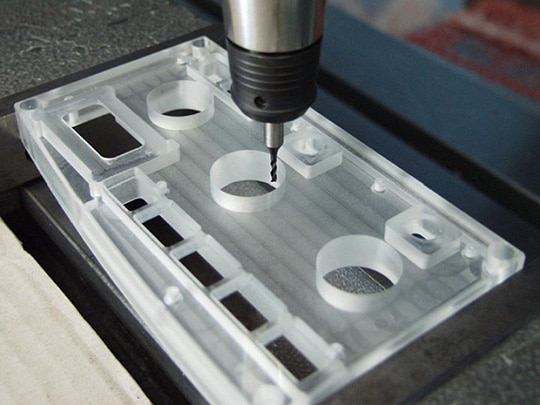
Custom CNC machining supports complex geometries, bespoke prototypes, and frequent design iterations. In contrast, standard CNC services are restricted to pre-set specifications, making them less adaptable for unique or evolving designs.
2. Material Options
Custom machining enables manufacturers to work with rare alloys, composites, or medical-grade materials. Standard services, however, typically focus on common metals such as aluminum, steel, or brass.
3. Production Volume
Custom CNC machining is best suited for low- to mid-volume runs, pilot projects, or specialized components. Standard CNC services excel in high-volume production, where cost per part must remain competitive.
4. Lead Times
Customization often involves extra engineering, setup, and validation steps, resulting in longer lead times. By contrast, standard CNC workflows are optimized and streamlined, ensuring faster turnaround times.
5. Cost Considerations
Custom machining usually involves higher upfront costs due to engineering input, prototyping, and tooling requirements. Standard CNC services reduce costs through efficiency and economies of scale, particularly for bulk orders.
Custom CNC machining delivers uncompromised precision for mission-critical applications but requires longer lead times and higher upfront investment. Standard CNC services offer economies of scale for stable, high-volume production with rapid turnaround.
Which Option Is Right for Your Business?
The choice between custom CNC machining and standard CNC services should be driven by your specific operational requirements and strategic goals:
Opt for Custom CNC Machining if:
- You are developing functional prototypes for R&D validation
- Your application requires tight tolerances (±0.005mm) or specialized materials
- You operate in regulated industries (medical, aerospace, defense) requiring certified processes
Select Standard CNC Services if:
- Your component designs follow established geometric parameters
- Your priority is cost-driven production with rapid turnaround
- You need high-volume runs (10,000+ units) of standardized parts
Many businesses implement a hybrid approach: beginning with custom machining during product development, then transitioning to standard services once designs are finalized and production scaling becomes necessary.
Conclusion
Selecting between custom and standard CNC services represents a strategic business decision that extends beyond technical considerations. Organizations must carefully balance four critical factors: design flexibility, precision requirements, cost efficiency, and production scalability. By aligning manufacturing methods with strategic objectives, a CNC machining company can simultaneously maximize product performance and return on investment. Industry data confirms that enterprises leveraging this framework reduce manufacturing costs and accelerate time-to-market. Ultimately, the strategic alignment of machining methodology to product lifecycle stage determines competitive advantage in precision manufacturing.