
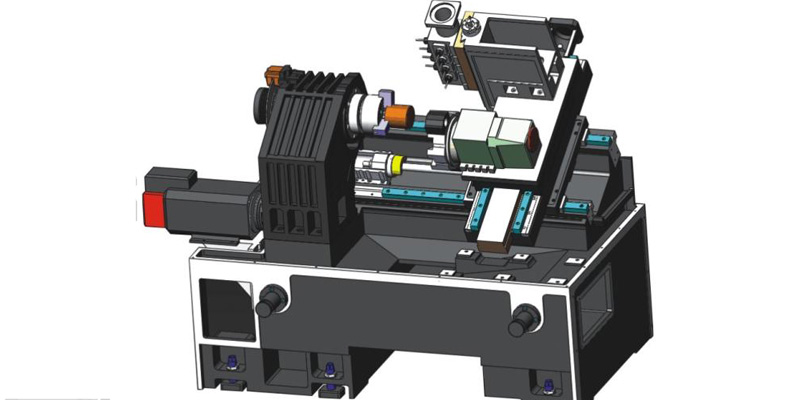
In precision CNC turning, micron-level accuracy hinges on your lathe’s core components. For engineers sourcing CNC lathe machine parts or buyers evaluating equipment, understanding these systems is non-negotiable. From aerospace bushings to automotive shafts, this guide breaks down the five critical lathe components that control productivity, tolerance adherence (±0.005mm), and machine longevity.
What Are CNC Lathe Parts?
A CNC lathe is a computer-controlled turning machine that rotates a workpiece against a stationary cutting tool to remove material. The parts of a CNC lathe are the structural and functional elements that enable this process. Each part plays a specific role in motion control, stability, and precision cutting.
Common CNC lathe machine parts include the bed, headstock, tailstock, carriage, and control panel — but in this article, we’ll focus on the five most crucial components for modern production environments.
1. The CNC Lathe Bed: Engineering Stability for Precision Turning
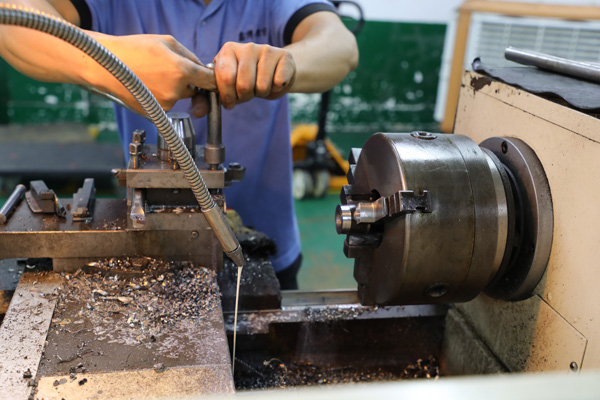
The lathe bed is one of the most critical CNC lathe parts, acting as the foundational platform that supports the entire machine. It absorbs cutting forces, maintains alignment, and ensures accuracy across long production runs.
Construction Materials:
- Meehanite-grade cast iron – renowned for vibration damping and dimensional stability
- Stress-relieved welded steel – for heavy-duty applications requiring maximum rigidity
Key Performance Features:
- Vibration Damping – Neutralizes chatter during heavy roughing operations, improving tool life and surface finish.
- Thermal Stability – Maintains ±0.01 mm/m alignment, even with temperature fluctuations.
- Wear-Resistant Guideways – Hardened or Turcite-coated surfaces resist wear from decades of carriage travel.
Why Precision Depends on the Lathe Bed
If the lathe bed lacks rigidity, it can cause:
- Taper errors exceeding 0.05 mm/m in long shaft machining
- Degraded surface finishes (Ra > 3.2 µm) due to vibration
- Deflection under high cutting forces – For example, in oil & gas manufacturing (e.g., 12 m drill collars), a monolithic bed prevents deflection under 8 kN forces, ensuring API-spec straightness within 0.1 mm over the full length.
Pro Tip: When selecting CNC lathe machine parts, ensure the bed meets both material and alignment standards to safeguard machining accuracy over the machine’s lifetime.
2. Headstock: Precision Powerhouse for CNC Lathe Rotation
As the core CNC lathe part governing rotational accuracy, the headstock integrates three critical CNC lathe machine parts:
- High-Torque Spindle: HSK-63/A2-6 taper holds chucks/collets with <0.003mm TIR runout
- Precision Bearings: P4-class angular contact bearings maintain <1μm concentricity at 4,000 RPM
- Vector Drive Motor: 15kW-40kW motors deliver constant torque from 50-4,000 RPM
Why these parts of CNC lathe dictate machining quality:
Headstock rigidity directly controls:
- Part Roundness: <0.005mm deviation in bearing races
- Surface Finish: Achieves Ra 0.4μm on aerospace alloys
- Vibration Control: Isolates harmonics during interrupted cuts
Industry Application: In Ti-6Al-4V aerospace shafts, liquid-cooled headstocks prevent thermal growth (>0.01mm) that causes microcracking in fatigue-critical components.
Maintenance Tip: Monitor spindle temperature with IoT sensors – +5°C anomalies signal bearing wear in critical CNC lathe parts.
3. The Tailstock – Supporting Long Workpieces
The tailstock is positioned opposite the headstock and supports the free end of a workpiece, especially when machining long shafts or rods. It can also hold drilling or tapping tools.
Key functions:
- Provides axial support to prevent bending
- Holds center drills, reamers, or taps for secondary operations
- Adjustable for precise alignment with the spindle axis
Why it matters:
Without a properly aligned tailstock, long workpieces can deflect, leading to taper errors. Adjustable tailstocks allow fine-tuning to maintain concentricity.
Example: In marine propeller shaft production, a robust tailstock prevents sagging and ensures smooth rotational balance.
4. Carriage System: Precision Tool Control in CNC Lathes
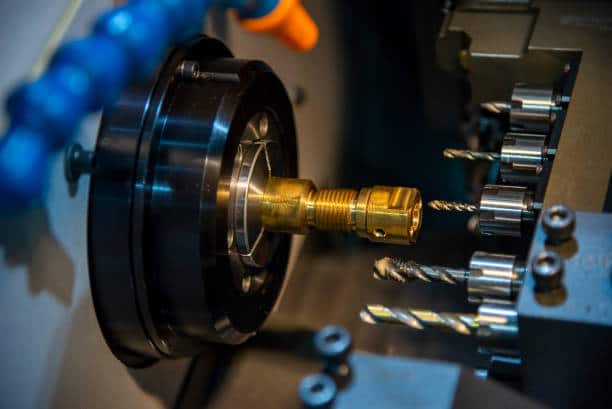
The carriage – among the most critical CNC lathe parts – orchestrates cutting tool movement along X/Z axes with micron-level accuracy. This system integrates four essential CNC lathe machine parts:
- Saddle: Turcite-coated base gliding on hardened bed ways
- Cross-Slide: Ball-screw driven for ±0.002mm radial positioning
- Compound Rest: Enables angular cuts (0-45°) for tapers/chamfers
- Tool Post: Hydraulic/Pneumatic quick-change systems (Capto/DIN 69880)
Why these parts of CNC lathe dictate machining precision:
- Zero Backlash: Prevents dimensional errors exceeding ±0.01mm
- Vibration Damping: Maintains Ra 0.8μm finishes during interrupted cuts
- Thermal Stability: Compensates for friction-induced expansion
Industry Case: In 4140 chromoly hydraulic cylinders, a rigid carriage maintains 0.005mm parallelism over 1m lengths – critical for ISO 10791-7 seal standards.
Maintenance Alert: Worn cross-slide ball screws increase scrap rates by 15% in high-tolerance CNC lathe machine parts production.
5. CNC Control Panel: Intelligent Command Hub for Lathe Operations
The CNC control panel – the central intelligence among CNC lathe parts – integrates hardware and software to orchestrate all machining functions. This critical interface manages every parts of CNC lathe through:
Core Capabilities:
- G/M-Code Execution: Processes complex programs for contours/threads
- Dynamic Control: Adjusts spindle torque (0-150%) and feed rates in real-time
- Tool Management: Automatic changers with <0.5s index times
- Industry 4.0 Integration: OPC-UA/MTConnect data streaming for predictive analytics
Why these CNC lathe machine parts drive efficiency:
- Error Reduction: AI-assisted programming cuts setup mistakes by 70%
- Downtime Prevention: Live diagnostics alert to 90% of failures pre-occurrence
- Seamless Automation: Enlights robotic part handling without cycle interruption
Automotive Case: In high-volume transmission shaft production, Siemens 840D controls enable <15s changeovers – boosting output by 300 shafts/day while holding ±0.01mm concentricity.
Upgrade Tip: Retrofit legacy panels with IoT edge devices to transform older CNC lathe parts into Industry 4.0 assets.
The synergy of these five parts determines a lathe’s capability. The bed provides stability, the headstock powers rotation, the tailstock ensures alignment, the carriage positions the tool, and the control panel orchestrates every movement. Any weakness in one component can compromise the entire machining process.
Conclusion
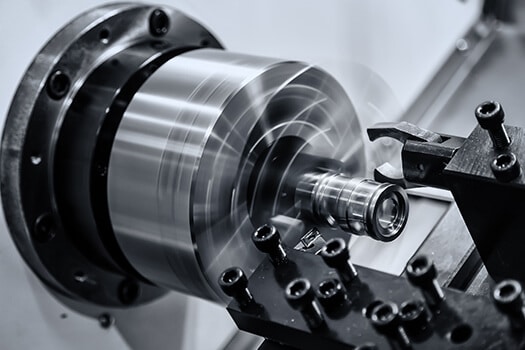
Understanding the pivotal CNC lathe parts is essential for anyone involved in specifying, purchasing, or operating turning machines. From the rigid bed to the intelligent control panel, each component plays a decisive role in machining accuracy, efficiency, and longevity.
Ancastings’ expertise in CNC lathe machine parts ensures that every project benefits from optimized equipment configurations, precision machining, and consistent quality.
Ancastings’ ISO 9001-certified expertise in parts of CNC lathe delivers:
- Precision Engineered Solutions
- Bed Rigidity (Meehanite castings)
- Headstock Accuracy (P4-class bearings)
- Carriage Repeatability (±0.003mm)
- Control Intelligence (Siemens/Fanuc)
- First-Article Acceptance Rate: 99.2%
Request a custom CNC machining quote today and see how our precision engineering can bring your designs to life:
- Optimized for your material/tolerance requirements
- 15% faster lead times through component-level optimization
- Full traceability of all CNC lathe machine parts