
A CNC router machine is no longer an optional luxury but a fundamental capital asset for wood product manufacturers. The performance of CNC router machine directly dictates operational efficiency, cost-per-unit metrics, and end-product quality—critical factors influencing customer satisfaction and competitive positioning.
However, significant variations exist in CNC router design and capability. For engineers, procurement specialists, and operations managers tasked with selecting equipment that meets both immediate production demands and accommodates future requirements, a thorough technical evaluation is imperative.
The following analysis details the core features essential for production-grade wood fabrication. Understanding these specifications—from spindle power and rigidity to advanced automation like integrated tool changers—is crucial for making a strategic, long-term investment that delivers sustained ROI and operational resilience.
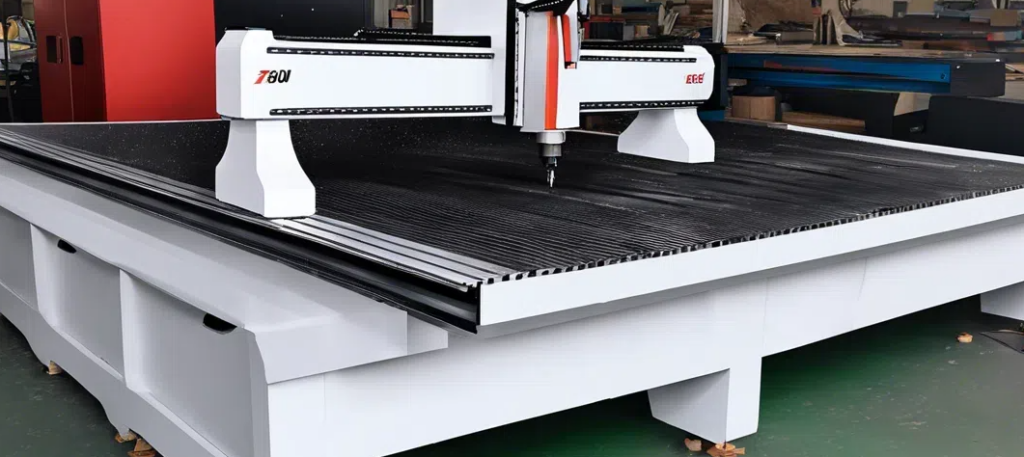
Industrial Frame Integrity: Mitigating Tolerance Drift in Precision Woodworking
The structural frame constitutes the foundational element defining the performance ceiling of any industrial CNC router for wood applications. While static, this component governs the precise translation of programmed toolpaths into micron-accurate workpiece geometry.
Material Selection for Stability:
- Welded Steel / Cast Iron: Provides essential resistance to flexure and resonant vibration under high dynamic loads (rapid acceleration, deep profiling).
- Advanced Mineral Composites: Deliver superior vibration dampening characteristics in high-end systems, further enhancing surface finish fidelity.
Operational Imperative:
Wood processing inherently involves large-panel machining with variable material density. Inadequate frame rigidity induces tool deflection during operation, manifesting as unacceptable surface defects (chatter, edge burning) and dimensional inaccuracies (out-of-square geometries).
Application-Specific Rigidity Requirements:
For high-volume operations utilizing nested-based manufacturing or full-sheet processing, a rigid gantry structure is non-negotiable. This ensures uniform Z-axis depth consistency across the entire work envelope—a critical prerequisite for precision joinery and seamless cabinetry assembly.
Performance Assurance:
A laser-cut, thermally stress-relieved steel frame with optimized gantry reinforcement represents the recommended engineering solution. This configuration guarantees sustained positional repeatability within ±0.05mm tolerance bands, even during extended 18+ hour production cycles, effectively eliminating tolerance drift and safeguarding part-to-part consistency.
Spindle Power and Speed Control
As the primary workhorse of an industrial CNC router, the spindle dictates critical performance metrics: material removal rate (MRR), edge finish integrity, and substrate versatility. Its specification directly influences production efficiency and product quality.
Power Requirements for Industrial Demands:
- Standard Range: 3 kW (4 HP) to 9+ kW (12 HP)
- Operational Impact: Higher wattage enables aggressive machining strategies (deep axial cuts, high feed rates), particularly essential for dense hardwoods, phenolic laminates, and thick composite materials.
Precision Speed Control via VFD:
- Optimal RPM Bandwidth: 6,000–24,000 RPM (variable frequency drive-controlled)
- Technical Rationale:
- *Low-Range (6,000–12,000 RPM):* Maintains torque integrity for large-diameter tooling and high-density substrates
- *High-Range (18,000–24,000 RPM):* Delivers superior surface finishes on engineered woods (MDF, particleboard) and softwoods
Tips: Specify ISO 30/HSK 63F tool interfaces for heavy profiling in teak or zebrawood:
| Feature | Softwoods (Pine) | Hardwoods (Oak) | Composites (HPL) |
|---|---|---|---|
| Optimal RPM | 18,000–24,000 | 10,000–14,000 | 12,000–16,000 |
| Torque Focus | Speed | Power reserve | Chip evacuation |
Choosing the right spindle ensures your router is a match for everything from delicate carving to aggressive hogging, eliminating the need for separate machines.
Automatic Tool Changer (ATC) for Multi-Operation Workflows
Automated Tool Changers (ATCs) transform CNC router productivity by eliminating manual intervention, directly enhancing operational efficiency and part consistency.
Key Technical Considerations:
- Tooling Capacity & Configuration:
- Standard Systems: 6–12 tool positions (sufficient for moderate job variation)
- High-Volume Production: 20–30+ tool magazines (enables complex, multi-operation parts without interruption)
Selection Criteria: Align capacity with part mix complexity and required tooling diversity.
- Indexing Performance:
- Critical Metric: Tool-to-tool swap time (typically 3–15 seconds)
- Throughput Impact: Directly reduces cycle time on parts requiring sequential operations (drilling, profiling, finishing). Faster indexing enables high-volume unattended production.
- Intelligent Tool Management:
- Integrated wear monitoring and predictive replacement protocols
- Prevents quality deviations by automatically retiring tools before dimensional tolerance loss occurs
Validated Efficiency Gains:
As substantiated by Fabricating & Metalworking (2023), a 12-tool linear ATC achieves 83% reduction in non-cut time versus manual changes. This enables economically viable unattended machining of complex components – such as 5-operation raised panel doors or intricate architectural profiles – while maintaining ±0.1mm feature consistency.
Strategic Applications:
ATC capability delivers disproportionate ROI for:
Industrial sign fabricators (integrated roughing/finishing/v-carving sequences)
Architectural millwork producers (multi-tool moldings, joinery)
High-mix furniture manufacturers (rapid changeovers between product lines)
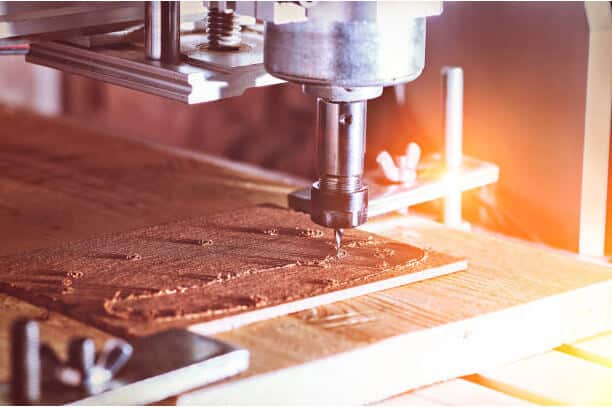
Production-Proven Workholding & Dust Management
Securing the workpiece and maintaining a clean machining environment are non-negotiable prerequisites for dimensional accuracy, operator safety, and sustained equipment performance.
1. Advanced Vacuum Workholding Systems:
- Full-Sheet Processing: Mandatory for panel processing efficiency. Multi-zone, independently controllable vacuum tables optimize energy consumption by activating only required zones, while maximizing holding force per square inch.
- Performance Benchmark: Zone-controlled pump systems (≥25 HP aggregate) maintaining ≥12″ Hg on standard MDF substrates. Hybrid T-slot/vacuum beds provide essential flexibility for mixed-batch production involving diverse part geometries.
2. Integrated High-Velocity Dust Extraction:
- Critical Specification: 6″ main extraction port supporting ≥4,500 CFM airflow capacity.
- Capture Efficiency: 360° brush-sealed dust skirts with active perimeter sealing ensure >99% particulate capture at the source. Dual-port designs and centralized system compatibility are essential for production-scale operations.
- Operational Imperatives:
- Quality: Prevents particulate-induced surface defects and toolpath deviation
- Maintenance: Mitigates abrasive wear on linear guides, spindles, and controls
- Compliance: Meets OSHA/NIOSH airborne particulate standards (PEL/TLV)
Consequence of Inadequate Systems:
Substandard hold-down induces workpiece shift, causing dimensional non-conformance (±0.5mm+ drift) and scrapped parts. Ineffective dust control compromises visibility (quality inspection failure), accelerates component wear (20-40% reduced bearing life), and creates combustible dust hazards (NFPA 664 compliance risk).
Control System and Software Compatibility
Even the best mechanics fall short without intelligent control. A CNC router machine for wood is only as good as its control system.
- Controller Brands: Opt for industrial-grade systems like Syntec, FANUC, Siemens, or OSAI, known for reliability and CNC-specific features.
- G-code Processing: Ensure your controller can handle complex toolpaths generated from top CAM software such as Fusion 360, Vectric Aspire, or AlphaCAM.
- User Interface & Diagnostics: Easy-to-use HMIs (Human-Machine Interfaces) and built-in diagnostics reduce training overhead and downtime.
Reject Compromise: Specify dedicated CNC controllers (Siemens 840D, FANUC 31i-B), not retrofit PC solutions.
Software Stack Integration:

For shops aiming to grow or scale production, a well-integrated controller ensures consistent part execution, day after day.
Scalability and Integration Potential: Future-Proofing Your CNC Wood Router Machine
You may begin with smaller batches today—a practical approach for any growing operation—but success demands planning for tomorrow. Growth isn’t just likely; it’s the goal. As demand increases and opportunities expand, your equipment must keep pace without costly overhauls.
That’s why inherent scalability is non-negotiable. The right machine doesn’t just meet today’s needs—it evolves with them, ensuring long-term efficiency and competitiveness.
Modular Flexibility for Uninterrupted Growth
- Expandable X-axis – Bolt on 1.5m+ extensions as needed
- Multi-spindle configurations – Dual-head gang routing for increased throughput
- MES connectivity – Real-time OEE tracking for optimized performance
Built for Automation, Ready for Tomorrow
- Pallet shuttle interfaces – Streamline material handling
- Robotic arm compatibility – Integrate UR10/KUKA units seamlessly
Scalability isn’t just about size—it’s about adapting workflows to match your growing production demands. Invest in a system that grows with you, not one you’ll outgrow.
Conclusion
Selecting the right CNC machining solution for wood isn’t just about raw specs—it’s about precision, scalability, and partnership. For cabinet makers, millwork specialists, and production facilities, outsourcing to a qualified CNC machining service can be a smarter investment than purchasing equipment outright.
Why? Here are the reasons:
- Avoid underperformance risks – Poorly matched machinery leads to bottlenecks, rework, and lost competitiveness.
- Access industrial-grade equipment – Without the capital expenditure of buying a CNC router.
- Scale on demand – From prototyping to full production, without equipment limitations.
Since Ancastings doesn’t sell directly CNC router machine for wood but instead provides CNC wood machining services, they offer a compelling alternative for businesses that need:
✔ Precision routing & milling – Hardwoods, MDF, melamine, and engineered panels.
✔ Advanced CNC capabilities – Multi-axis machining, custom shaping, and finishing.
✔ Scalable production – From one-off prototypes to high-volume runs.
By leveraging Ancastings’ expertise, manufacturers can achieve micron-level accuracy, faster turnaround, and cost-efficient production—without the burden of machine ownership.
For woodworking professionals who prioritize quality over equipment ownership, Ancastings Precision delivers a smarter CNC machining solution.