Like most CNC milling processes, plain milling plays a crucial role in manufacturing machined parts across various applications. Additionally, it also yields great benefits such as excellent precision and high effectiveness and efficiency.
In this article, therefore, we will delve into the exploration of plain milling’s definition, how it works, as well as its wide range of applications, and more.
What is Plain Milling?
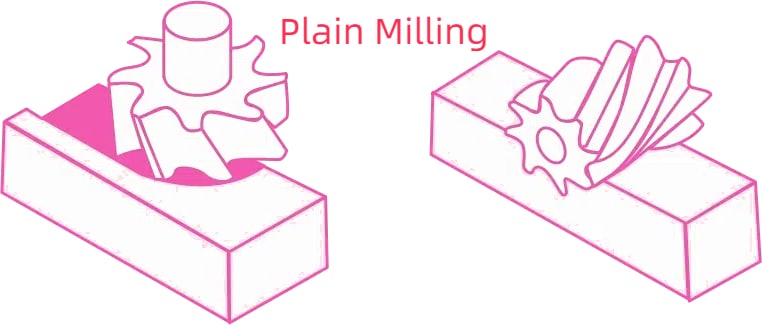
Plain milling involves a process that machines a flat or horizontal surface on components by utilizing a milling cutter. It is also referred to as surface milling or slab milling. In this process, the workpiece is fixed on the machine table, allowing the cutter to remove materials. The purpose is to produce smooth and accurate machined parts with a surface parallel to the tool’s axis.
How Does Plain Milling Machining Process Work?
Here are some key steps that the plain milling machining process includes:
- Workpiece Fixation: Ensure the workpiece remains stationary by using appropriate clamps.
- Milling Cutter Selection: Select the appropriate milling cutter, such as a flat-end or face mill, based on the size and geometrical form of the component. Different specifications of materials require appropriate tools to machine.
- Parameter Setting: Dimensions including cutting depth, rotating speed, and milling feed rate are responsible for the final quality of parts. As a result, operators call for adjusting the suitable parameters to produce components that meet the stringent requirements. Furthermore, the dimension also lies in the desired surface finish, tools, and materials.
- Cutting Motion: The workpiece moves linearly towards the high-speed rotating cutter, creating a relative motion between the two components. And in this process, the cutter will remove material to form a planer surface.
- Coolant Application: Coolant helps reduce heat generation, improve surface finish, and extend the life of the cutting tool.
Types of Plain Milling Cutters
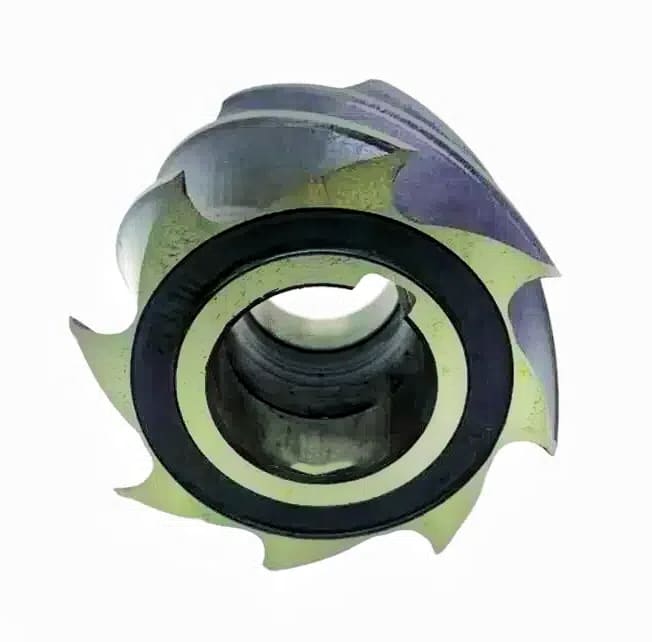
Here are two common types of plain milling cutters: light-duty milling cutters and heavy-duty milling cutters. This section will explain and contrast these two types of cutters in detail.
Light-duty Milling Cutters
- Mainly acts on machining smaller-sized and thinner components
- Features several helical teeth with a helix angle of no more than 25°
- Smaller tool diameters, usually under 20mm
- Lower cutting forces, suitable for precision and fine machining
- Higher spindle speeds can reach over 10,000 RPM
- Suitable for machining softer materials like aluminum alloys, plastics, and wood
- Achieve better surface finish, suitable for workpieces requiring high surface quality
Heavy-duty Milling Cutters
- Utilized for machining larger-sized and thicker workpieces
- Provides a few helical teeth with a helix angle ranging from 25° to 45°
- Larger tool diameters, usually over 50mm
- Higher cutting forces, suitable for roughing and medium machining
- Lower spindle speeds, usually under 5,000 RPM
- Suitable for machining harder materials like steel and alloy steel
- Can withstand higher cutting forces and torque
- Suitable for workpieces requiring higher production efficiency
In summary, light-duty milling cutters are suitable for precision and fine machining, while heavy-duty ones are for roughing machining.
Materials Available for Slap Milling
The diverse materials are available for the plain milling machining process. The following will introduce some common materials.
Metals:
- Brass
- Aluminum
- Aluminum alloy
- Stainless steel
- Titanium alloy
Non-metals
- Plastics
- Composite materials
- Ceramics
- Graphite
These metal materials are widely used in various applications such as the automotive and aerospace industries. Moreover, these composite materials are extensively employed in the medical and electronic industries.
Benefits of Plain Milling
- Efficiency: Well-suited for mass production and improves production efficiency.
- Precision: It can achieve high-precision dimensional control by setting the appropriate cutting parameters.
- Surface Finish: It can process surfaces with high flatness and parallelism. In addition, cutting fluid like coolant can further improve the surface quality.
- Versatility: Most materials are suitable for manufacturing numerous machined parts utilized in various industries.
- Automation: CNC machine tools also enable to improve production efficiency and consistency.
- Cost-Effectiveness: Equipment investment and operating costs are relatively low compared to other machining process.
Applications of Plain Milling
Some of the key applications of plain milling include:
- Automotive Industry: Engine blocks, cylinder heads, transmission housings, and brake discs.
- Aerospace Industry: Wing spars, fuselage sections, and landing gear components.
- Machinery Manufacturing: Machine tools, dies, and molds.
- Electronics and Electrical Equipment: Electronic enclosures, circuit boards, and other electrical components.
- Construction and Infrastructure: Plain Milling is used in the fabrication of construction materials, such as concrete formwork, and in the preparation of surfaces for building foundations and structures.
- Medical Devices: Orthopedic implants and surgical instruments
- General Engineering: Housings, brackets, and structural components across various industries.
Plain Milling VS Other Milling Operation
Plain milling differs from other common milling operations in the following ways:
- Plain Milling: Suitable for smaller planar areas by using standard flat-end mills.
- Face Milling: Uses larger diameter milling cutters
- Slot Milling: Machine various shaped slots and requires special cutters, such as T-slot cutters,
- Form Milling: To machine complex curved surfaces or special shapes
- End Milling: Creates vertical wall surfaces with end mills
- Gang Milling: Gang milling uses multiple cutters while processing different surfaces and requires a more complex machine tool.
- Profile Milling: Profile milling can machine complex contours by using special profile cutters.
Tips for Slab Milling
Here are the tips for plain milling to guarantee high-quality machined components.
- Select Appropriate Cutting Tools
- Optimize Cutting Parameters
- Ensure Stable Workpiece Clamping
- Utilize Coolant Effectively
- Manage Chip Evacuation
- Maintain Good Machine Tool Condition
By mastering these techniques, manufacturers can achieve higher machining accuracy and better surface quality in the slab milling process.
Conclusion
In general, plane milling is an efficient processing method that can meet the needs of a large number of manufacturing industries. This article introduces in detail the working principle of slap milling, common tool types, and typical application scenarios. At the same time, it compares the similarities and differences between plain milling and other milling processes.
Additionally, Ancastings Precision has outstanding strength in the field of plane milling. With advanced equipment, optimized technology, and rich experience, Ancastings can provide customers with high-precision and high-efficiency processing services. Moreover, it provides customized solutions and optimizes the design to ensure that the workpiece achieves ideal quality and precision. Please feel free to contact us to customize your machined parts or ask for an instant quote.
Other articles you may be interested in:
End Milling Process: Techniques and Types
CNC milling is essential in modern manufacturing, with end milling being a widely utilized process. This article explores the key concepts of end milling, including its methods and purposes. Furthermore, we will cover the different types of end mills, their … Read more
What is the Difference: CNC Router Vs. CNC Mill