Tack welding is a fundamental technique in many manufacturing and assembly processes. Furthermore, this method is widely employed across diverse industries due to its versatility, stabilizing capabilities, and cost-effectiveness.
Therefore, this article will explore the tack welding process, covering its definition, different types, as well as the pros and cons, to help readers thoroughly understand this welding technique.
What is Tack Welding?
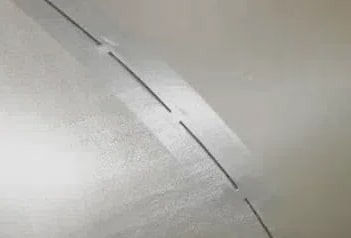
A tack weld is a temporary weld used to hold two or more pieces of metal in place before performing a final weld. This method commonly involves the use of low heat and a short welding arc to join the metal parts together.
Moreover, the purpose of this process is to align the metal pieces correctly before welding. And it also prevents the parts from moving or shifting during the welding process. In other words, it can provide enough stability to allow the welder to complete the final weld successfully. Thus, temporary welding is an essential preliminary step in many welding applications.
How Does Tack Welding Work?
It is common knowledge that this welding process typically uses the arc to fix the two pieces. As such, tack welding is a relatively simple process compared to others, and below are some common steps.
- Preparation: It is essential to understand the drawings and technical requirements before starting the welding. Next, it also requires ensuring the welding area is kept clean and free of other oxides.
- Parameters Adjustment: Portable arc welders like MIG welder and TIG welder, are typically applied in this process. Accordingly, the welder will adjust the welding current and voltage to fit the thickness and types of welding materials.
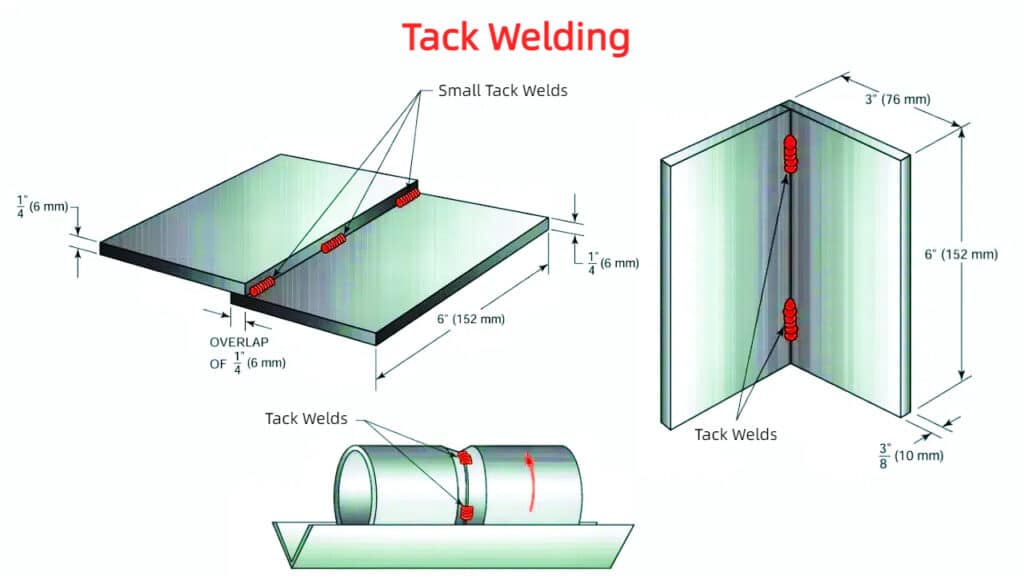
- Tacking: The heated temperature created by arc welds will lead to the welding metals melting rapidly. The metals then cool down quickly once the welding is complete. Generally, the length of small tack ranges from ½ inches to ¾ inches, and no more than 1 inch.
Materials that can be Tack Welded
Usually, welders often utilize metal materials in the tack welding process. However, how do we choose the appropriate and suitable materials? The key factors rest on a material’s thermal conductivity, susceptibility to distortion and coefficient of thermal expansion. Below are some common metals.
- Carbon Steel
- Stainless Steel
- Aluminum
- Aluminum Alloy
- Iron
- Copper
- CuCrZr
Types of Tack Welds
Each type of tack weld serves its own distinct applications and purposes, and this section will introduce some common types.
Standard Tack Weld
This type of weld can withstand heavy materials and firmly hold the pieces in place for the final welding process.
Bridge Tack Weld
Typically, welders often take advantage of this technique when there is a small gap between the two metal materials after assembly. In other words, this method is intended to fill those gaps caused by improper cutting or distortion.
Here are some skills in this type of welding: employing small tack on each part in turn, allowing enough time for them to cool down.
Hot Tack Weld
Hot tacking is similar to bridge tacking, as both techniques are meant to fill gaps. However, the key difference is that hot tacking requires the welder to use a sledgehammer to pound the pieces into the proper position
Thermit Tack Weld
Thermit welding is a process that utilizes an exothermic chemical reaction to generate high temperatures, which can reach up to 4000 degrees Fahrenheit. In addition, it also involves a mixture of materials, such as aluminum powder and iron oxide powder.
Ultrasonic Tack Weld
Ultrasonic welding involves the use of high-frequency mechanical vibrations to create heat and fuse the metals together. The rapid vibrations create friction at the interface between the metal components, resulting in localized heating and melting. In this process, the welders can directly push the melted parts into the base metal without additional filler materials.
Forms of Tack Weld
There are four forms of tack weld. Choosing the proper form can help improve welding efficiency and quality. Thus, this part will explain them in detail.
Square Tack Weld: This form of welding provides a strong joint by applying the welds in a square pattern, facilitating the joining of two parts positioned at right angles.
Vertical Tack Weld: This technique involves placing a vertical tack weld that runs the full height of the two pieces being joined, rather than just a localized spot weld on the surface.
Right Angle Tack: This type of tack weld is used to join two pieces of metal that are meeting at a 90-degree angle. It is often used to secure the bottom metal pieces in this perpendicular configuration.
Right Angle Corner Tack Weld: Welders commonly employ this form to prevent the formation of a T-shaped joint between the perpendicular metal components
The Pros and Cons of Tack Welding
Tack Welding technology yields a number of advantages, but it also involves some limitations.
Pros of Tack Weld
- Temporary Fixing: Metal parts are fixed temporarily to facilitate the correct position.
- Efficiency: Helps to improve work efficiency for its simple control
- Low Cost: Compared with other welding methods, tack welding is less expensive.
- Wide Application: Suitable for most materials and can be used for metal parts of different thicknesses.
Cons of Tack Weld
- Limited Strength: The temporary fixation cannot replace the strength of a properly executed final weld.
- Distortion: Improper tack weld placement or excessive tack weld size can lead to distortion.
- Skill Requirement: Producing high-quality tack welds requires skill and experience from the welder.
How to Achieve a Good Tack?
A high-quality tack weld helps to perform a perfect final weld as it can prevent the materials from cracking or falling on movement. Thus, this section will provide you with comprehensive tips to achieve a good tack weld.
- Keep the metal filler wire clean, and select a wire with a smaller diameter.
- Ensure the contact tip is free from wear.
- Make use of tapes to keep materials fixed.
- Ensure the number of tack welds matches the size of the weld.
- Preplan the order and direction of the welds.
- Employ an elevated voltage while keeping it steady.
Tack Welding vs. Spot Welding
Although these two welding are similar, they also have some differences. And the main contrasts between tack welding and spot welding are:
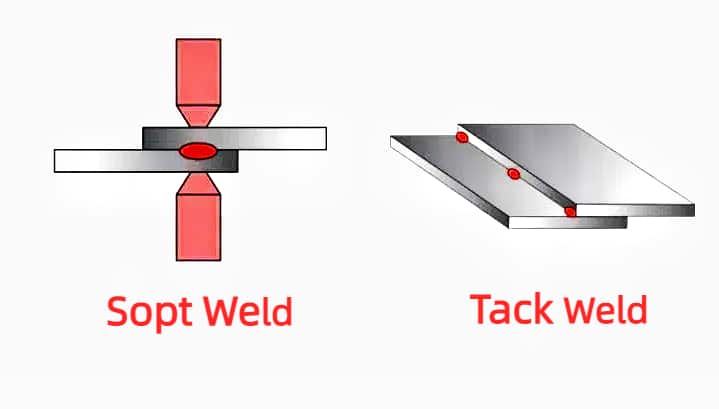
- Tack weld is a temporary welding process used to hold parts in place, while spot welding is a resistance welding process that creates a localized, circular weld.
- Tack welds are small and shallow, while spot welds are stronger and more durable.
- Tack welding is often employed for assembly and alignment, while spot welding is in mass production applications.
Conclusion
Understanding the intricacies of tack welding is essential for any welder, engineer, or fabricator looking to optimize welding processes and deliver high-quality results.
Additionally, Ancastings Precision has extensive expertise in tack welding technology. We specialize in custom CNC machining services, from design and rapid prototyping to low or high-volume production of complex parts. Therefore, we can meet your specific welding requirements. Please feel free to contact us for your projects or ask for an instant quote.
FAQs
Tack welds are relatively small and shallow compared to the final welds. They are meant to hold the workpieces in place temporarily, not to provide the primary structural strength. In addition, the strength of tack weld lies in the number of tacks and the types of filler materials employed.
Spot welding creates a small, localized weld by pressing two metal surfaces together. Tack welding manually applies small, intermittent welds to hold workpieces in place temporarily before final welding.
The smaller tacks are simpler to remove or grind compared to the larger ones. And they also cause less distortion to the interface of the two pieces.
Other articles you may be interested in:
Welding Joints: Different Types and Applications
Welding joints are critical connections in sheet metal fabrication that determine the strength and durability of a structure. This article will delve into the various types of weld joints, exploring their unique applications and symbols. Additionally, we’ll discuss the pros and … Read more