Engineering fit is a fundamental yet crucial concept in mechanical design. Proper fit ensures the parts can be smoothly assembled and reliably function, thereby guaranteeing the functionality and performance of a mechanical system. Therefore, in this article, we will have a comprehensive guide to explore its definition, classifications, and more.
What are Engineering Fits?
Engineering fit, also known as tolerance fit, describes the degree of mechanical clearance or physical contact between mating parts. It involves the relationships between components that enable their assembly and functional operation together. Moreover, the engineering fit serves a wide range of applications in various aspects, especially in the shaft or bearing assemblies.
Proper fits can enhance performance, extend lifespan, increase reliability, and save costs. Therefore, engineering fits play a key role in ensuring the functionality, cost-effectiveness, and reliable operation of mechanical assemblies.
The Basis of Engineering Fits
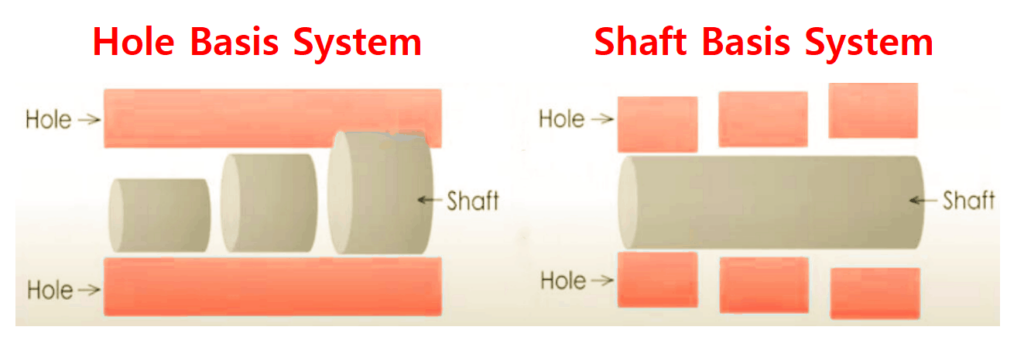
The widely used standard in engineering fits is the hole and shaft basis system. This system involves two mating components: a hole(the inner surface) and a shaft (the outer surface) that are designed to fit together.
In a shaft-based system, the size of the shaft is determined first, and then the hole is made to fit the shaft, while the hole-based system works vice-versa. Both these two approaches aim to achieve the desired fit between the parts. Moreover, compared to the shaft-based system, the hole-based one tends to be employed more widely due to its convenient operation.
Further, the key principles of the hole and shaft basis system are:
- Clearance: The amount of space or gap between the hole and shaft. This determines whether the fit will be a clearance fit, interference fit, or transition fit.
- Tolerance: The permitted variations in the size of the hole and shaft. Tighter tolerances result in more precise fits.
- Allowance: The intentional difference in size between the hole and shaft to achieve the desired fit type.
Types of Fits
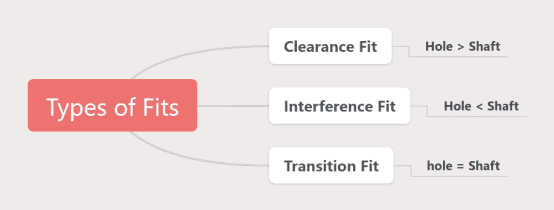
There are three main types of engineering fits, including clearance fits, interference fits, and transition fits. They will be discussed as described in the following.
1. Clearance Fits:
There is a space or gap between the mating surfaces in a clearance fit with a play ranging from +0.025mm to +0.089mm. It allows for easy assembly and disassembly but provides less stability. Examples include loose fits for bearings or bushings.
Below are some different types of clearance fits:
- Free Running Fit: It allows for free assembly and disassembly, rendering it suitable for extreme temperature changes, high-speed operation, and high loads on the journal. However, it provides minimal support or stability due to the observable play.
- Loose Running Fit: This is the loosest clearance and fit for applications with light loads or where some play can be tolerated.
- Easy Running Fit: This kind of tuning fit is snug, but it still be adjusted without undue difficulty.
- Sliding Fit: The parts slide together smoothly with minimal play, offering a balance of ease of assembly and good support between components.
- Close Clearance Fit: The clearance is just enough to allow assembly, and provides good stability and support, with minimal movement between the components.
- Locational Clearance Fit: These types of fits have an extremely small clearance, requiring lubrication to enable smooth movement between the parts.
2. Interference Fits:
Interference fits have no gap between the mating parts with a play ranging from -0.001mm to -0.042mm. The shaft is slightly larger than the hole, creating a tight, secure connection. Furthermore, it provides high stability but makes attachment and detachment more difficult. Examples include press-fit bearings or gears.
- Location/Interference Fit: It is also called press fit. And the interference helps secure the parts in place while still allowing some relative motion.
- Medium Driving Fit: A medium interference fit that requires force, such as pressing, to connect the parts. In addition, this type of fit can support moderate loads.
- Forced Fit: it is the strongest engineering fit, involving significant interference that requires substantial force. Meanwhile, it often includes heating or cooling, to join the mating parts. What’s more, forced fits create permanent, high-strength connections.
3. Transition Fits:
Transition fits have a small clearance or interference with a transition raging from +0.023mm to -0.018mm, providing a balance between the two. There is some play between the parts, but they still fit tightly together facilitating good stability. Examples include fitting shafts into housings or gears onto shafts.
- Location-Slight Interference Fit: This design uses a minute amount of interference to precisely position the mating parts while still preserving some clearance for smooth relative motion.
- Location/Transition Fit: This fit straddles the boundary between a clearance fit and an interference fit. It also provides accurate positioning while still allowing the parts to be fixed and unfixed with relative ease.
The selection of the appropriate fit type depends on the functional requirements of the application, such as the need for easy assembly, a secure connection, or the ability to withstand specific loads and stresses.
4. Below is the ISO standard chart:
| Types of Fits | Description | Hole Basis | Shaft Basis |
| Clearance Fits | Free Running | H9/d9 | D9/h9 |
| Loose Running | H11/c11 | C11/h11 | |
| Easy Running | H8/f8 | F8/h8 | |
| Sliding | H7/g6 | G7/h6 | |
| Close Clearance | H8/f7 | F8/h7 | |
| Locational Clearance | H7/h6 | J6/h7 | |
| Interference Fits | Location/Interference | H7/p6 | P7/h6 |
| Medium Driving Fit | H7/s6 | S7/h6 | |
| Forced Fit | H7/u6 | U7/h6 | |
| Transition Fits | Location-slight Interference | H7/k6 | K7/h7 |
| Location/Transition | H7/n6 | N7/h6 |
How to Achieve Fit Tolerance in Engineering?
Fit tolerance refers to the allowable variation in the dimensions and geometry of mating parts in a product to ensure proper fit and function. Engineering drawings typically convey the tolerance limits through the use of Geometric Dimensioning and Tolerancing (GD&T) symbols. Moreover, GD&T establishes the acceptable bounds for geometric variations from the true, intended shape and size.
Therefore, achieving the most appropriate fit tolerance is crucial for the successful design and manufacturing of a product or system. Here are some tips to help determine the optimal fit tolerance:
- Understanding the application requirements
- Specifying the appropriate fit type and tolerance
- Leveraging design guidelines and standards
- Selecting the appropriate manufacturing processes
- Optimizing manufacturing processes
- Conducting tolerance analysis
- Validating fit through prototyping and testing
- Maintaining quality control and traceability
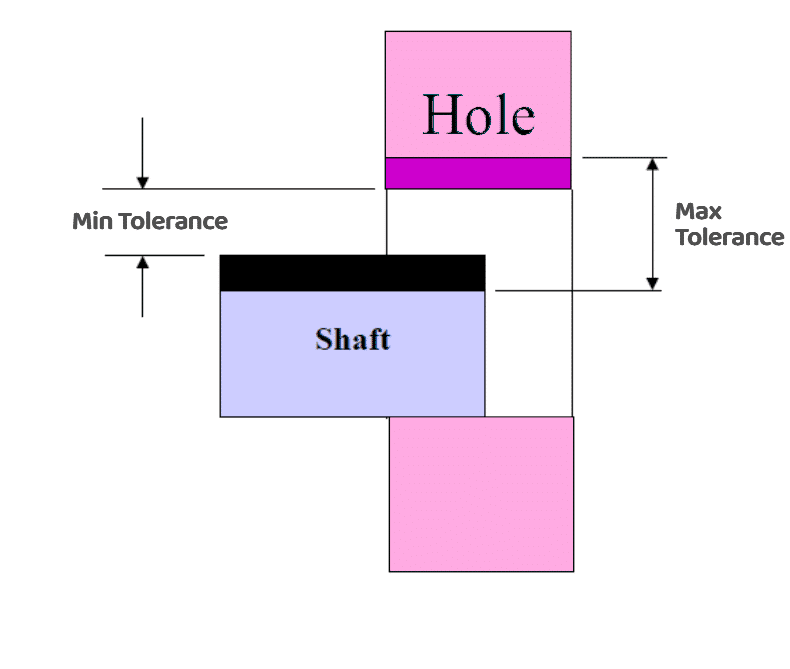
Besides, it is crucial to pay attention to tolerance slack when manufacturing products. Tolerance slack refers to the total maximum or minimum allowable deviation in a particular measurement. It accounts for the combined tolerance of individual components or parts that make up a larger assembly or product. Therefore, managing tolerance slack is essential to ensure that the final product meets the required specifications and functions correctly.
Conclusion
In summary, engineers can create products that meet the required standards by understanding the principles of engineering fit in design and manufacturing. Additionally, Ancastings Precision has more than 10 years of custom CNC machining experience. We specialize in custom CNC machining services from design, rapid prototyping, and complex parts geometry to low or large-volume production.
Therefore, we can achieve the right fits for your specific requirements. Feel free to contact us for your projects or ask for an instant quote.
Other articles you may be interested in:
Abbreviations and Symbols for Engineering Drawing & CNC Machining
Engineering drawing abbreviations are a set of standardized symbols and abbreviations used on engineering drawings to represent common terms and phrases. The symbols and abbreviations represent various components, processes, and measurements used in engineering design. Abbreviations are used to reduce … Read more
What are Types of Taps?