TC4 (Ti-6Al-4V) titanium alloy, also known as Grade 5 aerospace titanium, is the most reliable structural material for modern medical collaborative robots, surgical robotic arms and humanoid robot moving structures. Compared with conventional aluminum alloy and stainless steel robot parts, TC4 features low density, high tensile strength, excellent fatigue resistance and extreme structural stability under dynamic cyclic load. It perfectly adapts to high-precision, high-frequency and long-service-life working requirements of high-end robotic equipment in Europe, North America, Japan and Australia.
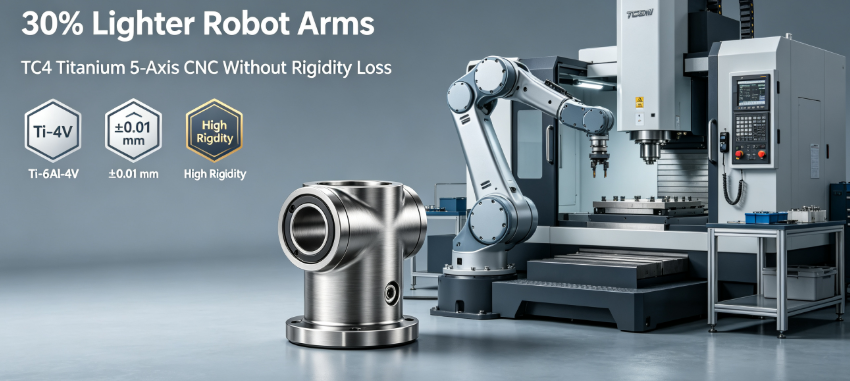
However, robot structural lightweighting has long faced an industry-wide paradox: blindly reducing weight will inevitably weaken rigidity, cause high-speed vibration, positioning drift and shortened service life, while retaining solid structures leads to excessive self-weight, increased motor load, high power consumption and reduced robot endurance. Most CNC suppliers only adopt simple material cutting or partial hollow-out schemes, which can only achieve 10%-15% weight reduction and cannot balance lightweight and rigidity performance. This is the core technical blind spot of peers. Ancastings’ professional 5-axis CNC structural optimization process stably realizes 30% weight reduction for TC4 robot arms while maintaining original rigidity, thoroughly solving the lightweighting dilemma of high-end robotic components.
Why TC4 Titanium Is Irreplaceable for High-End Robot Manipulators
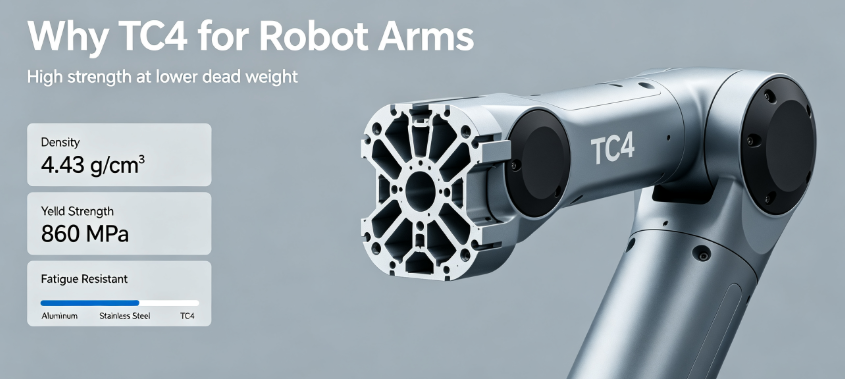
Aluminum alloy is lightweight but poor in rigidity and fatigue resistance. It is prone to structural deformation after long-term cyclic movement, unable to support high-precision repeated positioning of medical robots. Stainless steel has sufficient rigidity but excessive density, which greatly increases robot self-weight load, reduces motion flexibility and increases operating energy consumption. As a transitional high-performance material, TC4 titanium alloy perfectly balances weight and mechanical performance.
With a density of only 4.43g/cm³ (60% of stainless steel) and yield strength up to 860MPa, TC4 can withstand frequent acceleration, deceleration and impact loads of robotic arms. Its excellent low-stress characteristics and structural stability make it the only preferred material for lightweight and high-rigidity requirements of surgical robots and humanoid robot moving arms.
Industry Pain Points: Why Ordinary 3-Axis CNC Cannot Achieve 30% Lightweight & Rigidity Balance
Most robotic component manufacturers still rely on traditional 3-axis CNC machining. Limited by single-angle tool feeding and multiple clamping positioning, 3-axis equipment can only process simple regular hollow structures. It cannot complete complex curved surfaces, internal rib reinforcement and topological optimization structures required for high-standard lightweighting.
To avoid structural collapse and rigidity failure, peers can only retain a large amount of redundant materials, resulting in insufficient lightweight effect. Even if individual parts are hollowed out blindly, unbalanced stress distribution and lack of reinforced structures will cause local rigidity attenuation, high-speed resonance and positioning accuracy attenuation. In addition, repeated clamping of 3-axis machining leads to accumulated positioning errors, making it impossible to meet the ±0.01mm high-precision assembly standard of medical robot arms.
Core Advantage of Ancastings 5-Axis CNC: Realize 30% Weight Reduction Without Rigidity Loss
Different from peers’ simple material removal logic, Ancastings’ TC4 robot arm lightweighting solution adopts simulation optimization + 5-axis one-time forming + stress balance control closed-loop process. We do not reduce weight randomly, but remove redundant materials outside the force transmission path and retain high-rigidity reinforced structures precisely, achieving extreme lightweighting while ensuring overall structural stability.
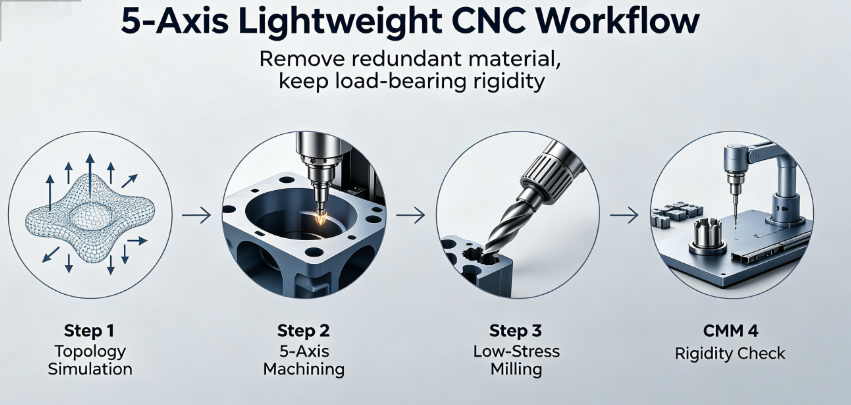
1. CAE Topology Simulation & Generative Design Optimization
Before formal machining, our engineering team conducts full-load simulation analysis according to the robot arm’s actual operating torque, bending moment, impact load and fixed support constraints. Through topological algorithm calculation, we retain materials along the main force transmission path and remove completely non-stress redundant areas. The optimized structure forms scientific hollow cavities, curved transition surfaces and integrated reinforcing rib structures, laying a theoretical foundation for 25%-35% weight reduction.
2. 5-Axis One-Time Clamping Machining to Ensure Structural Integrity
5-axis CNC equipment has two rotating axes on the basis of XYZ linear axes, realizing arbitrary angle tool feeding and no dead-angle machining. It can complete all complex lightweight structure processing in one clamping, avoiding positioning errors and structural stress distortion caused by repeated clamping of 3-axis machining. All transition edges and reinforcing ribs are integrally formed, ensuring uniform force and consistent rigidity of the entire mechanical arm.
3. Layered Low-Stress Milling & Rigidity Balance Control
TC4 titanium alloy has high hardness and strong work hardening tendency. Improper cutting parameters will cause surface stress concentration and local rigidity difference. Ancastings adopts layered small-feed low-vibration milling process, matched with professional titanium alloy tools and high-pressure constant-temperature cooling technology. It effectively suppresses work hardening, balances internal structural stress, and avoids local rigidity weakness caused by processing defects.
4. Post-Processing Rigidity Calibration & Full Dimensional Inspection
After machining, all TC4 lightweight robot arms undergo static deflection test, dynamic vibration test and fatigue cycle test. We use CMM three-coordinate detector to fully inspect key assembly dimensions, flatness and parallelism. General dimensions comply with ISO 2768-M standard, and critical functional dimensions are strictly controlled within ±0.01mm. Only parts with qualified rigidity and dimensional stability can be delivered.
Free DFM Lightweight Optimization Analysis & CNC Quotation
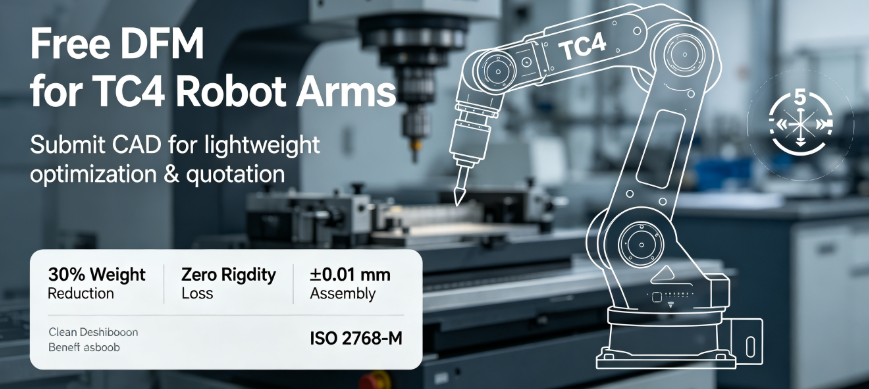
If your TC4 robot arm projects are troubled by insufficient lightweight effect or rigidity loss after weight reduction, Ancastings provides exclusive structural optimization and 5-axis CNC processing solutions. We break the industry’s common lightweighting dilemma and help you achieve double improvement of light weight and high stability.
Submit your robot arm CAD/STEP drawings now. Our native English engineering team will provide free DFM manufacturability analysis, lightweight feasibility evaluation and accurate quotation within 24 hours, supporting your prototype verification and mass production projects.