
A lot of people face problems in deciding whether to pick cast iron or steel for their project works. This mistake, in return, may lead to increased spending over time. In this post, we will look at the main differences as well as the advantages and disadvantages of both materials.
What is Cast Iron?
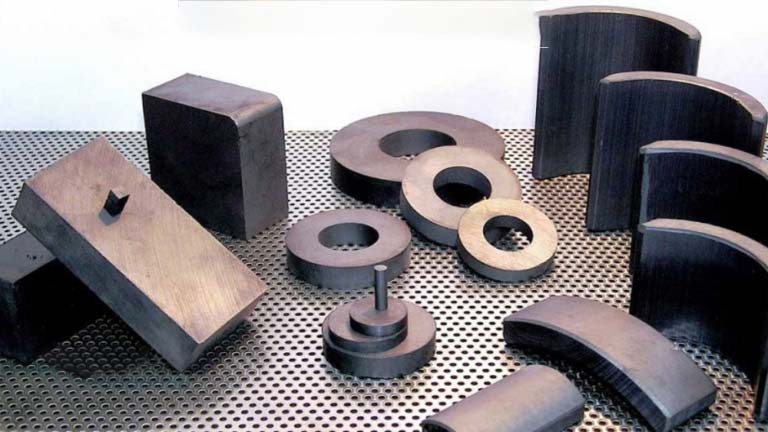
Cast iron is a type of iron that is made by melting iron-carbon alloys that have 2% or more carbon. It may contain 1 to 3% silicon and other impurities such as phosphorus, manganese, and sulfur.
What is Steel?
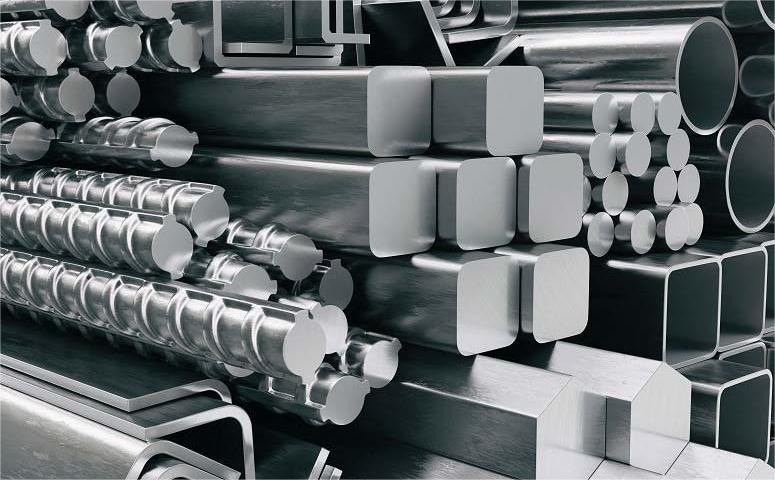
Steel is also a type of iron but it contains less than 2% carbon and about one percent manganese and small amounts of sulfur, oxygen, phosphorus and silicon. Steel is one of the most used metals in our lives. It is used in construction, cars, washing machines, refrigerators, almost everywhere.
Cast Iron vs Steel – 5 Main Differences
1. Differences in Mechanical Properties
Hardness
Cast iron has higher Brinell hardness of 179 to 444 HB than steel’s 156 to 537 HB. This higher surface hardness will give more wear and extrusion resistance.
Brittleness
The graphite flake structure of cast iron makes it more brittle and prone to sudden fracture under stress. Whereas steel’s crystalline matrix structure is more ductile.
Tensile Strength
Steel has higher tensile strength (70–150 ksi) than cast iron (20–60 ksi). This means steel can withstand more pulling force before failing.
Compressive Strength
Cast iron has compressive strength of 63-71 kN/cm² which is rather lower than that of steel with 475-252 kN/cm².
Ductility
Steel has greater ductility with 22-24% elongation. Cast iron gives maximum 6-18% elongation before breaking.
Impact Resistance
The ability to absorb sudden forces without deformation gives steel an edge in impact resistance. Contrary to that, cast iron’s crystalline structure makes it prone to fracture under impact.
Fatigue Strength
Steel has more resistance to fatigue (under cycling loading) due to the rotating bending limits of 225-240 MPa while cast iron shows lower endurance of 134-140 MPa.
Wear Resistance
The pearlitic structure of cast iron with distributed graphite flakes gives better wear resistance than steel. On other hand, steel needs particular alloying elements to get similar surface durability.
Machinability and Weldability
Graphite in cast iron helps in easy machining due to discontinuous chip formation. But its brittleness makes welding difficult. Whereas steel has better weldability but machinability varies with grade.
2. Differences in Chemical Properties
Composition of cast iron and steel
| Element | Steel (%) | Cast Iron (%) |
|---|---|---|
| Iron | 98.0 | 90.0 |
| Silicon | 0.2 | 3.0 |
| Carbon | 0.5 | 2.5 |
| Chromium | 0.1 | 0.1 |
| Phosphorus | 0.04 | 0.1 |
| Sulfur | 0.01 | 0.1 |
| Nickel | 0.5 | 0.3 |
| Manganese | 0.6 | 0.5 |
Corrosion Resistance
Cast iron, due to its outstanding anticorrosive capabilities, can withstand surface rusting, while steel, in order to guarantee its maximum corrosion resistance needs protective coatings.
Reactivity against Acids and Alkalis
In an acidic environment, high silicon cast iron resists concentrated H2SO4 and H3PO4. But standard steel degrades quickly in acids unless coated.
3. Differences in Thermal Properties
Thermal Conductivity
Heat distribution in cast iron is better than stainless steel, with thermal conductivity of 52 W/mK and 14 W/mK respectively. This higher conductivity assures uniform heating across surfaces.
Thermal Expansion
Cast iron has more dimensional stability under temperature changes than steel. Its coefficient of thermal expansion (11.0 × 10⁻⁶/°C) is also less than carbon steel (12.2 × 10⁻⁶/°C).
Melting Point
Melting points also vary between these two materials. Cast iron melts at much lower temperatures (1127-1204°C) compared to steel (1371–1593 °C). So it is more energy proficient for casting operations.
4. Applications of Cast Iron and Steel
The characteristics of these metallurgical materials also determine their use in different industries. They are mostly used in following.
- Automotive Components: Cast iron is used for making cylinder heads, brake rotors and engine blocks of vehicles while steel is used for body panels, chassis frames, and suspension components.
- Pipes & Tubing: Cast iron pipes are used in municipal water mains and underground sewage systems. While steel pipes are best for oil lines, gas networks and even for highly precise hydraulic tubing.
- Heavy Machinery: Better vibration damping and stability of cast iron make it a leading material for making machine tool bases, lathe beds and industrial press frames. At the same time, steel is used in high performance gears, drive shafts and bearings in industrial equipment.
- Cookware & Kitchenware: Cast iron’s thermal retention (52 W/mK) and natural seasoning also make it perfect for heat intensive cooking. It’s mostly used in heavy duty frying pans, dutch ovens and griddles while stainless steel is used in pans, utensils, pots and serving trays.
- Construction & Infrastructure: Construction and infrastructure projects use both the materials. Cast iron’s high compressive strength is used in making manhole covers, drainage grates and decorative facades. Steel is used in modern construction in structural beams, bridge supports and reinforcement bars.
5. Cost Analysis of Cast Iron vs Steel
Cast iron is cheaper to produce. Its basic grades are $187-$231 per ton while particular grades can cost up to $1000. On the other hand, steel is more expensive. Standard steel is $400-$700 per ton and some stainless steel can reach up to $1200-$2000 due to intricate alloying process. Although the initial cost is high, steel is normally a better investment in the long run.
Cast Iron vs Steel – Data Sheet
| Properties | Cast Iron Range | Steel Range | Comments |
|---|---|---|---|
| Modulus of Elasticity | 100 – 140 GPa | 190 – 210 GPa | This range consists of Ductile, compact, Malleable, Gray types of cast iron and Tool, Alloy, Carbon, and stainless steel types |
| Hardness Brinell | 160 – 320 HB | 120 – 600 HB | These are common for ductile and gray cast irons, while steel shows wider hardness range |
| Tensile Strength – Yield | 100 – 200 MPa | 250 – 1000 MPa | Steel types from mild to stainless show superior yield strength range |
| Tensile Strength – Ultimate | 150 – 400 MPa | 400 – 2000 MPa | It includes ranges from Gray iron to ductile iron (highest) and low-carbon steel to Alloy steel |
| Elongation at Break | 0.3 – 0.8% | 10 – 25% | Different steel types austentic, duplex and high carbon demonstrate much higher ductility |
| Density | 7.1 – 7.3 g/cm³ | 7.75 – 8.05 g/cm³ | Gray and ductile cast irons have lower density than most steels |
| Thermal Conductivity | 36 – 46 W/m·K | 45 – 60 W/m·K | Their values varies with graphite content in cast iron |
| Melting Point | 1150 – 1250°C | 1450 – 1520°C | All cast irons have a similar range but steel has different for tool steel (highest) and carbon steel (lower) |
Pros and Cons of Cast Iron vs Steel
Every material has its strengths and weaknesses. Here are some important advantages and disadvantages of each.
Advantages of cast iron
- The graphite structure allows for even cutting of the chips and decreases tool wear during machining operations.
- Cast iron’s graphite flakes that serve as a lubricant minimize friction and wear and hence, the components, which are typically under stress, last longer and are more durable.
- The graphite flakes in the iron cast are responsible for absorbing or dampening the vibrations which can be used to increase productivity in mechanical circumstances.
- Because of its outstanding fluidity and low shrinkage, cast iron can be cast into complicated and even shallow shapes with high dimensional accuracy.
Disadvantages of cast iron
- Cast iron is prone to rusting if it comes into contact with moisture, which then requires the material to constantly be covered with protective coatings to increase its lifespan.
- The material is too dense for lightweight applications which increase handling costs and decrease proficiency.
Advantages of steel
- Steel keeps the structural integrity in aggressive conditions through impressive molecular bonding and crystalline structure, which makes it resistant to deformation and fatigue.
- The greatest advantage of steel is the high strength that enables it to remain durable in application with high load bearing capacity and mechanical load.
- Steel production is a less wasteful process and it also helps to recover metal through the process of magnetic separation.
- Steel is inherently resistant to corrosion and wear, which decreases repair needs, thus reducing downtime and the expense of maintenance.
Disadvantages of steel
- Steel production produces high noise (110-115 dB) and needs hearing protection in industrial environment.
- Continuous cyclic stress can cause fatigue failure in steel components that are loaded and unloaded over time.
Cast Iron or Steel: Which Material You Should Choose?
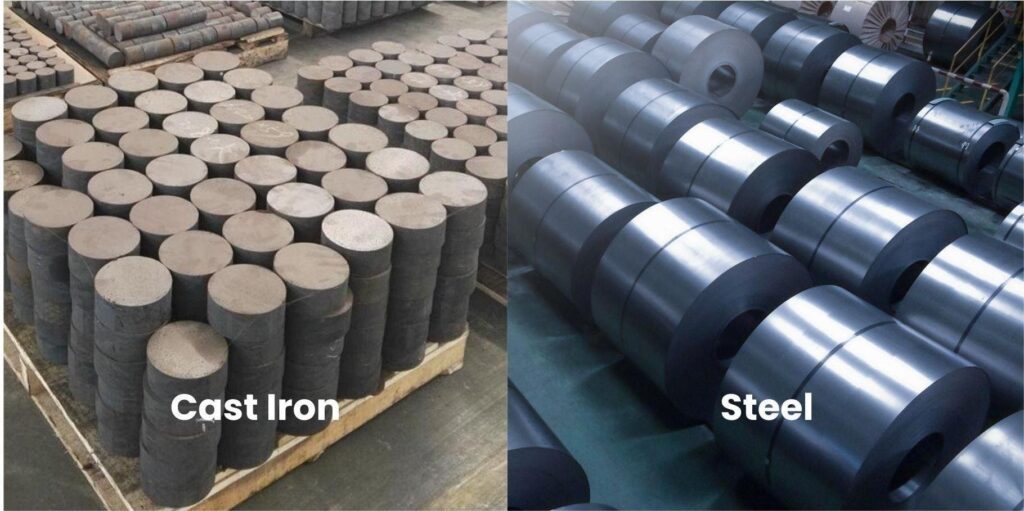
The decision of selecting between cast iron and steel lies in the particular application demands. In case you are looking for a material to withstand heavy loads, resist the strain and have outstanding tensile strength, then steel is best. It is the perfect choice for structural uses and machinery parts that get fatigued due to frequent stress. Nevertheless, if your task involves convenient machining along with the art of forming complicated outlines with high accuracy, cast iron is a top choice.
Conclusion
The requirements for cast iron and steel are different in engineering because their characteristics are not same. Cast iron is more suitable for compression and thermal management and it is cheaper too. Whereas steel is better for high stress applications because of its high tensile and impact strength. Ultimately, it depends on your application needs.
Ancastings provides best CNC machining services related to cast iron and steel. You can contact us anytime with your particular needs.
FAQs
Is cast iron stronger than steel?
Cast iron has greater compressive strength while steel has more tensile strength and impact resistance. Which one is strong normally depends on the application.
How to identify cast iron vs cast steel?
Comparison between cast iron and steel is possible by means of 3 spark test (iron produces red/orange sparks whereas steel gives yellow), filing test (iron results in grey dust and steel in silver chips), and drilling test.
Which one is better for structural applications?
Steel is better. It’s greater impact resistance, ductility and strength are why it is mostly used for high load structures like bridges.
Does cast iron need seasoning?
Yes, seasoning is required for cast iron. It makes an oil coating at high temperature which produces a non stick surface which improves cooking and stops rust.
Is cast iron heavier than Steel?
Yes, cast iron has higher density (7.2 g/cm³) than steel (7.85 g/cm³). So it is more heavy and therefore better for use cases which require stability.