
Introduction
Medical ceramic components—from dental crowns and abutments to orthopedic implant bearings and surgical tool insulators—demand submicron precision, flawless edge integrity, and biocompatible surfaces that meet ISO 13485 and FDA standards. Unlike metals, ceramics such as yttria-stabilized zirconia (Y-TZP), alumina (Al₂O₃), and hydroxyapatite (HA) exhibit extreme hardness (HV 1,500–2,500), low fracture toughness (≈1/20 of steel), and poor thermal conductivity—making them prone to edge chipping, microcracking, and thermal damage during CNC machining.
For medical applications, even micro-scale edge defects (<50 μm) are unacceptable: they act as stress raisers leading to in-vivo fracture, harbor bacteria, or disrupt osseointegration. This guide explores the root causes of chipping in medical ceramic CNC machining and presents actionable strategies to control edge integrity, drawing on Ancastings Precision’s decade-long experience in manufacturing high-accuracy medical ceramic parts for Europe, North America, and Australia.
The Unique Challenges of Medical Ceramic Machining
Medical ceramics are engineered for biological compatibility and mechanical performance, but their inherent material properties create machining hurdles that directly impact edge quality.
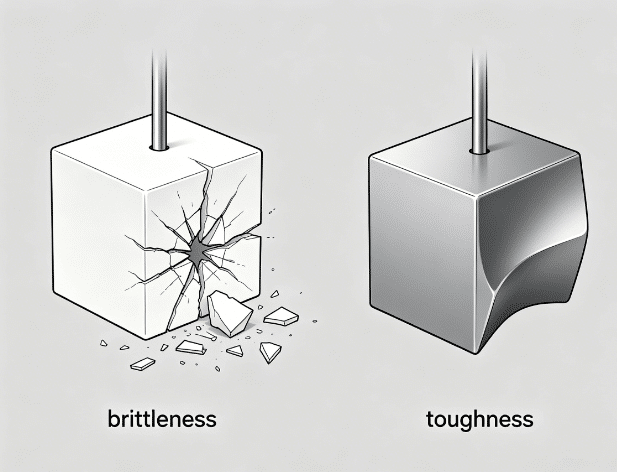
1. Material Brittleness & Low Fracture Toughness
Ceramics lack ductility; instead of deforming under load, they fracture abruptly. Y-TZP, the most common medical ceramic, has a fracture toughness of 5–10 MPa·m¹/²—far lower than titanium (≈110 MPa·m¹/²). This brittleness makes edges highly susceptible to transverse chipping when cutting forces exceed the material’s tensile strength, especially at sharp corners, thin walls (<1 mm), and chamfers.
2. High Hardness & Tool Wear
Medical ceramics are harder than most cutting tools, requiring PCD (polycrystalline diamond) or monocrystalline diamond tools for machining. Even diamond tools wear rapidly: worn tools generate erratic cutting forces, increasing chipping risk by 30–50% and leaving microcracks on edge surfaces.
3. Poor Thermal Conductivity & Heat Accumulation
Ceramics conduct heat poorly (≈1–3 W/m·K, vs. steel’s ≈50 W/m·K). Machining heat concentrates at the cutting edge, causing thermal shock, phase transformation (e.g., tetragonal-to-monoclinic in zirconia), and microcrack propagation—all of which degrade edge integrity.
4. Strict Medical Surface & Dimensional Requirements
Medical components demand Ra < 0.4 μm for implant surfaces (to prevent bacterial adhesion) and ±2–5 μm dimensional tolerance for critical features like 0.5 mm 45° chamfers. Even minor chipping (≥50 μm) or edge rounding violates these specs, risking regulatory non-compliance and implant failure.
What Is Edge Chipping in Medical Machining?
Edge chipping is defined as localized material loss at component edges, categorized by size and severity:
- Micro-chipping (<20 μm): Invisible to the naked eye but detectable via SEM; acts as a stress initiator.
- Macro-chipping (20–200 μm): Visible edge notches; common in rough machining or with worn tools.
- Catastrophic chipping (>200 μm): Severe edge breakage rendering parts scrap.
In dental and orthopedic applications, chipping factor (CF%)—the ratio of chipped edge length to total edge length—is a key quality metric, with medical-grade parts requiring CF% < 1%.
Root Causes of Chipping in Medical Ceramic CNC Machining
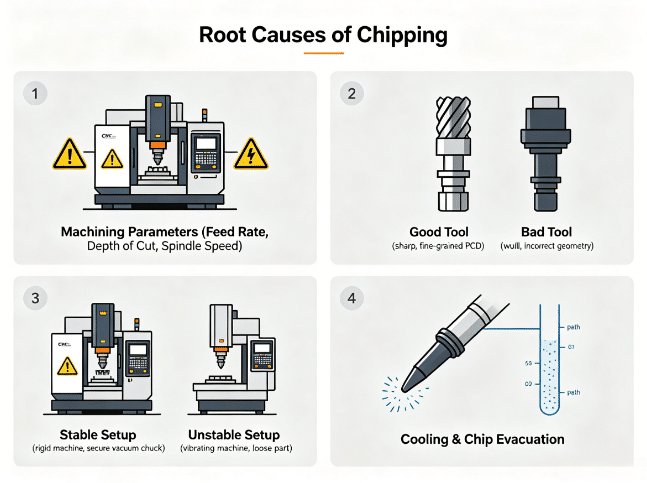
1. Incorrect Machining Parameters
Aggressive parameters are the leading cause of chipping:
- Excessive feed rate: High feed increases cutting force, causing edge fracture. For zirconia, reducing feed by 10% (to 1,000 mm/min) cuts chipping by 25%.
- Large depth of cut: Deep cuts concentrate stress at edges; roughing depths >0.3 mm and finishing depths >0.05 mm trigger chipping.
- Improper spindle speed: Too low (<30,000 RPM) increases tool friction; too high (>60,000 RPM) causes thermal damage.
2. Inadequate Tooling
- Worn or low-quality diamond tools: Dull tools tear instead of cut, leaving jagged edges. Medical machining requires fine-grained (5–15 μm) PCD tools for finishing, replaced every 50–100 cycles.
- Incorrect tool geometry: Tools without polished flutes or high positive rakes (15°–25°) increase cutting forces and chip adhesion.
3. Poor Machine Stability & Fixturing
- Vibration: Even minor spindle or axis vibration (≥2 μm) amplifies edge stress, causing micro-chipping. Medical machines need high-rigidity linear guides and active vibration damping.
- Insecure fixturing: Thin or complex parts (e.g., dental abutments) shift under cutting forces, leading to uneven edges. Vacuum chucks or custom soft fixtures are essential.
4. Inadequate Cooling & Chip Evacuation
Dry machining or insufficient coolant flow causes heat buildup and chip recutting—chips trapped between tool and workpiece scratch edges and induce microcracks.
Proven Strategies for Chipping Reduction & Edge Integrity Control
At Ancastings Precision, we implement a 5-step control framework to achieve CF% < 0.5% and Ra < 0.2 μm for medical ceramic parts, validated across 5,000+ components delivered to EU and US medical device manufacturers.
1. Parameter Optimization: Precision Cutting for Brittle Materials
Roughing (Material Removal)
- Spindle speed: 40,000–50,000 RPM (zirconia/alumina)
- Feed rate: 800–1,200 mm/min
- Depth of cut: 0.1–0.2 mm (shallow passes to minimize stress)
- Cutting mode: Climb milling (forces inward, reducing edge breakout)
Finishing (Edge Definition & Surface Quality)
- Spindle speed: 50,000–60,000 RPM
- Feed rate: 500–800 mm/min (30–50% lower than roughing)
- Depth of cut: 0.01–0.03 mm (ultra-light passes for edges)
- Path strategy: Smooth, continuous toolpaths (avoid sharp direction changes)
Critical Edge Chamfering (e.g., 0.2–0.3 mm 45°)
- Pre-chamfer with 0.1 mm oversize in roughing
- Finish chamfer with a dedicated 45° PCD tool at 500 mm/min feed
- Avoid vertical entry; use 45° angular approach to prevent stress concentration
2. Tooling Excellence: Diamond Tools for Clean Cuts
- Tool selection: Use fine-grained (5–10 μm) PCD tools for finishing edges; avoid coarse-grained tools near critical features.
- Tool maintenance: Inspect tools after every 20 parts; replace at first sign of micro-wear (≤5 μm).
- Tool geometry: Polished flutes for chip evacuation; 20° positive rake to reduce cutting force.
3. Machine & Fixturing Rigidity: Eliminate Vibration
- Machine specs: 5-axis CNC with ±0.003 mm positioning accuracy and active vibration damping (e.g., DMG MORI or Haas medical-grade machines).
- Fixturing:
- Thin walls (<1 mm): Vacuum chuck with protective rubber backing
- Complex geometries: Custom 3D-printed soft fixtures to distribute clamping force
- Avoid over-clamping (≤0.5 MPa) to prevent workpiece cracking
4. Advanced Cooling & Chip Management
- Coolant type: pH-neutral synthetic coolant (no chlorides) to prevent ceramic corrosion and tool wear.
- Coolant delivery: High-pressure (70–100 bar) through-tool coolant to target cutting zones directly, reducing heat by 40–50%.
- Chip evacuation: Vacuum system to remove chips immediately; prevent recutting and edge scratching.
5. Post-Machining Edge Deburring & Inspection
- Soft polishing: After machining, use 1–3 μm diamond polishing paste with flexible pads at low speed (≤300 RPM) to remove micro-burrs without rounding edges.
- Quality inspection:
- Optical microscope (100–500×) to check for micro-chipping
- 3D scanner to verify chamfer dimensions (±0.02 mm)
- Surface profilometer to measure Ra (target <0.2 μm)
Real-World Application: Dental Zirconia Abutment Machining
A European dental device manufacturer required Y-TZP abutments with:
- 0.3 mm 45° chamfer (no rounding, CF% <1%)
- Ra <0.2 μm
- ±3 μm dimensional tolerance
Ancastings’ Solution
- Roughing: 45,000 RPM, 1,000 mm/min feed, 0.15 mm depth, climb milling
- Finishing: 55,000 RPM, 600 mm/min feed, 0.02 mm depth, smooth toolpaths
- Chamfering: Dedicated 45° PCD tool, 500 mm/min feed, 45° entry
- Cooling: 80 bar through-tool synthetic coolant
- Inspection: 500× microscope + 3D scanning
Results
- Chipping factor: 0.3% (well below 1% requirement)
- Surface roughness: Ra 0.18 μm
- Dimensional accuracy: ±2 μm
- Client outcome: 10,000+ abutments delivered with zero field failures, compliant with CE marking.
Why Partner with Ancastings Precision for Medical Ceramic Machining?
As a ISO 13485-certified CNC machining provider focused on medical components, we combine material science expertise, precision engineering, and strict quality control to solve your ceramic machining challenges:
- Specialized knowledge: Deep understanding of medical ceramic properties (zirconia, alumina, HA) and their machining quirks.
- Advanced equipment: 5-axis medical-grade CNC machines with vibration damping and high-pressure cooling systems.
- Rigorous quality control: 100% inspection of edge integrity, surface roughness, and dimensions; full traceability for regulatory compliance.
- Global delivery: Experience serving medical device manufacturers in Europe, North America, Japan, and Australia; compliance with regional standards (CE, FDA).
Conclusion
Edge chipping is the biggest barrier to high-quality medical ceramic CNC machining, but it is controllable with the right parameters, tooling, fixturing, and inspection processes. By prioritizing low-force cutting, rigid setups, and precision finishing, you can achieve flawless edge integrity, meet strict medical standards, and ensure long-term implant performance.