
Introduction
Non-traditional manufacturing processes is defined as a group of processes that remove excess material by various techniques involving mechanical, thermal, electrical or chemical energy or combinations of these energies but do not use a sharp cutting tools as it needs to be used for traditional manufacturing processes.
Extremely hard and brittle materials are difficult to machine by traditional machining processes such as turning, drilling, shaping and milling. Non traditional machining processes, also called advanced manufacturing processes, are employed where traditional machining processes are not feasible, satisfactory or economical due to special reasons as outlined below.
- Very hard fragile materials difficult to clamp for traditional machining
- When the workpiece is too flexible or slender
- When the shape of the part is too complex
Several types of non-traditional machining processes have been developed to meet extra required machining conditions. When these processes are employed properly, they offer many advantages over non-traditional machining processes. The common non-traditional machining processes are described in this section.
Chemical Machining (CM) Introduction
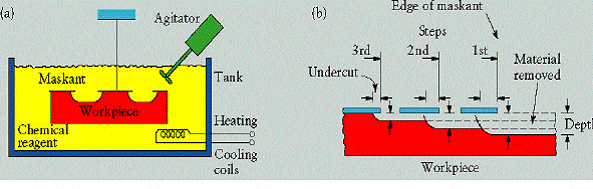
Chemical machining (CM) is the controlled dissolution of workpiece material (etching) by means of a strong chemical reagent (etchant). In CM material is removed from selected areas of workpiece by immersing it in a chemical reagents or etchants; such as acids and alkaline solutions. Material is removed by microscopic electrochemical cell action, as occurs in corrosion or chemical dissolution of a metal. This controlled chemical dissolution will simultaneously etch all exposed surfaces even though the penetration rates of the material removal may be only 0.0025–0.1 mm/min. The basic custom machining takes many forms: chemical milling of pockets, contours, overall metal removal, chemical blanking for etching through thin sheets; photochemical machining (pcm) for etching by using of photosensitive resists in microelectronics; chemical or electrochemical polishing where weak chemical reagents are used (sometimes with remote electric assist) for polishing or deburring and chemical jet machining where a single chemically active jet is used. A schematic of chemical machining process is shown in Figure 6.
Chemical milling
In chemical milling, shallow cavities are produced on plates, sheets, forgings and extrusions. The two key materials used in chemical milling process are etchant and maskant. Etchants are acid or alkaline solutions maintained within controlled ranges of chemical composition and temperature. Maskants are specially designed elastomeric products that are hand strippable and chemically resistant to the harsh etchants.
Steps in chemical milling
- Residual stress relieving: If the part to be machined has residual stresses from the previous processing, these stresses first should be relieved in order to prevent warping after chemical milling.
- Preparing: The surfaces are degreased and cleaned thoroughly to ensure both good adhesion of the masking material and the uniform material removal.
- Masking: Masking material is applied (coating or protecting areas not to be etched).
- Etching: The exposed surfaces are machined chemically with etchants.
- Demasking: After machining, the parts should be washed thoroughly to prevent further reactions with or exposure to any etchant residues. Then the rest of the masking material is removed and the part is cleaned and inspected.
Applications:
Chemical milling is used in the aerospace industry to remove shallow layers of material from large aircraft components missile skin panels (Figure 7), extruded parts for airframes.
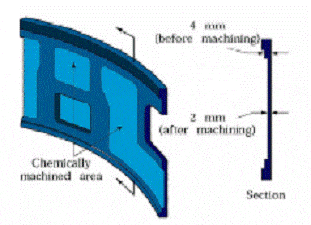
Figure 7: Missile skin-panel section contoured by chemical milling to improve the stiffness- to- weight ratio of the part (Kalpakjain & Schmid)