
In the machining industry, while turning and wire EDM machines play crucial roles in processing various products, waterjet cutting also offers specialized benefits for specific applications. This article will explore its definitions, benefits, applications, and more.
What is Water Jet Cutting?
Waterjet Cutting is a process that uses a high-pressure stream of water, often mixed with an abrasive substance, to precisely cut through a wide range of materials, including metals and composites. In addition, this process utilizes a waterjet cutter as its primary industrial tool for cutting, reaming, and shaping materials. Unlike CNC cutting and laser cutting, water jet cutting is a cold cutting process that does not generate heat.
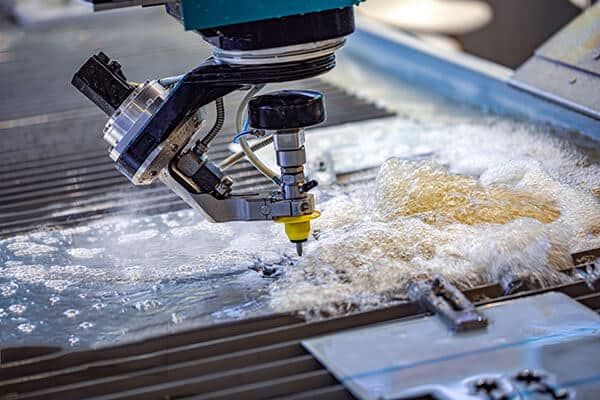
How Waterjet Cutting Works?
The process of water jet cutting involves several key steps and components:
- High-Pressure Pump: To begin with, the high-pressure pump generates an extremely high-pressure water stream, typically between 20,000 and 60,000 psi. Moreover, it includes two different types of pumps, from direct drive-based pumps to intensifier pumps.
- Water Jet Formation: Next, the high-pressure water passes through a tiny orifice, typically 0.1-0.50 mm in diameter, which accelerates the water to supersonic speeds.
- Cutting Head and Nozzle: The high-pressure water jet or abrasive water jet is then directed through a cutting head. This cutting structure contains a small, precision-made sapphire or diamond orifice nozzle that focuses and shapes the water jet.
- CNC System: Furthermore, the cutting head is mounted on a CNC gantry system following the programmed design. Therefore, it can precisely move the nozzle along the desired cutting path.
- Material Cutting: As the high-velocity water jet or abrasive-water jet contacts the workpiece, it erodes and cuts through the material. The depth and quality of the cut depend on factors like pressure, flow rate, abrasive type, and cutting speed.
- Waste Removal: The used water and abrasives are captured in a water tank or collection tray beneath the workpiece, allowing for easy disposal or recycling of the waste.
Types of Waterjet Cutters
The cutting capabilities of water jet cutting machines depend on several factors, including water pressure, abrasive type and flow rate, nozzle diameter, cutting speed, and the physical properties of the material. Below are some common water jet cutters.
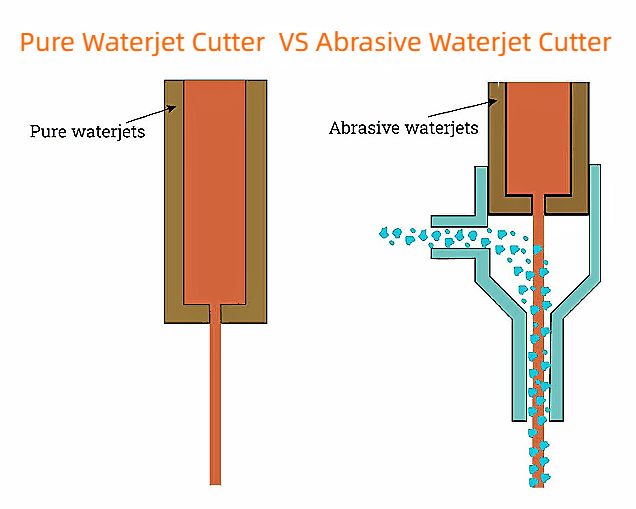
1. Pure Waterjet Cutters:
Used for cutting softer materials like foam, rubber, and some plastics, these cutters employ a high-pressure water stream without any added abrasives. The nozzle width of these machines typically ranges from 0.1mm to as low as 0.08mm. As such, they are generally more precise and produce a cleaner cut edge compared to abrasive water jet cutters.
2. Abrasive Waterjet Cutters:
These cutters use a high-pressure water stream mixed with an abrasive material like garnet to cut through a wide range of materials. The abrasive jet cutting process employs nozzles with a larger diameter, up to 0.375mm, compared to pure water jet systems.
Additionally, some abrasive water jet machining tools are capable of generating pressures up to 6000 atmospheres. Moreover, the abrasive material increases the cutting power and is commonly used for cutting metals, stone, glass, and other tough materials.
3. Hybrid Waterjet Cutters:
These cutters combine the features of both abrasive and pure water jet cutters. Depending on the material being cut, these cutters can switch between using abrasive-laden water and pure water,
The multi-functionality of these hybrid water jet cutting machines allows them to process a wider range of materials and thicknesses, thereby enhancing the adaptability and efficiency of the cutting machines.
4. 3D Waterjet Cutters:
These advanced cutters can move the cutting head in multiple axes, allowing for 3D cutting and shaping of materials. In addition, they are often used for complex, intricate cuts and for creating 3D-shaped parts.
Materials Available for Water Jet Cutters
Waterjet cutting machines can create intricate shapes and patterns on a wide range of materials. Below are some common materials employed in this process.
Metals:
- Steel (carbon steel, stainless steel, alloy steel)
- Aluminum
- Titanium
- Hastelloy
Plastics and Composites:
- Acrylic (PMMA)
- Polycarbonate (PC)
- Polyethylene (PE)
- Polypropylene (PP)
Glass and Glass Laminates:
- Float glass
- Tempered glass
- Laminated glass
- Bulletproof glass
Stone and Ceramics:
- Natural stones: granite, marble, limestone
- Engineered stone: quartz, solid surface materials
- Technical ceramics: alumina, zirconia
Waterjet Cutting Tips & Tricks
Here are some helpful tips and tricks to maximize the performance and versatility of the waterjet cutting system.
- Nozzle Selection: Choose the appropriate nozzle size based on the material thickness and complexity.
- Abrasive Selection: Select the right type and size of abrasive material like garnet and aluminum.
- Cutting Angle and Taper Control: Adjust the cutting angle to minimize taper and ensure clean, perpendicular cuts. In addition, optimize the cutting speed and water pressure to further minimize taper.
- Water Pressure and Flow Rate: Maintain the appropriate water pressure and flow rate for the specific material and thickness.
- Piercing and Cutting Techniques: Use pre-drilled holes or pierce the workpiece to initiate the cutting process.
- Workpiece Clamping and Support: Securely clamp the work piece to prevent vibration and ensure accurate cutting.
- Maintenance and Optimization: Regularly maintain the water jet system, from the nozzle to the pump to the abrasive delivery system.
Benefits and Limitations of Waterjet Cutting
Waterjet Cutting technology yields several advantages through its specialized machining approach. However, there are also some limitations in this process.
Benefits:
- Precision and Accuracy: Achieves tight tolerances and intricate, complex designs due to its precise control over the cutting process.
- Thermal-Free Cutting: Not generate significant heat, preventing thermal distortion or damage to the workpiece.
- Minimal Kerf Width: The narrow kerf width, typically 0.08-0.25 mm, results in less material waste and allows for closer nesting of parts.
- Additional Finishing: Preserves the original material properties and eliminates the need for post-processing.
- Handles Thick Materials: Effectively cuts through thick materials, often up to 150 mm or more.
Limitations
- Slower Cutting Speed: Generally has a slower cutting speed compared to laser cutting or plasma cutting.
- Noise and Water Consumption: Relatively noisy and requires a significant amount of water.
- Abrasive Maintenance: The abrasive material needs to be regularly replenished in an abrasive water jet cut to ensure consistent performance.
- Limitations for Delicate Materials: Extremely delicate or fragile materials that could be damaged by the high-pressure water stream.
By understanding both the benefits and limitations of waterjet cutting, you can better evaluate its suitability for your specific manufacturing requirements and applications.
Applications of Waterjet Cutting
Water jet Cut technology has proven to be extensively useful across various industries due to its incredible efficiency and versatility. Let’s explore some of the key applications:
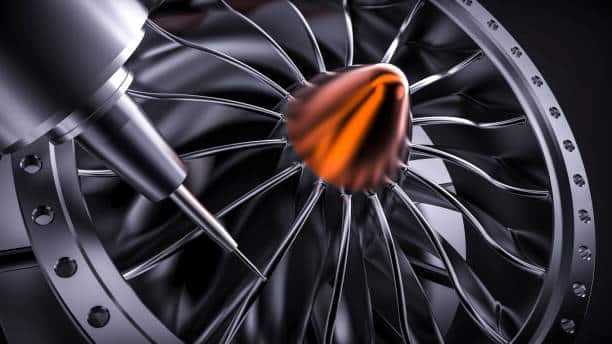
- Aerospace Industry: This process plays a crucial role in this field for producing various components, from turbine blades to fuselages.
- Automotive Industry: It facilitates rapid prototyping and design iterations by providing clean, precise cuts without the need for extensive post-processing. Therefore, it is commonly found in cutting automotive parts, including interiors, glass, and metal sheets.
- Medical Industry: The water jet equipment has greatly increased productivity and cutting speed due to its excellent precision and stringent tolerances. As such, it also finds application in creating a wide range of surgical equipment, such as scalpels, forceps, orthopedic implants, and more.
- Electronics Industry: It is capable of cutting and shaping printed circuit boards without causing thermal damage, ensuring high accuracy.
Other Types of Cutting Technologies
1. Laser Cutting
- Uses a focused, high-energy laser beam to melt and vaporize materials
- Produces very fine, detailed cuts with a small heat-affected zone
- Ideal for cutting thin, delicate materials like metals, plastics, and textiles
- Offers high speed and automation capabilities
- Commonly employed in electronics, consumer goods, and sheet metal fabrication
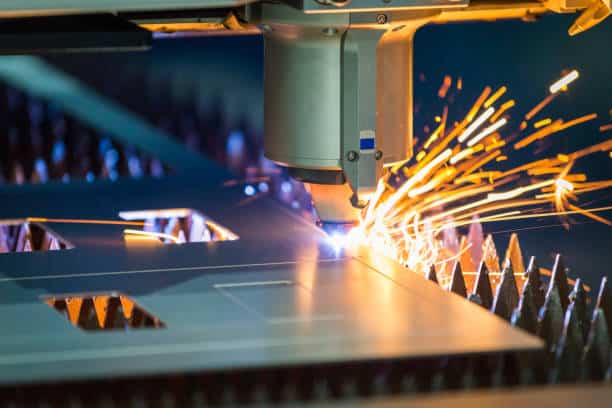
2. Plasma Cutting
- Utilizes a high-temperature, ionized gas jet to rapidly cut through metal materials
- Offers high cutting speeds and the ability to cut thick materials
- Produces a relatively wide kerf compared to other methods
- Can be automated for mass production applications
- Commonly used in steel fabrication, shipbuilding, and construction
3. Electrical Discharge Machining
- Uses electrical discharges to remove material from a workpiece
- Allows for the creation of complex, intricate shapes in hard, conductive materials
- Particularly useful for machining parts with tight tolerances and delicate features
- Reduces the risk of deformation by avoiding direct contact between the tool and the workpiece
- Produces molds, dies, and other precision components in industries like aerospace, automotive, and electronics
4. CNC Machining
- Utilizes computer-controlled tools to mechanically remove material from a workpiece
- Provides excellent dimensional accuracy and surface finish
- Can handle a wide range of materials, from metals to composites
- Suitable for producing complex, three-dimensional shapes
- Finds in aerospace, automotive, and industrial equipment manufacturing
Conclusion
Water jet machining has emerged as one of the fastest-developing machining processes due to its ability to deliver high-quality cuts through a diverse range of materials. Additionally, the process is environmentally friendly, as it does not involve the application of heat.
Due to the high-pressure nature of the waterjet cutting process, industrial applications require careful handling by experienced experts at every stage. Ancastings Precision is a full-service, one-stop rapid prototyping manufacturer, specializing in CNC machining, sheet metal fabrication, rapid injection molding, and a wide range of surface finishing options. Thus, at Ancastings Precision, you can access our professional CNC experts to address all your water jet machining needs. Please feel free to contact our experts and request a free quote for your project requirements.