

Deep draw stamping is a metal forming technique that creates conical, cup, cavity, cylinder frustum, and similar shapes through controlled material deformation. As a specialized stamping process, deep drawing involves a punch and die setup. The raw sheet metal is placed into a die and the counterpart punch pressurizes the sheet to deform into a deep die cavity shape.
The deep drawn metal stamping parts are defined by their ratio between diameter to depth. Typically, the deep-drawn length is higher than its diameter. Some common examples are cookware, sinks, caps fittings, and structural brackets.
Continuing the discussion, we will elaborate on the deep draw stamping process, compatible materials, benefits, application examples, etc.
How Does it Work? The Mechanism
The drawing stamping process uses a specialized press-brake machine that can provide the punch for sufficient descend time and pressure to stretch the sheet metal deep. Especially the height of the die and press should be enough to accommodate the draw depth. Meanwhile, the shape & size of the die cavity and punch are almost identical with a clearance equal to the the worksheet thickness.
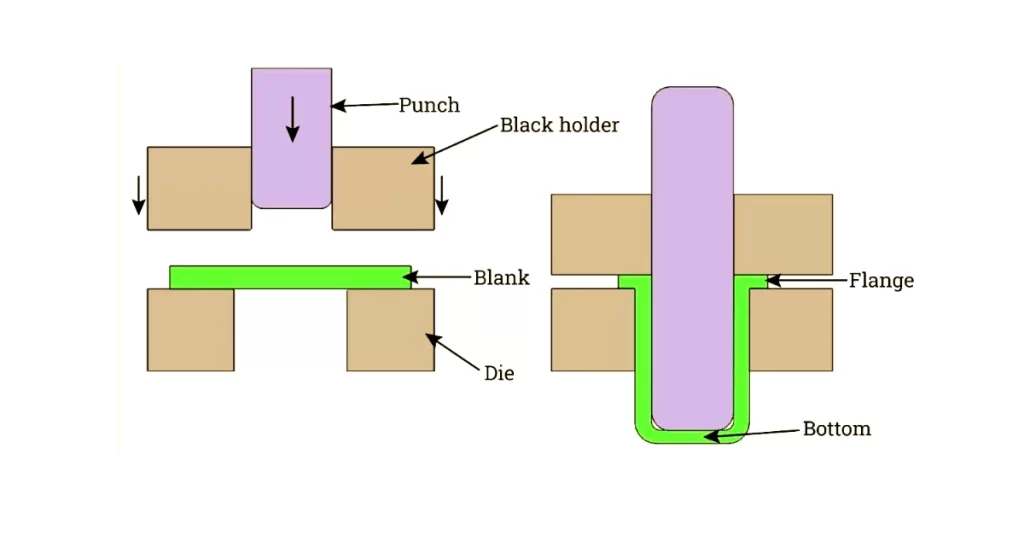
Deep draw stamping mechanism
Based on the capability of press brake or stamping machines, the transfer of sheet and punching process can be manual or automated. The CNC stamping technology automates these steps and streamlines the process.
Furthermore, there are different presses and dies to perform the deep drawing with their own distinct capabilities;
| Type | Description | Application |
| Single-Action Press | A single punch creates a single part in one step | It is suitable for simple designs like shallow cups or cylindrical parts |
| Double-Action Press | Two punches execute forming and redrawing(multiple draws) | Automotive parts or appliances requiring intricate geometries |
| Compound Die | Multiple operations like cutting and bending in a single pressing. | Uses in high-efficiency production like electronic housings. |
| Progressive Dies | Blank is continuously transferred through several stations using a carrier strip. | Used in high-volume runs |
Try Ancastings Now!
The Deep Draw Stamping Process
The following are the steps involved in the deep draw stamping process.
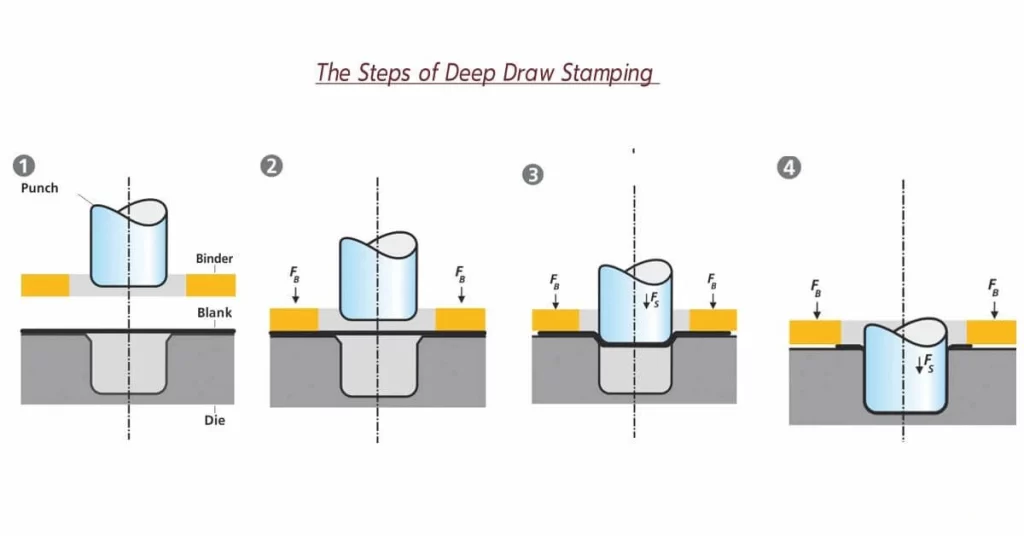
Deep draw stamping steps
- Preparing the Blank Sheet
Choose which type of metal or alloy sheet suits your property needs and prepare the blank sheets to feed into the die. You need to de-coil the sheet and align it with the feeding carrier in a way that continuously supplies the sheet for the process. Here you also need to match the chosen thickness and capability of stamping equipment.
- Sheet Transfer and Punching
In manual machines, operators transfer the material between the die and punch by hand, whereas deep draw stamping companies use automated CNC stamping machines for it. After feeding the sheet, the punch descends and starts to stretch the sheet into a cavity until the desired shape is achieved. In a progressive die system, the sheet moves across different stations for distinct forming operations.
- Ejection of Parts
After completion of deformation, deep drawn metal stamping part is ejected from the setup automatically in CNC machines, and by hand in manual machines.
- Post Processing Operations
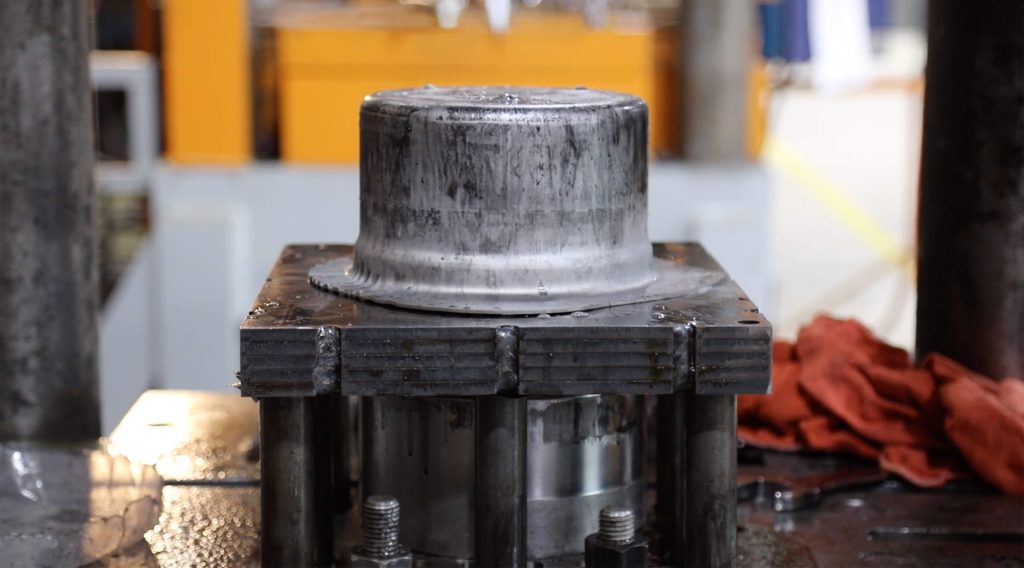
Deep draw machining process
After deep drawing, the parts go for post-machining operations like trimming, piercing, machining, deburring, and sanding to achieve the specified dimensions accurately. Another aspect of post-processing is surface finish. Depending on whether finishes are required for performance or aesthetics, you can choose from powder coating, anodizing, electroplating, painting, etc.
Variables in the Deep Draw Stamping Process
The following are the key variables/parameters of the deep drawing process. These variables influence the results and help to set the die and punch press accurately.
- Holding Pressure: The pressure is applied to hold the sheet metal blank in place during the drawing to prevent wrinkling and allow the material to flow freely at the same time.
- Drawing ratio: The ratio between the blank diameter to the throat diameter
- Radial Clearance: Clearance between the punch and draw stamping die.
- Die Profile Radius: curved edge of the die, larger die radius decreases punch load.
Materials Used in Deep Drawn Metal Stamping
For any material sheet to be deep drawn, it requires a certain level of ductility, anisotropy, and formability. Additionally, a low yield-to-tensile strength ratio is essential to deform the sheet without cracking.
The following are the common deep-draw stamping materials;
Steel
Low carbon and mild steels are used for deep drawing deformation as they provide better ductility and formability than other types. For example, ASTM A1008. Furthermore, there are other market grades for drawing deformations, such as the deep draw and extra deep draw steels (DDS and EDDS).
Stainless Steel
Stainless steel provides more strength than ordinary steel, but the formability is relatively low. Typically, chrome and chrome-nickel variants of stainless steel are suitable for deep drawing. Some common grades are stainless steel 304, 304EDD, and 3DDQ.
Aluminum
Aluminum is a lightweight and malleable metal that offers excellent formability. Aluminum grades like 1100, 3003, 5005, and 5052 are used for drawing stamping projects.
Copper
Copper is known for excellent ductility, electrical and thermal conductivity, and corrosion resistance. You can use beryllium copper, C11000 (pure), C10200, C12200, etc. for deep drawing. Additionally, Brass (Cu +Zn) is a popular copper alloy for this process,
Nickel
Nickel provides high formability at room temperature, which can be deep-drawn into strong and conductive parts. The common grades for deep drawn metal stamping are Nickel 200, 201, and 205.
Moreover, the selection of material for deep drawing requires consideration of serval factors like specific mechanical, thermal, or environmental requirements of the final product. For example, ductility, yield strength, elongation, work hardening, formability temperature, and surface finish.
Benefits of Deep Draw Stamping
Drawing stamping is a seamless metal forming technique, you can get precise and strong parts with computerized machines that automate the process for utmost repeatability. Additionally, it reduces material waste and requires minimal welding or joints.
- Efficient High-volume Production: The automated stamping setup can continuously produce identical parts, especially with the progressive die stations.
- Reduced Assembly: The final deep-drawn parts require minimal processing and assembly. It creates a final part with multiple features from a single blank sheet.
- Repeatability: Each drawn part from a die setup is identical to each other, they are dimensionally consistent across the cycles.
- Material Options: Steel, stainless steel, copper, brass, aluminum, nickel, and other various metals and alloys can be used for deep draw stamping.
- Parts’ Strength: The pressure and deformations enhance the physical and mechanical properties of blank sheets in drawn parts.
Try Ancastings Now!
Applications of Deep Drawing Stamping
The deep drawn metal parts are everywhere from home appliances to military and medical equipment. The production efficiency, accuracy, and repeatability of sheet metal drawing make the process popular for diverse industrial manufacturing needs.
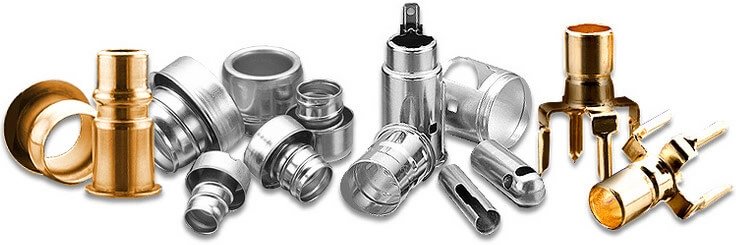
Deep-drawn metal parts
The table below shows the application examples of sheet metal drawing across the industries.
| Industry | Application Examples |
| Automotive | Fuel tanks, exhaust components, engine housings, and body panels. |
| Aerospace | Aircraft panels, fuel systems, and structural supports. |
| Medical Equipment | Surgical instruments, catheter tubes, and syringes. |
| Consumer Electronics | Mobile phone casings, laptop enclosures, and battery housings. |
| Appliances | Washing machine drums, refrigerator panels, and sink basins. |
| Industrial Equipment | Industrial tanks, heavy machinery covers, and pressure vessels |
| Military | Military vehicle panels and protective gear housings. |
Manufacturing MacPro Shell with Deep Drawing

Mac pro shell
One key application example of the deep drawing process is the making of a MacPro shell. Apple production factory mainly uses deep draw, milling, and laser cutting for this. Especially, the deep drawing process makes the basic cylinder shape for the MacPro shell.
The process begins with an aluminum puck, which is placed in the die. Then, the draw stamping punch stretches the punch into the desired depth, creating a fine and precise cylindrical shape. This process forms a uniform thickness and structural integrity across all stretched areas, allowing for the production of durable and lightweight shells.
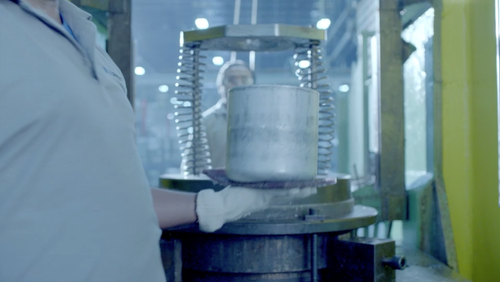
Mac pro shell deep drawing
Furthermore, grinding, polishing, and anodizing are applied to the shell to achieve dimensional accuracy and desired aesthetic.
Is Deep Drawing Stamping Expensive?
Like the standard stamping cost, the cost of drawing stamping is expensive for prototyping and small volumes. The main reason is the high costs of die and punch-press installation. Additionally, for complex shapes, you need to make custom stamping dies for this. For high-volume production, the cost per part is reduced significantly as the die can be reused for up to a million cycles.
Subsequently, the type of press, inclusion of complex features in designs, and desired tolerance also influence the cost. For example, hydraulic and servo presses for deep drawing are more costly than traditional mechanical presses.
Try Ancastings Now!
Get Deep Drawn Metal Stamping Parts at Ancastings
Are you looking for custom deep-drawn metal parts that accurately fit your requirements? If so, Ancastings can be the best option for you. An advanced CNC stamping factory and expert engineers at Ancastings provide high-quality deep-drawn parts for diverse industries. Our custom metal stamping approach can produce features of ribs, flanges, coining, curls, embossed, extrudes, holes, tabs, and notches.
So, request a quote for the stamping service and leverage our expertise for your projects!