
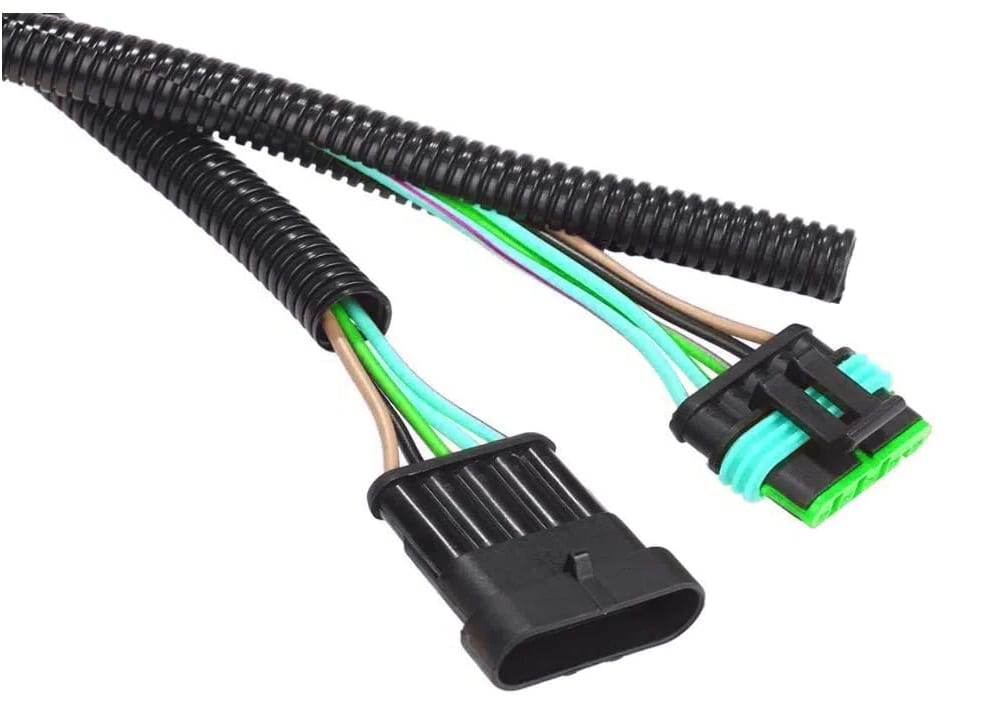
Plastic products see everywhere in our daily lives due to their cost-effectiveness, lightness, and durability. The plastic extrusion technology, nevertheless, plays a crucial role in the production of these ubiquitous plastic parts.
Therefore, this article will delve into plastic extrusion in detail, covering its definition, different types, as well as widespread applications. The aim is to provide you with a comprehensive understanding of this important manufacturing technology.
What is Plastic Extrusion?
Plastic extrusion involves a continuous manufacturing process of molten plastic. It can extrude thermoplastic materials into products by heating and forcing the material through a specific extruder. As such, this process is commonly employed in the manufacturing of pipes, films, and cable insulation.
Typically, the plastic extruder consists of several parts, from the hopper to the cooling system. Let us explore these structures more extensively.
- Hopper: It is responsible for storing and reliably transmitting powdered or pelleted materials to other parts of the extruder.
- Feed-throat: This part connects the hopper to the barrel, channeling plastic materials from the hopper to the barrel.
- Screw: It is the core component of the extruder. It rotates inside the barrel, pushing the material forward and plasticizing it.
- Barrel: The barrel surrounds the screw and usually consists of high-temperature and wear-resistant materials to contain and heat the material.
- Breaker Plate: Known as a perforated plate, it functions to effectively disperse and regulate the plastic melt entering the die head.
- Die: The plastic extrusion die, situated at the extruder’s frontier, shapes plastic into specific sizes and forms. It comes in various shapes like round, rectangle, or some intricate geometric designs.
- Heating System: Heating the inside of the barrel to ensure that the material reaches the appropriate plasticizing temperature.
- Cooling System: Cooling the product to prevent overheating and keep the product size stable.
- Die: Located at the end of the extruder to determine the final shape of the plastic product.
- Drive System: This system includes a motor and a reducer that drives the screw, allowing it to rotate and adjust its speed based on the process requirements.
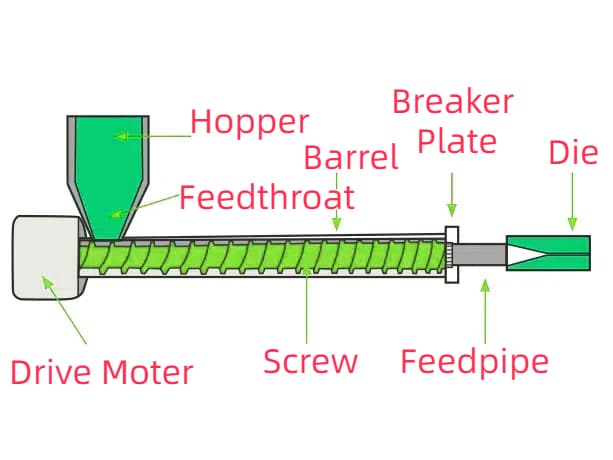
These components work together to enable the plastic extrusion machine to effectively produce plastic products that meet the requirements.
How Plastic Extrusion Works?
In the previous section, we gained a foundational understanding of the plastic extruder structure, which will assist us in comprehending its operation. In this section, we will explain how it works.
- Plastic extrusion begins with feeding plastic pellets or powders into a heated barrel.
- Then the barrel gradually melted and compressed materials by a rotating screw.
- The molten plastic is forced through a shaped die.
- Next, the cooling system immediately solidifies them into a continuous profile.
- A puller mechanism then draws the extruded plastic away, maintaining uniformity in shape and size.
- Depending on the application, the product may be cut into desired lengths or coiled onto reels.
- At last, some extruded products may require additional processes such as printing or punching holes.
The key steps in the plastic extrusion process are: feeding the raw plastic, melting and compressing it, forcing it through a die, cooling the extruded shape, and collecting the final product.
Types of Plastic Extrusion Process
The working principles are quite similar across various types of plastic extrusion processes. Here are four common types of plastic extrusion processes:
Tubing Extrusion:
This method is suitable for producing plastic hollow pipes, such as water pipes or gas pipes. Typically, it utilizes a pin or mandrel inside the die to apply pressure, which allows for the creation of hollow products. Additionally, the ability to adjust the air pressure renders more convenient control over the diameter of the holes.
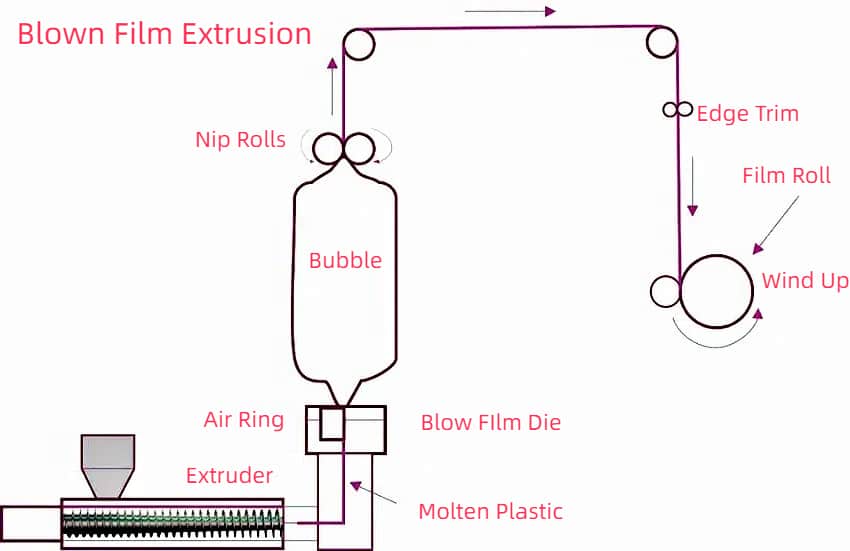
Blown Film Extrusion:
Blown Film Extrusion acts to produce plastic films, from plastic bags to agricultural mulch. First, the plastic is melted into a thin sheet, then blown into a film, and finally cooled and solidified. In addition, this mold features an upright cylinder with a circular opening, whose diameter ranges from a few centimeters to more than three meters.
Sheet Film Extrusion:
Similar to the blown film extrusion, it can produce thicker plastic sheets or films. Further, it achieves desired requirements, involving surface texture and thickness, through the rolling and pulling technology.
Over-Jacketing Extrusion:
Over-jacketing extrusion is used to wrap wires, cables, or other objects with a protective layer. There are two primary types of plastic tooling, jacketing, and pressure tooling. Ordinarily, jacketing tools are used when a tight fit between the plastic material and the wire is not required, while pressure tools are the opposite.
These extrusion processing methods have their own characteristics and are suitable for different products and application scenarios.
Types of Plastic Extruders
According to the structural characteristics, plastic extruders can be divided into three types.
- Single-Screw Extruder: As the name suggests, this kind of extruder consists of a single rotating screw. It is well-suited for processing most general-purpose plastics, from pipes to sheets.
- Twin-Screw Extruder: Consists of two intermeshing screws and is suitable for processing high-performance plastics. Additionally, it provides better mixing and plasticizing effects, like stability and excellent exhaust performance.
- Multi-Screw Extruder: It’s comprised of three or more screws, typically used for processing specialized materials such as rubber and thermoset plastics.
Plastic Extrusion Materials
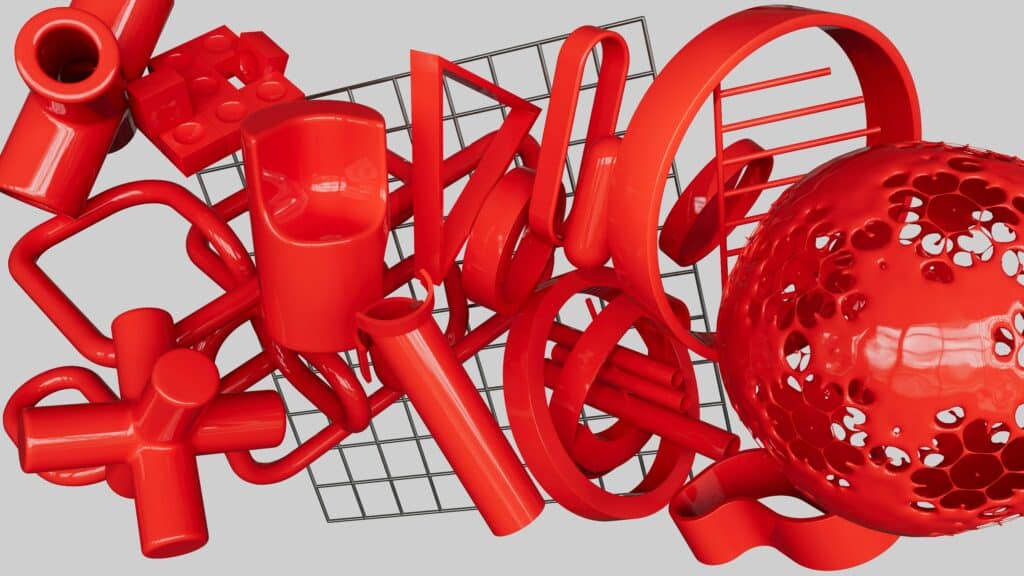
These materials have different physical and chemical properties, so they can be used in a variety of different fields. The following are some common plastic extrusion materials and their characteristics:
| Type of Plastics | Characteristic |
| Polyvinyl Chloride (PVC) | Corrosion-resistant, Insulating, Versatile |
| Polyethylene (PE) | Flexible, Low-temperature resistant, Packaging |
| Polypropylene (PP) | High-temperature resistant, Anti-corrosive, Easy to process |
| Polycarbonate (PC) | High strength, Transparent, Weather-resistant |
| Polyamide (PA) | High strength, Wear-resistant, Toughness |
| Polystyrene (PS) | Transparent, Insulating, Easy to process |
| Acrylonitrile Butadiene Styrene (ABS) | Tough, Waterproof, Glossy |
| Acrylic | Clear, Durable, Versatile |
| Thermoplastic Vulcanizate (TPV) | Wear-resistant, Tear resistance, Low-temperature flexibility |
Comparison Chart
| Material Name | Heat Stability | Chemical Resistance | UV Resistance | Rigidity | Cost |
| ABS | Fair | Poor | Poor | High | Medium |
| PVC | Poor | Poor | Poor | Varies | Medium |
| Low Density Polyethylene (LDPE) | Poor | Good | Poor | Poor | Low |
| High Density Polyethylene (HDPE) | Fair | Good | Fair | High | Low |
| PETG | Poor | Excellent | Good | Medium | Medium |
| UHMW PE | Poor | Good | Poor | Medium | Low |
| Polypropylene (PP) | Excellent | Excellent | Poor | High | Low |
| Nylon | Excellent | Excellent | Fair | High | High |
| Polycarbonate (PC) | Excellent | Fair | Excellent | High | High |
Pros and Cons of Plastic Extrusion
Plastic extrusion yields a great number of benefits in a wide range of applications. However, it also has some limitations requiring strict process control and equipment maintenance.
Advantages:
- High production efficiency and continuous production.
- Applicable to various thermoplastics and a wide range of products.
- Can achieve complex cross-sectional shapes and structures.
- Provides relatively low production cost and enables automated production.
Disadvantages:
- Requires high requirements for raw materials and strict control of temperature and pressure parameters.
- Not suitable for the production of small batches or personalized products.
Applications of Plastic Extrusion
Plastic extrusion molding is widely used, covering many fields such as daily life, industrial manufacturing, and medical industry.
- Pipes and Tubing: Water pipes, wire pipes, and drain pipes.
- Profiles and Shapes: Door and window profiles and decorative strips.
- Films and Sheets: Packaging, building materials, and other fields.
- Wire and Cable Coating: Protective plastic outer layer to wires and cables.
- Packaging: Plastic bags, containers, and other packaging products.
- Construction Materials: Plastic profiles, sheets, and other building decoration materials.
- Automotive Parts: Automotive interiors and bumpers.
- Medical Devices: Medical packaging and housing.
Plastic Extrusion VS. Injection Molding
| Plastic Extrusion | Injection Molding | |
| Production Efficiency | Continuous process, highoutput, suitable for mass production | Shorter cycle time, suitable for small-batch and complex-shaped production |
| Product Shape | Suitable for producing 2D products | Suitable for producing 3D products |
| Material Applicability | Suitable for thermoplastic materials | Suitable for both thermoplastic and thermoset plastics |
| Production Cost | Low | High |
| Product Precision | Low | High |
Conclusion
In summary, as an important plastic processing technology, plastic extrusion has a wide range of applications in various fields. Through this comprehensive guide, I believe readers will acquire valuable information in plastic processing or plastic product manufacturing.
Furthermore, Ancastings Precison offers high-quality CNC machining services to ensure you get perfectly formed plastic items for your engineering needs. We have experienced machinists who utilize advanced plastic extrusion techniques and equipment to deliver precise. Please feel free to contact us or ask for an instant quote.
Other articles you may be interested in :
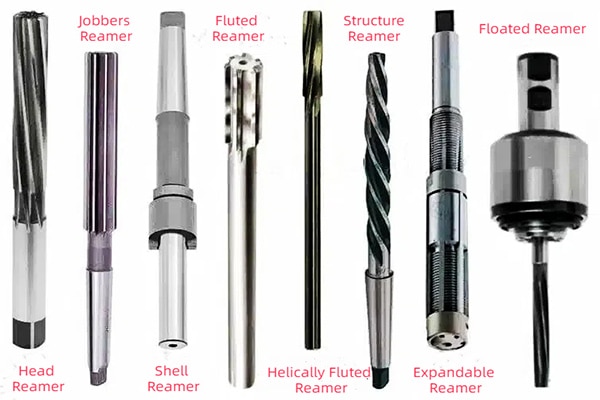
Guide to Reaming: Processes, Tools, and Applications
Reaming, a finishing process or hole machining, plays an essential role in the accuracy and surface quality of machined parts. Furthermore, this technology is widely employed across diverse industries due to its several benefits like dimensional control. Therefore, this article … Read more