
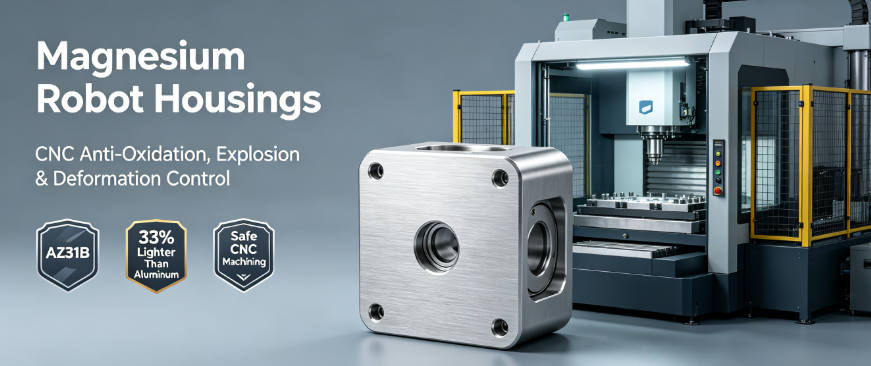
Magnesium alloy (most commonly AZ31B for robotic applications) delivers exceptional lightweight performance for robot and medical device housings. It is approximately 33% lighter than aluminum alloy, with excellent vibration‑damping characteristics that benefit high‑speed moving robotic assemblies. For European, North American, Japanese and Australian medical robot and humanoid robot OEMs, magnesium alloy housings can effectively reduce overall system inertia, lower servo motor load and improve dynamic response of moving equipment.
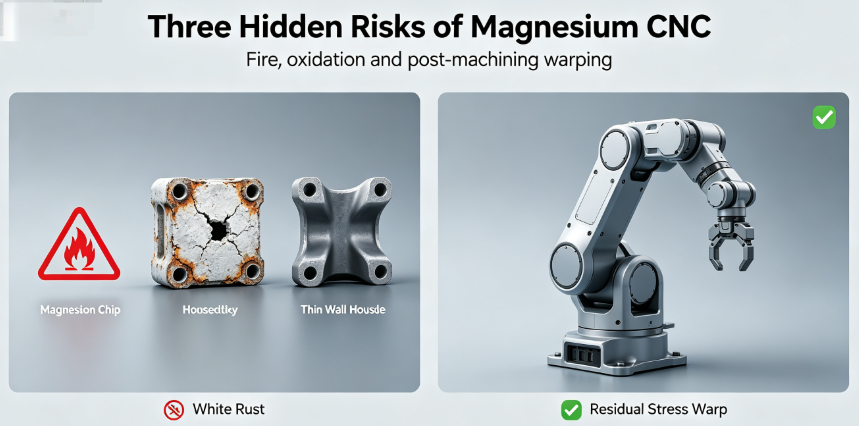
However, magnesium is a highly reactive metal. Three major technical barriers frequently derail housing projects: explosion and fire hazards during CNC machining, rapid surface oxidation and corrosion after processing, and dimensional warping caused by residual stress and high thermal expansion coefficient. A large number of machine shops refuse magnesium orders because they lack dedicated safety and process protocols. Even those who accept magnesium work often apply aluminum‑alloy machining parameters, resulting in scrap parts: oxidation rust, dimensional distortion, or even machining‑site safety incidents. This is the core blind spot of most competitors. Ancastings’ end‑to‑end CNC workflow for magnesium robot housings systematically addresses explosion‑proof production, anti‑oxidation protection and deformation prevention to deliver stable, reliable magnesium enclosure components.
Why Magnesium Alloy Is Attractive for Robotic & Medical Housings
Compared with aluminum and die‑cast zinc, magnesium alloy offers unique material advantages for lightweight enclosures. Its low density reduces overall equipment weight, while good vibration absorption reduces mechanical noise during continuous robotic operation. For portable medical devices and mobile humanoid robots, lower housing weight directly translates to extended battery runtime.
Yet these benefits come with inherent material risks. Magnesium chips and fine dust generated during CNC milling are highly flammable. Water‑based coolant must never be used for magnesium machining, as water reacts with burning magnesium to produce explosive hydrogen gas. Raw‑machined magnesium surfaces oxidize quickly in humid ambient air, forming white rust within days without proper surface treatment. Furthermore, magnesium’s high thermal expansion coefficient (26 μm/m·°C) means temperature fluctuations during processing cause significant dimensional shift, and residual cutting stress will trigger post‑machining warping on thin‑wall housing structures. These challenges cannot be solved by simple tooling changes alone; they require dedicated, standardized manufacturing procedures.
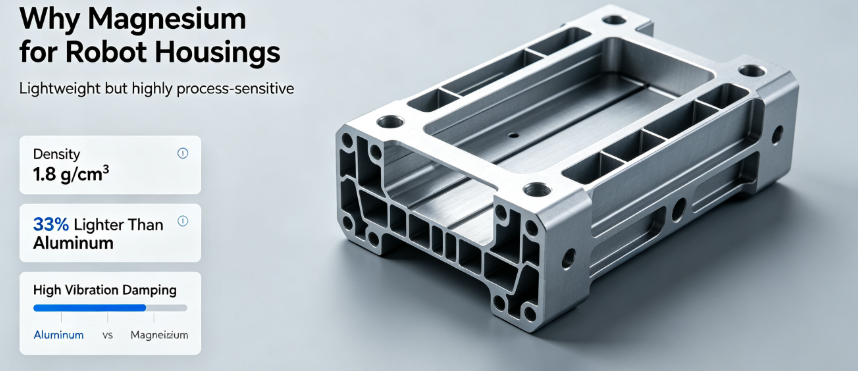
Three Critical Risks of Magnesium Robot Housing CNC Machining
Risk 1: Combustion & Explosion Hazard During Milling
Solid magnesium billet is stable under normal conditions. The danger comes from fine chips and dust produced by cutting. Dull cutting tools cause friction‑generated heat, which can ignite magnesium swarf. Magnesium fires cannot be extinguished by water or CO₂ fire extinguishers, requiring specialized Class‑D combustible‑metal fire suppression equipment. Many general‑purpose CNC workshops are not equipped for magnesium processing, leading to safety hazards and high scrap rates.
Risk 2: Rapid Oxidation & Corrosion of Machined Surfaces
Magnesium is chemically active. Once the protective oxide layer is removed by CNC cutting, the fresh bare metal surface will react rapidly with moisture and oxygen in the air. Without timely anti‑oxidation surface treatment, white powdery corrosion appears on housing surfaces, ruining assembly fit, cosmetic appearance and long‑term service life for robot and medical enclosures. Many suppliers delay post‑processing for weeks, leading to hidden corrosion defects before customer delivery.
Risk 3: Residual‑Stress‑Induced Deformation & Dimensional Drift
Robot housings usually adopt thin‑wall designs for lightweight goals, with wall thickness often between 1.5 mm‑2.5 mm. Magnesium’s low elastic modulus makes thin‑wall structures very sensitive to cutting‑induced residual stress. Parts may pass dimensional inspection right after machining, but warp gradually days later after being unclamped, exceeding drawing tolerance. High thermal expansion further amplifies dimensional deviation when workpiece temperature rises during milling. This is one of the most‑common hidden failure points for magnesium robot housing projects.
Ancastings’ Complete CNC Workflow for Magnesium Robot Housings
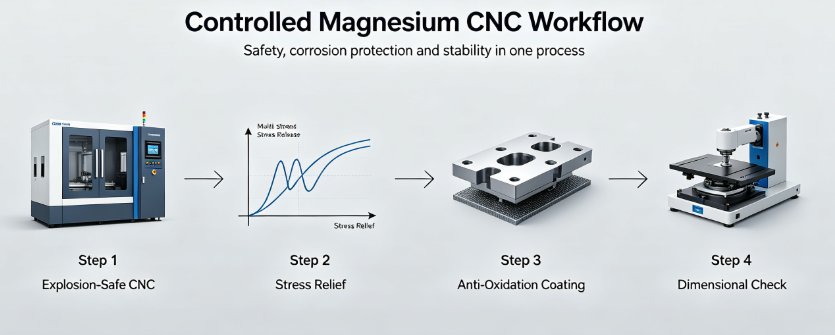
Ancastings’ magnesium‑housing manufacturing system integrates explosion‑proof machining protocols, multi‑stage stress‑release, strict anti‑oxidation time‑management and precision inspection. This process is built for AZ31B and other magnesium alloys used in medical and robotic enclosure applications.
Step 1: Explosion‑Safe Dedicated CNC Machining Setup
We use dedicated isolated CNC cells for magnesium processing. Water‑based coolant is strictly forbidden; mineral‑oil‑based cutting fluid is deployed to control cutting‑zone temperature and avoid hydrogen‑gas risk. Sharp polished carbide tools are applied to minimize friction heat. High‑volume chip evacuation systems continuously remove magnesium swarf into sealed fire‑proof collection bins. Every magnesium‑processing station is fitted with Class‑D fire‑suppression equipment to comply with global combustible‑metal safety standards (NFPA 484). Our operators receive specialized magnesium‑machining safety training.
Step 2: Multi‑Stage Stress‑Release to Prevent Post‑Machining Deformation
retain 1‑2 mm machining allowance and perform stress‑relief thermal treatment. Semi‑finishing is followed by vibration‑based stress‑release processing. Final finishing is completed in a temperature‑controlled workshop environment. Parts are cooled fully to room temperature before final CMM dimensional measurement, eliminating thermal‑expansion‑caused dimensional drift. This prevents parts from warping weeks after delivery, a frequent failure in competitor projects.
Step 3: Timely Anti‑Oxidation Surface Treatment
All magnesium housing parts must enter anti‑oxidation surface treatment within 48 hours after CNC machining to stop white‑rust formation. Common options for robot and medical housings include non‑chromate conversion coating, micro‑arc oxidation (MAO), or anodizing. We calculate coating‑thickness compensation for mating surfaces during DFM review to guarantee assembly fit. Proper surface treatment delivers long‑term corrosion resistance for housings operating in humid industrial or medical environments.
Step 4: Precision Inspection & Document Delivery
Every magnesium robot housing undergoes CMM coordinate‑measuring inspection. Critical assembly features are controlled to tight tolerances. We provide ISO 9001 material certificates, DIN EN 10204 3.1 material test reports and FAI first‑article inspection reports for European, North‑American, Japanese and Australian customers. All documentation supports medical‑device and robotics‑OEM factory‑audit requirements.
Request Free DFM Evaluation for Your Magnesium Robot Housing Project
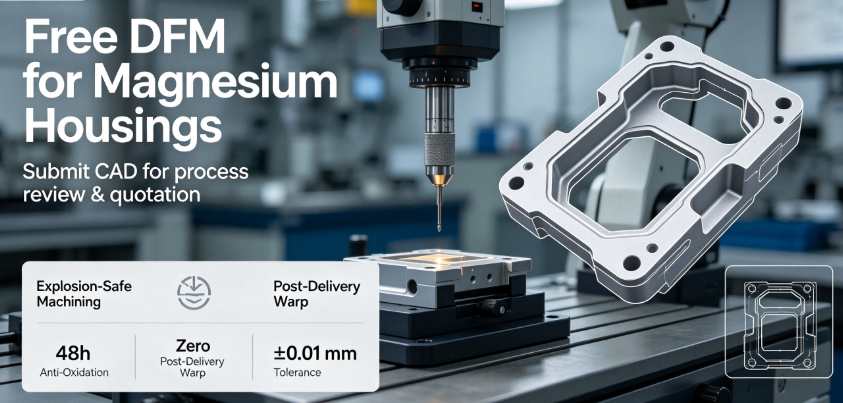
If your engineering team is developing lightweight magnesium enclosures for medical robots, humanoid robots or portable medical equipment, and you are concerned about machining‑safety, oxidation or post‑machining warping, Ancastings can deliver professional manufacturing assessment and quotation.
Share your STEP/CAD drawings. Our engineering team will conduct DFM review, evaluate magnesium‑CNC feasibility, suggest optimal anti‑oxidation surface treatment options, and provide lead‑time and cost proposal for prototype and low‑volume production.