
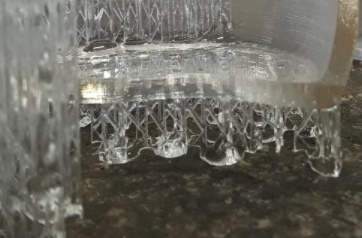
SLA is able to produce very fine details and features as small as 0.3 mm. This technology always produce very small parts, and require orientation at an angle. This need support structures to attache on the parts surface, leave marks on surface and create uneven surfaces. However, most SLA resins are easily post processed. SLA parts are suitable for a wide range of finishing options, we will describe the most common ways as following:
| Finish type | Visual rank | Tolerance | Speed | Applied area |
| Basic removal | Low | Medium | High | All SLA parts |
| Nibs sanding | Low | Medium | Medium | All SLA parts |
| Wet sanding | Medium | Medium | Medium | All SLA parts |
| Mineral oil finish | Medium | Medium | Medium | All SLA parts |
| Spray painting | Good | Low | Low | All SLA parts |
| Clear transparent polishing | Excellent | Low | Low | Clear resin parts |
Basic Removal
Process: support structure is cut off or broken form SLA parts, and leave a bumpy surface with support materials. High quality surface requires at least 0.1mm extra materials, then sanding afterwards for better dimensional accuracy.
| Finish type | Advantage | Disadvantage |
| Basic removal | Complete control of finishes
Drilling on vertical for high accuracy High accuracy for overall geometry |
Not aesthetic
High level of skills |
Nibs Sanding
Process: only small support nibs need to be sanded. This process is most suitable for flat surface. In reason of this process only sand support nibs area, there is no effect on the overall geometries.
| Finish type | Advantage | Disadvantage |
| Nibs sanding | Accurate surface
Matte finish |
Uneven surface on side area
Not aesthetic |
Wet Sanding
Process: Wet sanding is able to provide the smoothest surface finish, which depend on sandpaper graduations. On unsupported side, we just need to sand the build lines, this process only require a single high grade sandpaper. On supported side, this process is more labor intensive, it requires at least 4 sandpaper graduations. So we recommend that the support structure should be placed on the least visible part. There will be some accuracy loss as materials is removed at support placement.
| Finish type | Advantage | Disadvantage |
| Wet sanding | Excellent smooth finish
Perfect for complex geometries Best surface preparation for painting |
Lower accuracy at supported area
Result white or light spots |
Mineral Oil Finish
Process: This process is similar to wet sanding, just add a mineral oil layer after sanding process. This mineral oil will hide the white or light spot on parts surface, in order to create a nice even finish. This surface finish is most suitable for mechanical parts with fiction reducing and surface lubrication.
| Finish type | Advantage | Disadvantage |
| Mineral oil finish | Semi transparent finish for clear resins | Not suitable for paint adhesion |
Spray Painting
Process: Spray painting will conceal layer lines, in order to reducing the sanding of unsupported area. In addition, it will also limit UV exposure, and avoid yellowing and post curing on parts. Acrylic paint cannot adhere well on flexible resin surface, so a glossy thin layer will need on parts surface. However, this will affect parts tolerance and details dramatically.
| Finish type | Advantage | Disadvantage |
| Spray painting | Clear finish on complex geometries
UV protection |
Orange peel on surface
Increase overall dimensions Not suitable for sliding or moving parts |
Clear Transparent Polishing
Process: SLA parts will be sanded by increased grit levels of sandpaper, then polished with polishing compound. This will get the most clear surface, but it is very time consuming and only possible for easy sanding surfaces. This finish is most suitable for simple shapes with less details, but less suitable for complex geometries parts.
| Finish type | Advantage | Disadvantage |
| Clear transparent polishing | Clear finish
Very smooth surface |
Labor intensive
Not suitable for complex geometries |