
“Sheet metal gauges are the heart of sheet metal measurement in manufacturing. Since it is impossible to measure each sheet’s thickness with a conventional measurement tape, sheet metal gauges are used in this situation. In essence, a gauge represents the thickness of the sheet metal and can be expressed in millimeters or inches. Except for zinc, higher gauges represent thinner metal sheets.”
There are different Gauges for a specific material, stainless steel, galvanized steel, sheet steel, brass, aluminum, and copper. Among these Sheet metal gauges for steel are the standard ones in manufacturing, which is based on the idea that an inch of steel weighs 41.82 pounds per square foot.
The gauge system does not fall under the standard metric system. Therefore, it is an entirely independent system for typical sheet metal thickness measurements. However, with the conversion chart’s help, engineers and mechanists can convert the gauge thickness into inches or millimeters.
In this article, we will briefly overview the use of sheet metal gauges, various factors that need to be considered, the selection of gauge number, and its advantages & disadvantages.
Gauge Number and Thickness Chart
The various gauge numbers and the corresponding thickness of each type of metal are listed on a metal gauge chart. It is used in CNC machining to verify the material choice and consistency.
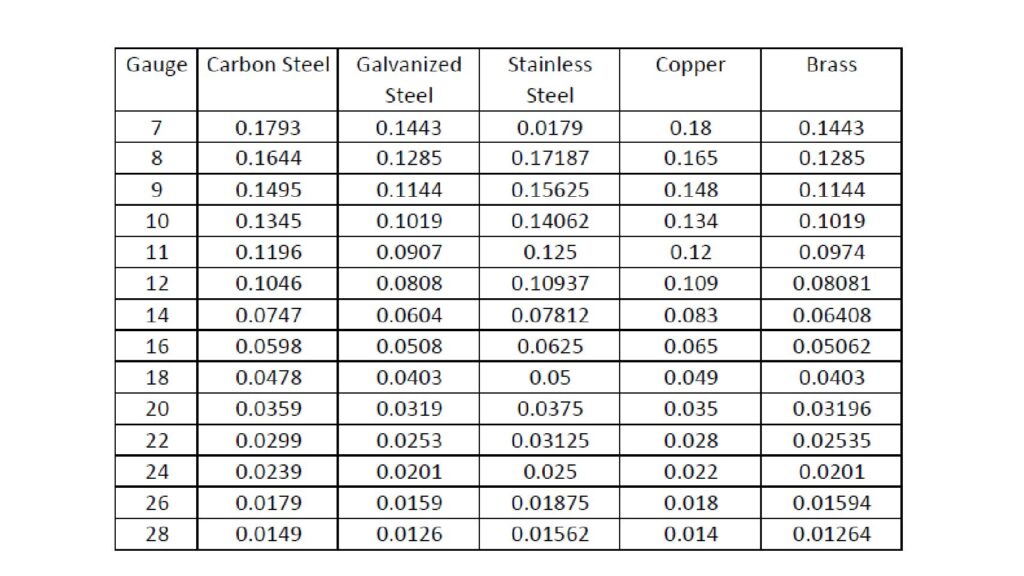
A portion of thickness chart
Using the correct gauge chart for each material is important in sheet metal design because the same gauge number does not represent the same thickness across different metals. For example, 10-gauge aluminum is 2.588 mm thick, 10-gauge stainless steel is 3.510 mm, and 10-gauge galvanized steel is 3.571 mm. Choosing the right gauge helps ensure accurate dimensions and proper material selection.
The gauge standard is based on the weight of the sheet for the specific material. Among the gauges for various materials, Manufacturers’ Standard Gage offers thicknesses for standard, galvanized, and stainless steel.
- Brown and sharp gauge: It is the American standard gauge, applicable for nonferrous material sheets such as brass, aluminum, copper, and tin.
- Birmingham Gauge: It is the United Kingdom standard gauge that is applicable for strips and tubes, and a higher number denotes a thicker sheet in terms of zinc.
Try Ancastings Now!
How to Use Sheet Metal Gauges?
1. Verifying the thickness with gauge number
With the help of a millimeter hash, mark the measuring tape. According to the mark you made, note the obtained thickness. Be careful; there are two units in the measuring tape: millimeter (mm) and centimeter (cm).
Change the thickness into inches. You can multiply your noted millimeter by 0.03937 to obtain it into inches. For example, if your measuring tape gives 30 mm, it will be 30 x 0.03937 = 1.1811 inches.
After getting the measuring thickness into inches, look at the gauge chart of the material and find the nearby gauge number.
2. Using the wheel gauge for thickness measurement
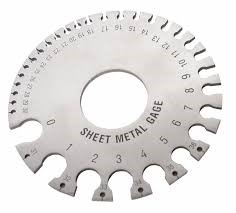
Wheel-gauges
Choose the appropriate gauge wheel first, depending on whether you are measuring ferrous or nonferrous metals because there are different gauge wheels for measuring ferrous and nonferrous materials. Nonferrous and ferrous metals are labeled in front of the wheel.
3. Wheel gauge
The gauge has gaps of various sizes with labels for thickness on the front. Check your sheet by inserting it into each opening and adjusting it until it is the best fit. After the sheet has the perfect fit on the gap, take note of the thickness label on the front.
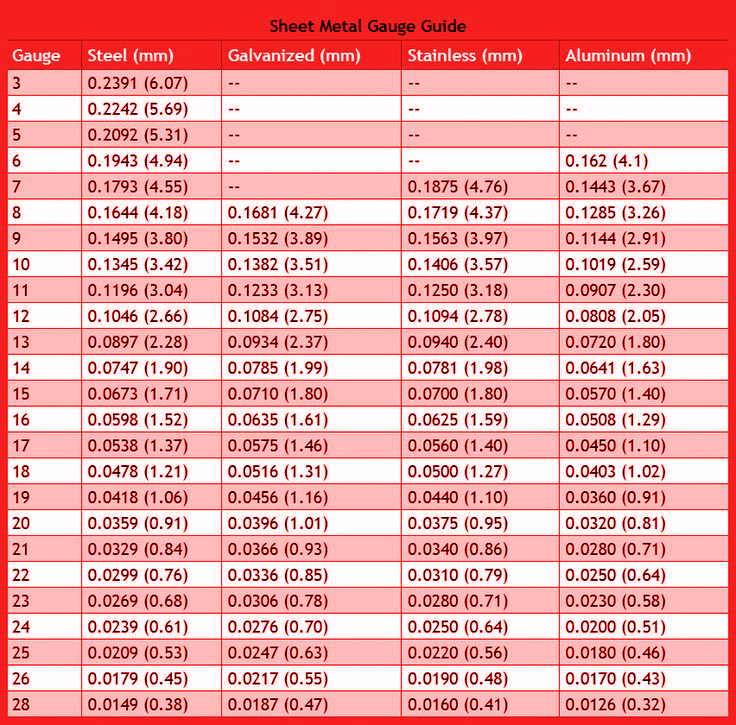
Sheet metal gauge chart
Selection of Correct Gauge Number in Manufacturing
The selection of a proper gauge for sheet metal plays a vital role in manufacturing. It ensures the functionality as well as the economy of the parts to be fabricated.
The following factors should be taken into account by a designer and a mechanic when choosing the gauge number.
- Strength: Because the sheet with a lower gauge would be more rigid and strong, it is also necessary to consider the required strength, rigidity, and other mechanical properties when choosing the gauge.
- Performance & Suitability: The performance and effectiveness of the manufactured project and the sheet’s workflow are determined by the ideal thickness of the sheet. Therefore, the engineer must consider performance and suitability when choosing the appropriate gauge of sheet metal during the design phase.
- Installation site: There is a high risk of wear and tear of the sheet metal components and entire product made of sheet metal if the installation site is in an open environment, so thinner material will be required. A lower gauge would be better in these circumstances.
- Economics: Budget constraints are another consideration when choosing a gauge because thicker sheets cost more. After all, the thickness of the sheet metal will determine its weight. Therefore, the cost-effective gauge should be selected while keeping the mechanical properties and required specifications.
Try Ancastings Now!
Advantages and Disadvantages of Sheet Metal Gauge
There are several advantages of sheet metal gauge in the manufacturing industry because it is a very straightforward approach to measuring and confirming the thickness. Let’s look at some of the prime advantages in brief;
- Rapid procedure: Direct measurement takes much longer than measurement with a sheet metal gauge. As a result, it cuts down on manufacturing-related inspection time.
- Low skill level: Semi-skilled laborers can also use this system to ensure thickness because the gauge is a straightforward measurement process.
- Mass production: Have you ever thought about how workers and engineers can guarantee the thickness of the product produced in large quantities? In contrast to direct measurement, using a gauge allows them to quickly and efficiently ensure the dimensional stability of a large number of products.
- Cost: Gauges are affordable on their terms, and because they can be inspected more quickly, the inspection cost will also decrease.
Disadvantages
- Wear and tear on the sheet metal gauges can lead to errors in the thickness measurement.
- In many cases, It does not provide a sheet metal’s precise thickness value.
- It requires using different sheet metal gauges for ferrous and nonferrous sheets.
Quick Tips for Using an Aluminum Sheet Metal Gauge Chart
Below, we have listed some helpful tips for using the sheet gauge for aluminum effectively.
Determine Your Project’s Requirements
Before utilising the aluminum sheet metal gauge chart, determine the requirements of your project. Determine the level of strength, weight, and durability. Once these parameters are identified, they will help you select the proper gauge to meet the performance requirements of your design without wasting material.
Select the Proper Gauge
Utilise the chart to identify the aluminum sheet metal gauge that corresponds to the desired thickness. As previously stated, the higher the gauge number, the thinner the aluminium sheet metal. Therefore, select the indicator accordingly based on the structural requirements of your design.
Compare with Other Materials
Many aluminum sheet metal gauge charts also compare to steel or galvanised steel. Comparing the gauges of aluminium to those of other metals will assist you in understanding the differences in strength and flexibility of aluminium compared to different types of metal.
Verify Measurements Carefully
Double-check your measurements against the chart before proceeding with your application. Minor variations in thickness can significantly impact the ability to bend, weld, or finish your application; therefore, accuracy is critical for achieving professional results.
Consider the Application
Determine how the sheet metal will be utilised within your design. Different enclosures, brackets, or panels may require different thicknesses of aluminium sheet metal. It’s recommended to match the gauge of your sheet metal to the intended application of your design.
Confirm with Your Supplier
After determining the proper gauge, contact your supplier to verify that the material you have ordered meets the specifications you provided. This will ensure that there are no surprises and that your project progresses smoothly from design to completion.
- Quick Selection Checklist for Aluminum Sheet Metal
- Decide how strong your piece needs to be for the job.
- Consider how you will bend, weld, or fasten it.
- Choose a finish that works for your design or use.
- Check the weight you want the sheet to achieve.
- Make sure your supplier can provide the thickness you need.
- Compare costs and choose a gauge that fits your budget.
Conclusion
Sheet metal gauges are a crucial component of the manufacturing process for ensuring material thickness and selection. For each type of sheet material, there is a different gauge chart from which engineers and mechanics can compare the results of their measurements and select the appropriate gauge number.
You can receive any necessary consultation regarding the sheet metal gauge system at Ancastings. We are a leading sheet metal service provider and offer professional services such as cutting, punching, bending, welding, etc. If you require any related services, don’t hesitate to contact us.
FAQ’s
What are the uses of sheet metals?
Sheet metal has applications in various industries, from automotive and aircraft to construction.
What is the primary purpose of sheet metal gauges?
A sheet metal gauge system is used to measure and certify the thickness and selection of material type.
Is there a different gauge for ferrous & nonferrous metal sheets?
Yes, there are separate gauges for Ferrous and nonferrous metals. In fact, according to the material (Steel, aluminum, copper, and brass), there is a different chart for gauge numbers and their corresponding thickness.
What factors should be considered while selecting metal sheet thickness (gauge)?
There are several factors, such as strength, effectiveness, cost, and installation site.
What does it mean by a lower gauge number?
The lower gauge number represents the higher thickness of the metal sheet (Except for Zinc).