
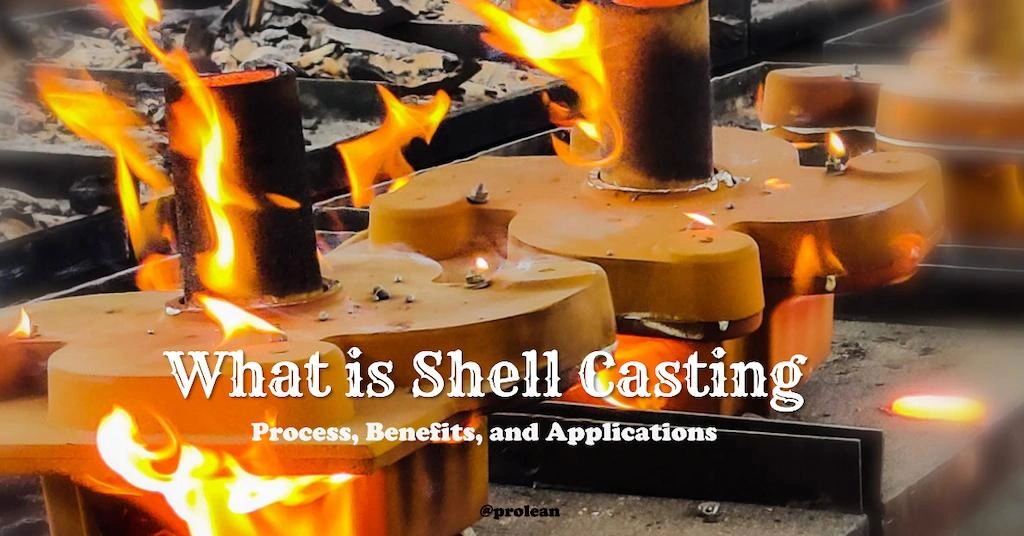
“Manufacturers use multiple casting techniques to shape the metal parts, including squeeze casting, sand casting, centrifugal casting, lost foam casting, and shell casting. Particularly, we will discuss shell casting here”
Shell casting, shell molding, or shell mold casting is the process of shaping metal and alloy parts in a sand mold infused with resins like phenolic. The additional resin provides a hardshell for shaping molten metal, enhancing both surface finish and casting speed.
Although shell molding is similar to sand casting, it has differences in the formation of the outer surface or covering shell. The faster production and minimal post-processing requirements make this method favorable for numerous industrial applications.
This article will discuss what is shell mold casting, the step-wise process, benefits, application, etc. Let’s start!
What is Shell Mold Casting?
First, why it is called shell mold casting? The reason is that the mold resembles a “shell structure” by placing the heated pattern into resin-infused sand. The resin melts and forms a hard shell with detailed cavities.
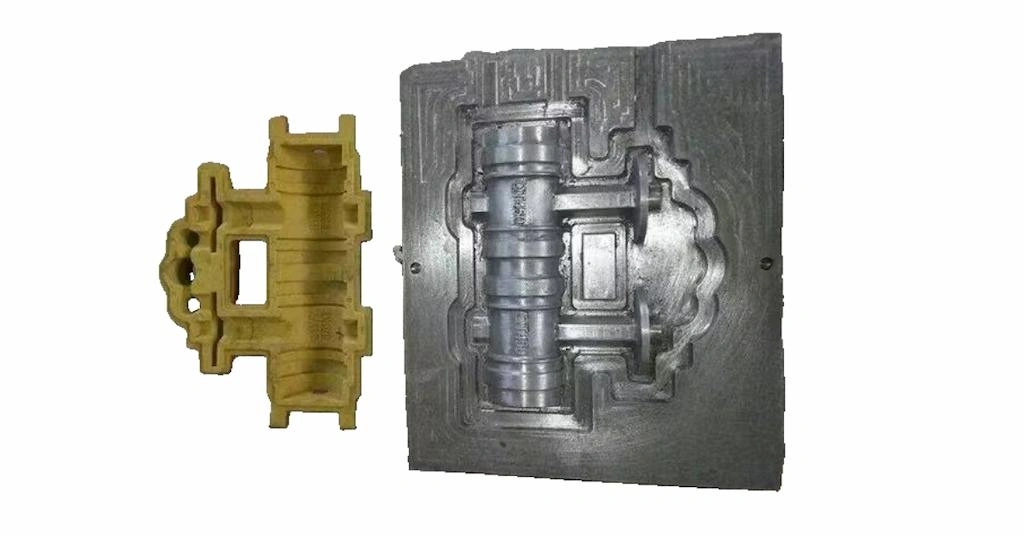
Shell mold and casting process
The shell molding process is compatible with both ferrous and non-ferrous metals with relatively low melting points like aluminum, cast iron, steel, copper, and brass.
“It is a precision casting method, in which a thin resin-bonded sand mold is used to produce intricate metal parts.”
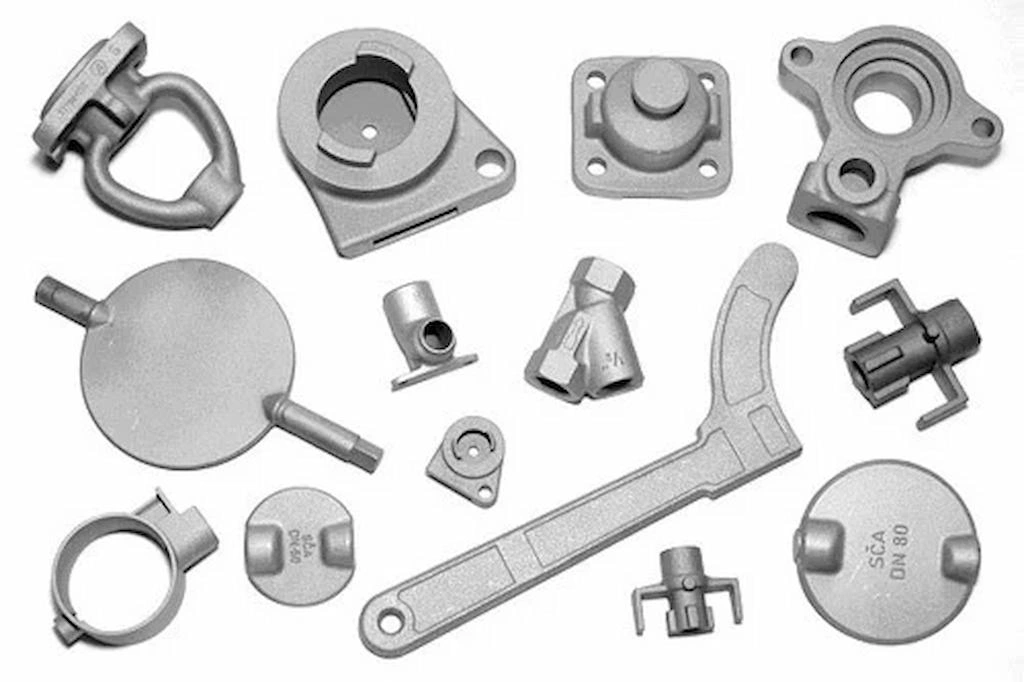
Shell molding items
Moreover, shell casting can make thin-walled cylindrical, cubic, and complex geometries. You can use it to produce small to medium-sized parts with tight tolerances. Subsequently, shell casting applications span from automotive and aerospace to agriculture and industrial machinery.
Try Ancastings Now!
How Does Shell Casting Work? Step-by-Step
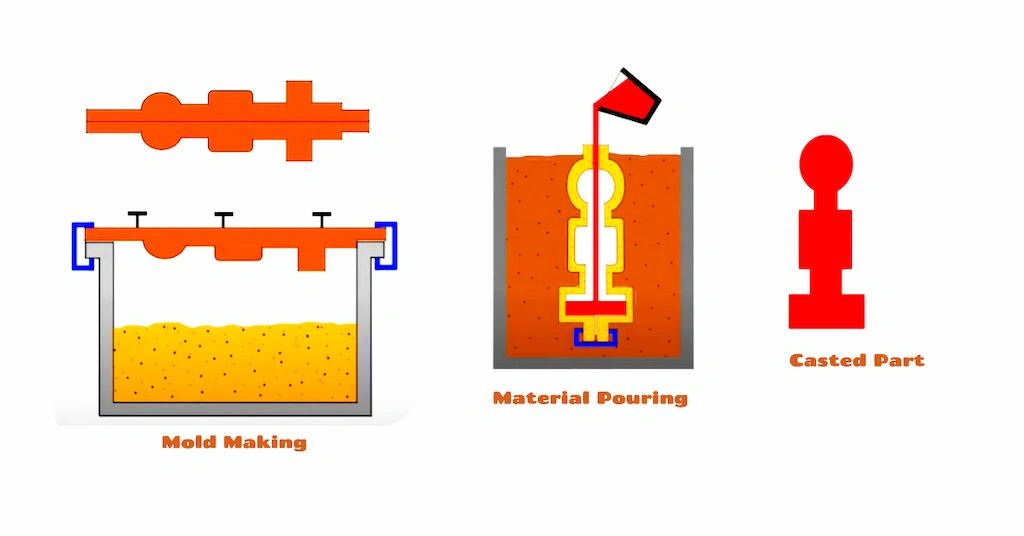
Steps of shell mold casting process
The shell casting is unique from typical sand or other casting method, mainly due to the mold-making procedures. Two mold halves are made with repetitive heating and contact of the pattern with resin-infused sand. Then, those halves are assembled to form the cavity, followed by liquid metal pouring, solidification, curing, and ejection.
The individual steps of the shell mold casting process are as follows;
- Pattern Creation
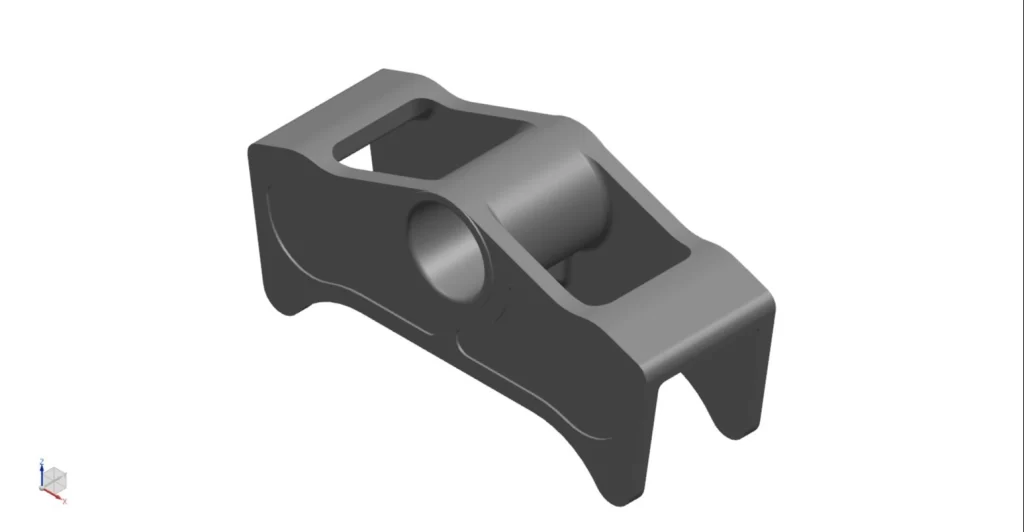
Design of a shell molding pattern
The “pattern” is a replica of the end part you want to shape cast, two halve patterns are needed representing two sections of the desired part. You can machine metals or wood to make the pattern. Additionally, also consider the shrinkage while sizing the pattern.
- Mold Making
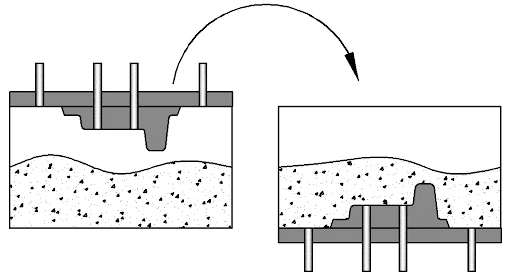
Shell mold making
Put the heated( 175–370°C) pattern on the top of the box containing resin-bonded sand; fully closing the box by the pattern at the top. Then, revert the box, which will attach the resin-sand to the pattern. Repeat this step until the pattern forms a hard shape around it. Once both mold sections are ready, assemble them into a single mold with calming pins or gluing. The mold also needs backing materials for support.
- Pouring the Molten Metal into Mold
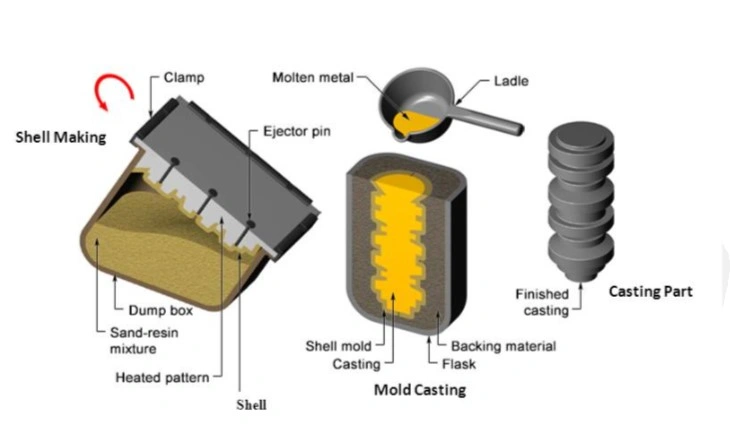
Shell mold casting process
Melt the raw metals into the suitable furnace and pour them into the pre-heated shell mold. Also, consider the pouring temperature and flow to minimize the possible defects.
- Cooling and Part Ejection
Let the mold cool to room temperature. You can also apply a cooling mechanism to speed up the process based on the properties of the metal you are casting. Meanwhile, maintain a uniform cooling throughout all cross sections of the mold.
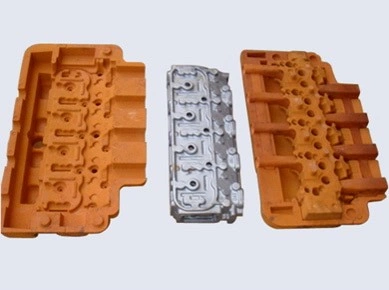
Past ejection from shell mold
Once fully solidified, remove the parts from the shell mold with ejector pins (or other ejector mechanism) without any cracks or damage.
- Post Processing and Surface Treatment
Proceed with the casted parts for some minor post-processing operations like deburring and grinding. If needed, apply suitable finishing to the surface to enhance durability and appearance.
Metals for Shell Casting
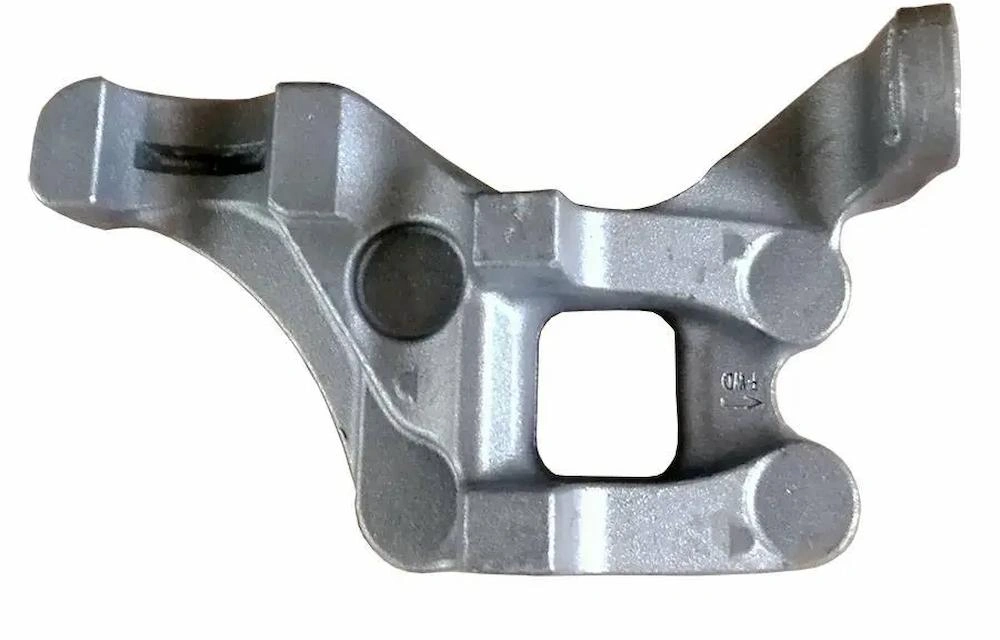
Carbon steel shell molding part
As mentioned before, shell casting is used for both ferrous and non-ferrous metals with relatively low melting points, so the hard shell can withstand the temperature with melting. Let’s elaborate on some common metals for shell mold casting in brief;
-
- Carbon Steel: Carbon steels like C20, C30, and C45 are used for some high-strength metal parts like camshafts, axles, and agricultural machinery.
- Aluminum: Aluminum alloys are popular for their lightweight and high-strength benefits, grades like 356, 413, 304, and 360 are popular in the shell mold casting process. Additionally, aluminum also has high thermal conductivity, making it easier for shell molding.
- Copper and Its Alloys: Pure copper and alloys both are known for excellent thermal and electrical properties. Their ductility also helps in the shell casting. They are used for electrical accessories and heat exchangers.
- Alloy Steel: Alloy steel provides enhanced strength, toughness, and temperature resistance. You can shell cast alloy steels like 42CrMo, especially for structural components for different industries.
Try Ancastings Now!
Try Ancastings Now!
What Are the Benefits of Shell Casting?
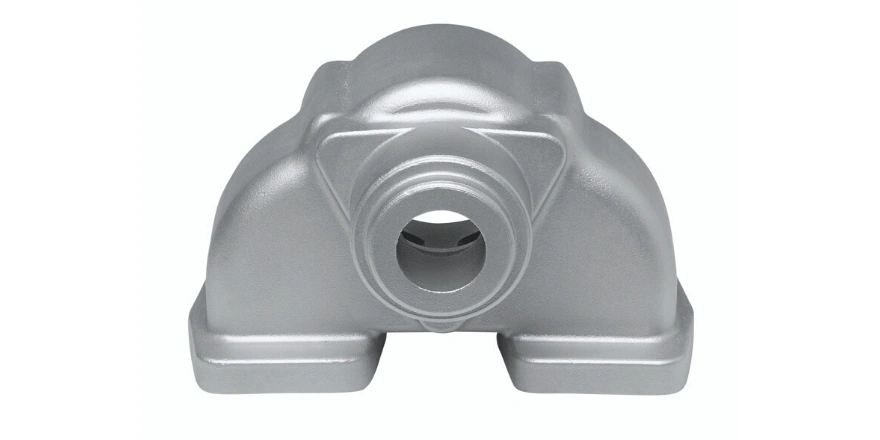
Smooth finish of shell casting part
High-quality finish with minimal post-processing requirements and accuracy of casted parts are the main benefits of the shell casting method over other types of casting.
Some major advantages are as follows;
-
- Smooth Finish: The casted parts capture the smooth details of the hell mold cavity, which makes a uniform and smooth exterior.
- Accuracy: The shell molding can achieve tolerances down to ± 0.005mm, higher than sand casting and other casting methods.
- Complex Parts: It can make complex metal parts with accurate details, such as cylinder heads and compressor blades. Shell mold provides efficient flow and fine details with deep and sharp cavities.
-
- Material Versatility: You can use iron, steel, copper, magnesium, aluminum, and other several metals and alloys to cast the desired parts. The only requirement is that the shell should withstand the melting temperatures of raw metals.
- Production Speed: The shell mold casting process is faster and allows to production of large volumes quickly with minimum downtime.
What are the Disadvantages of Shell Casting?
Despite several benefits, shell casting has some disadvantages also. Considering those drawbacks helps to make better decisions whether it is suitable for your technical requirements and budget constraints or not.
- Higher cost for initial installation and mold-making
- There is a risk of defects like shrinkage, porosity, and flushes.
- The post-processing requirements increase the production cost per/part.
- It is challenging for automation and requires more human resources for the process.
- Not suitable for metals with very high melting temperatures.
Industrial Applications of Shell Mold Casting
The shell molding parts are used in automotive, aerospace, electrical, and other different industries for precision and strength. Additionally, it is also favorable for making lightweight components.
Let’s see some real-world industrial applications in the table below;
| Industry | Benefit | Part Examples |
| Automotive | Accuracy and finish reduce further machining costs. | Engine blocks, brake components, gears, cylinder heads, and camshafts. |
| Industrial Machinery | Production of complex parts with tight tolerances. | Valves, impellers, bushings, and levers. |
| Aerospace | It produces lightweight yet strong parts with intricate designs | Turbine blades, nozzles, brackets, and casings. |
| Electrical Equipment | A smooth surface finish minimizes finishing work | Motor housings, switchgear parts, connectors, and junction boxes. |
| Oil & Gas | Wear and corrosion resistive part for harsh environments | Pipeline fittings, seals, couplings, and valve items. |
| Consumer Goods | Aesthetic and functional components at lower costs | Handles, knobs, decorative parts, cookware bases, and furniture fittings. |
Shell Molding Vs Sand Casting
Sand casting uses silica or other abrasive sands instead of resin-coated ones. The replica pattern is kept in the packed sand to form the cavity. Although it can make large-sized parts at low cost, the finish and precision are not as high as shell molding or shell mold casting.
The table below outlines the shell molding vs sand casting differences;
| Aspect | Shell Molding | Sand Casting |
| Process | Resin-coated sand is used to make a heat-cured shell. | It uses simple sand and binder molds. |
| Surface Finish | Smooth and precise. | Rough; may need machining. |
| Material | Non-ferrous and ferrous with low melting temperature. | High melting metals like steel. |
| Complexity | Ideal for complex designs with intricate contours. | Suited for simple shapes. |
| Cost | Higher due to resin and tooling. | Lower due to the use of basic equipment. |
| Efficiency | Moderate; precise but slower. | Fast for large-sized products. |
| Applications | Aerospace, automotive, precision parts. | Heavy machinery, large castings. |
Read More: Die Casting Companies
Summing Up
Overall, shell casting is an ideal alternative for sand casting of metal parts requiring more precision and accuracy with smooth surfaces. You can mold steel, iron, aluminum, copper, and other various metals and alloys with relatively lower melting points.
Making of hard shell for mold is the most critical factor in leveraging the full advantages of the shell mold casting process. For this, you need the right “pattern” and expert engineers to make shell mold with it. At Ancastings, we can help you will the pattern creation and subsequent casting production phases. Contact us, if you have any further queries.
FAQs
Is shell casting different from sand casting?
Yes, shell casting is different from sand casting, especially in how the mold is made in these two processes. Shell mold involves a solid shell made of heated resin-coated sand, whereas sand casting uses damp sand molds bound by clay.
When to use the shell mold casting process?
Shell mold casting is suitable for applications requiring lightweight components, complex geometries, or high production volumes.
What are the examples of shell mold casting products?
Some typical shell molding products are cylinder heads, crankshafts, turbine blades, military hardware, valve bodies, mold inserts, etc.
Can I shell cast any metal or alloy?
Most of them but not all, the compatibility depends on whether the melting point of raw material is within the range of a hard shell or not. However, all common materials are castable with shell molding, including aluminum, copper, steel, and cast iron.