
Mr. Zhang runs a small but busy CNC machining shop in Dongguan, China. His main customers are energy companies in Europe. In the first quarter of this year, he almost fell off his chair when he opened the electricity bill — 22% higher than the same period last year. But his orders hadn’t changed. No new machines. No overtime.
“Where is the money going?” he asked his shop floor manager, Qiang, a veteran with ten years of experience.
Qiang didn’t answer right away. He grabbed a portable power meter and clamped it onto the main drive of a vertical machining center.
“Come here, Mr. Zhang. Watch.”
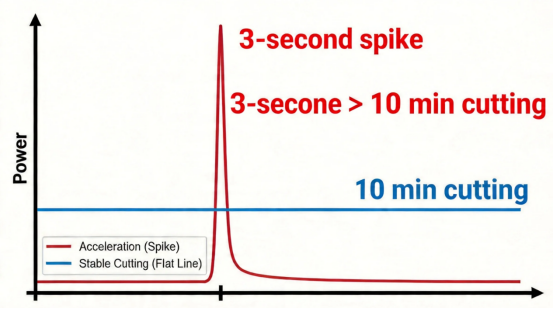
Qiang pressed cycle start. The spindle ramped from zero to 10,000 RPM. The power meter jumped like it had been stung — 18.6 kilowatts in a sharp spike. A few seconds later, the spindle reached its target speed and started cutting steadily. The meter dropped to about 6.2 kW and sat there, quietly.
“See that?” Qiang pointed at the spike. “Those three seconds of acceleration use more electricity than ten minutes of steady cutting. Every time the spindle restarts, it‘s like flooring the gas pedal at a green light — that one stomp burns enough fuel to cruise for half a block. ”
Mr. Zhang stared at the screen. For a long moment, he said nothing.
How expensive is that “flooring the pedal”?
No complicated formulas. Just one physical fact: double the speed, quadruple the energy.
Anyone who has ridden a bicycle knows: pushing from 0 to 10 km/h is easy. But pushing from 10 to 20 km/h takes real effort. The same thing happens with a spindle — the last two seconds of acceleration from 8,000 to 10,000 RPM can consume more energy than the entire ramp from zero to 8,000.
Worse, many machine tools come from the factory with “gentle acceleration” — a slow, conservative ramp. A slow ramp means the motor draws high current for a longer time. Total energy consumption actually goes up.
A 2017 study in the Journal of Cleaner Production used high-frequency power meters (500 samples per second) on a CNC lathe. It found that the power spike during acceleration could reach 20 kW. By optimizing control, the same spike was reduced to 10 kW — a 50% cut.
Mr. Zhang’s 18.6 kW spike was right in that painful zone.
The hidden charge nobody talks about
Qiang helped Mr. Zhang run the numbers.
That machining center performed four tool changes per part. Each time, the old program stopped the spindle completely, changed the tool, then accelerated back to 10,000 RPM.
150 parts per day → 600 spindle start-stop cycles.
“The direct energy of those few seconds isn’t huge,” Qiang said. “But that 18.6 kW peak pushes up your entire factory‘s demand charge. ”
In many industrial electricity tariffs — including China’s — you pay two things: energy charge (per kWh) and demand charge (based on the highest instantaneous power draw during the billing period). The demand charge can easily account for 20–30% of the total bill.
Mr. Zhang pulled out his latest bill. Sure enough, there was a line for “maximum demand” with a surprisingly high rate. By spiking to 18.6 kW six hundred times a day, his spindle was not only wasting the energy of those start-ups — it was raising the price of every single kWh on his entire bill.
“That’s like every time you fill up your tank, the gas station raises the price per liter,” Mr. Zhang sighed.
What the research says — this hole can be plugged
Mr. Zhang searched online and found that researchers had already studied this “start-up spike” problem.
·The 2017 Journal of Cleaner Production study, conducted on a CK6153 CNC lathe, concluded that spindle acceleration energy can be reduced by 10.6% to more than 50% by avoiding unnecessary stops and starts and by optimizing acceleration parameters.
·2024 study went even further — optimizing deceleration strategies cut idle-phase energy waste by 53%.
The simplest, zero-cost fix from all this research: Don’t stop the spindle unless you absolutely have to.
During tool changes, use constant speed mode (G97) instead of constant surface speed mode (G96). The spindle keeps rotating. No stop. No re-acceleration. No spike. No wasted energy.
No new hardware. No new machines. Just a few lines of G-code.
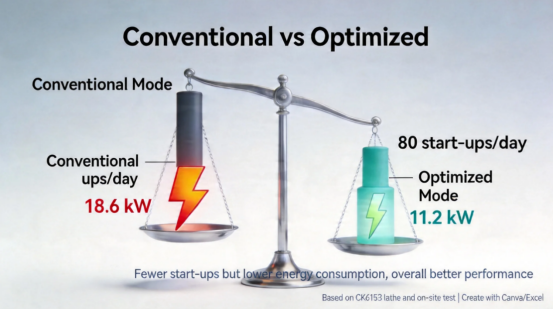
Mr. Zhang had Qiang modify five machines. One week later, Qiang re-ran the power meter on the same part: same batch of 100 parts, but spindle start-ups dropped from 400 to 80. Peak power fell from 18.6 kW to 11.2 kW.
Based on local electricity and demand rates, this single change saves about $2,000 USD per year — enough to buy a used small machine or replace every dull end mill in the shop with premium carbide.
Three no-cost or low-cost improvements
Besides “don’t stop the spindle unnecessarily,” Mr. Zhang and Qiang found three other quick wins:
1. Shorten the acceleration time
Many machines come with a conservative acceleration time (e.g., 2.5 seconds). Ask your service technician to shorten it to, say, 1.8 seconds within the motor/drive limits. Peak power may be slightly higher, but the high-power window is shorter — total energy drops. Counterintuitively, a very slow ramp often wastes more energy than a brisk one.
2. Use lightweight tool holders
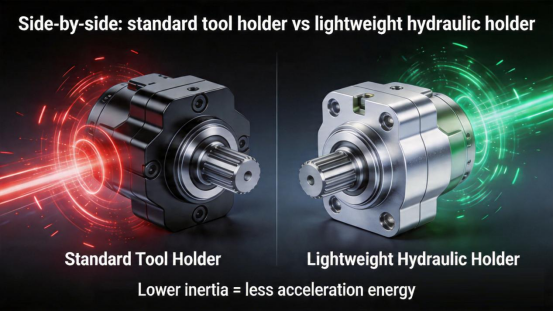
The spindle rotates the tool holder and the cutting tool together. Heavier holder = higher inertia = more energy to accelerate. Switching to lightweight hydraulic or shrink-fit holders directly reduces acceleration energy. Mr. Zhang tried it — peak power dropped another 0.8 kW.
3. Remove idle waiting in the program
Some old programs include “G04 X2.0” (dwell for two seconds). The spindle spins in air during those two seconds, burning electricity without cutting. Qiang deleted those dwell commands and let the spindle accelerate while approaching the workpiece (as long as there is no risk of a crash). The acceleration and cutting phases overlap — essentially free energy use.
The “foot technique” that saved $2,000 a year
Three months later, Mr. Zhang’s electricity bill finally turned downward. The reduction was only 8.3%, but that was pure profit. More importantly, everyone in the shop now remembers a simple rule:
“Before a tool change, look at the spindle — if you don‘t have to stop it, don‘t.”
Later, Mr. Zhang was on a video call with a German customer. The customer asked how he kept his prices stable while improving margins. Mr. Zhang smiled and said:
“We changed our foot technique on the gas pedal.”
How many spindles in your shop are still flooring the gas pedal at every tool change?
This article comes from the CNC machining team at Ancastings Precision. We provide precision CNC machining services for the energy, automotive, and medical industries in Europe, North America, Japan, and Australia.