
Introduction
Why are some robot parts 2–3 times more expensive than expected?
If you have ever requested a quotation for a robot component and felt surprised by the price, you are not alone. Many engineers and sourcing managers assume that cost is mainly driven by material, quantity, or supplier differences. However, in real CNC machining projects, these factors are often secondary.
In most cases, the real reason behind high machining costs is design.
In CNC machining for robot parts, even small design decisions can have a significant impact on manufacturing efficiency. A feature that looks simple in CAD may require complex tooling, multiple setups, or slow machining strategies in reality. These hidden challenges increase cost, extend lead time, and raise production risks.
What makes this more difficult is that these issues are rarely obvious during the design phase. They only become visible when the part enters production or when suppliers start asking for design changes.
If your quotation is higher than expected, or if different suppliers give very different prices, there is a strong possibility that your design includes hidden cost drivers.
In this article, we will walk through the most expensive design mistakes in robot part machining—and show you how to avoid them through better design decisions.
1. Deep Cavities That Increase Cost and Machining Risk
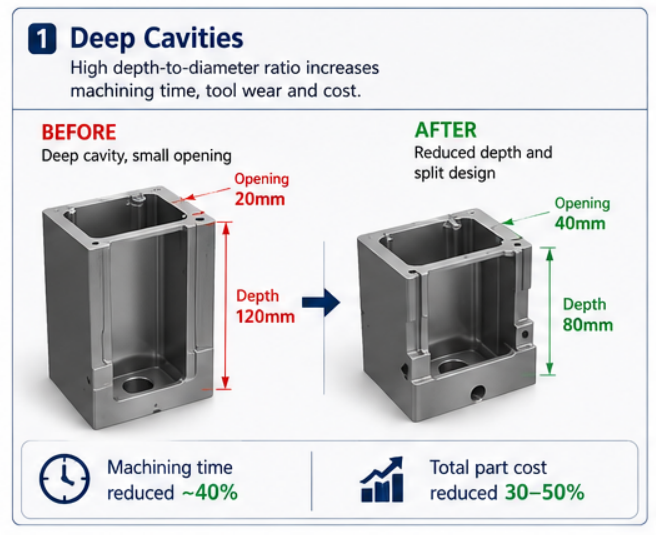
Deep cavities are one of the most common reasons why CNC machining costs increase unexpectedly.
At first glance, a deep pocket or cavity may seem like a simple feature. However, from a machining perspective, it creates serious challenges. When the depth of a cavity is too large compared to its opening, standard cutting tools cannot operate efficiently.
The deeper the tool needs to reach, the more unstable it becomes. This leads to vibration, tool deflection, and reduced cutting performance.
As a result, manufacturers are forced to:
- Use long-reach cutting tools
- Reduce cutting speed and feed rate
- Increase machining passes
All of these factors directly increase machining time, which is one of the biggest cost drivers in CNC production.
In addition, deeper cavities often result in poor surface finish and higher scrap risk, especially when tight tolerances are required.
From a cost perspective, what seems like a minor design decision can easily increase the total machining cost by 30% to 50%.
How to Avoid
To reduce cost and improve manufacturability:
- Limit cavity depth whenever possible
- Increase the opening size to improve tool access
- Consider redesigning the part into multiple components
In many cases, splitting a complex cavity into two simpler parts can significantly reduce cost while maintaining functionality.
2. Sharp Internal Corners That Require Secondary Processes
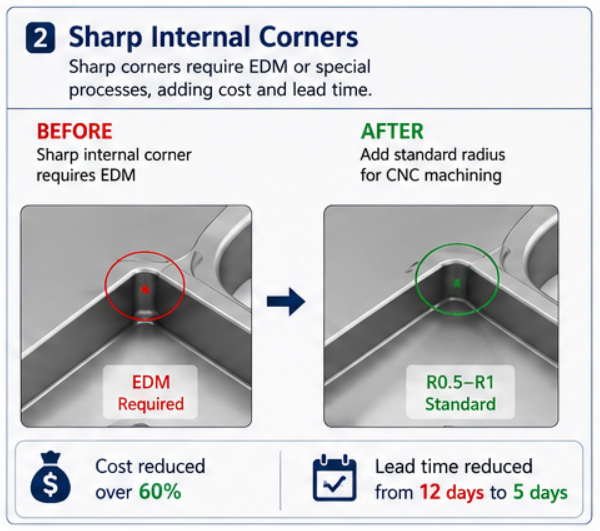
Another common design mistake is specifying perfectly sharp internal corners.
In CAD models, sharp corners are easy to create and often look cleaner. However, in CNC machining, they are not practical.
Cutting tools are always round, which means they cannot create a perfectly sharp internal corner. To achieve such geometry, additional processes such as EDM (Electrical Discharge Machining) are required.
While EDM can produce sharp corners, it comes with several disadvantages:
- Much higher cost compared to standard CNC machining
- Longer lead time
- Additional setup and handling
This is one of the most frequent reasons why a part that appears simple becomes unexpectedly expensive during quotation.
For example, a bracket with internal sharp corners may require both CNC machining and EDM, effectively doubling the manufacturing complexity.
How to Avoid
To prevent unnecessary cost:
- Always design internal corners with a radius
- Use standard tool radius values (e.g., R0.5–R1 or larger)
- Ensure features are accessible by standard cutting tools
Even a small design change, such as adding a radius, can eliminate the need for EDM entirely and reduce cost by more than 50%.
3. Overly Tight Tolerances That Add No Functional Value
Precision is critical in robotics, but not every feature requires ultra-tight tolerances.
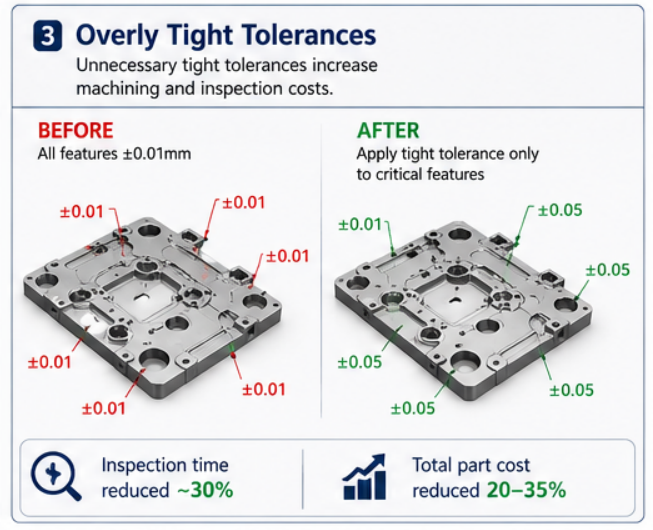
A common mistake is applying tight tolerances across the entire part, even when many features are not functionally critical.
From a manufacturing perspective, tighter tolerances require:
- Slower machining speeds
- More precise tooling
- Additional inspection processes
- Higher rejection rates
Each of these factors increases cost.
In practice, applying ±0.01 mm tolerance to all features can easily double or even triple the machining cost, especially for complex parts.
However, in most designs, only a small number of features truly require high precision—such as bearing seats, alignment interfaces, or sealing surfaces.
How to Avoid
To optimize cost without sacrificing performance:
- Apply tight tolerances only to critical features
- Use general tolerances (e.g., ±0.05 mm or ±0.1 mm) elsewhere
- Clearly define functional requirements
Working with your CNC supplier during the design phase (DFM review) can help identify which tolerances are necessary and which can be relaxed.
4. Thin Walls That Lead to Deformation and High Scrap Rates
Thin walls are commonly used in robot parts to reduce weight and improve efficiency. However, they create significant challenges during machining.
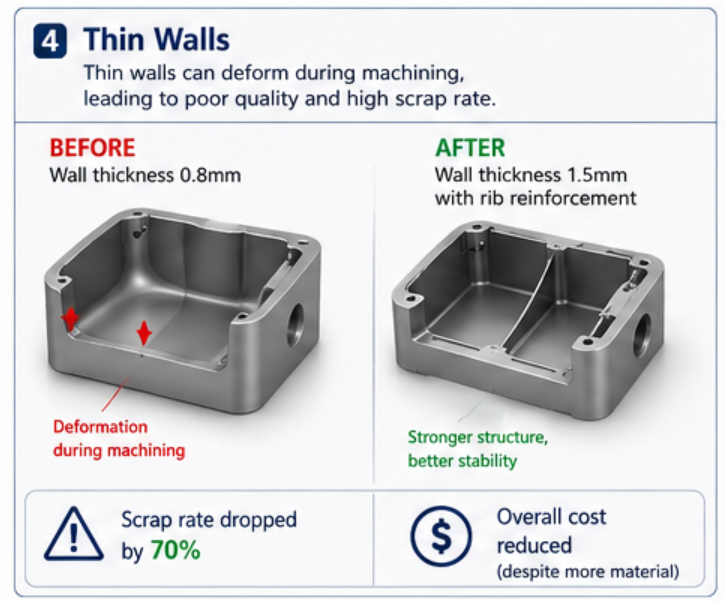
When walls are too thin, they lack rigidity. During cutting, the force of the tool can cause the material to deform, leading to dimensional inaccuracies.
This results in:
- Poor surface finish
- Out-of-tolerance dimensions
- Increased scrap rate
In extreme cases, parts may become unusable after machining.
To compensate, manufacturers may need to use special machining strategies, such as reduced cutting forces or multiple finishing passes. These methods increase machining time and cost.
Ironically, while thin walls are intended to reduce material usage, they often lead to higher overall manufacturing cost.
How to Avoid
To improve stability and reduce cost:
- Maintain a reasonable minimum wall thickness
- Add ribs or reinforcement structures where needed
- Balance weight reduction with structural integrity
In many cases, slightly increasing wall thickness can significantly improve manufacturability and reduce total cost.
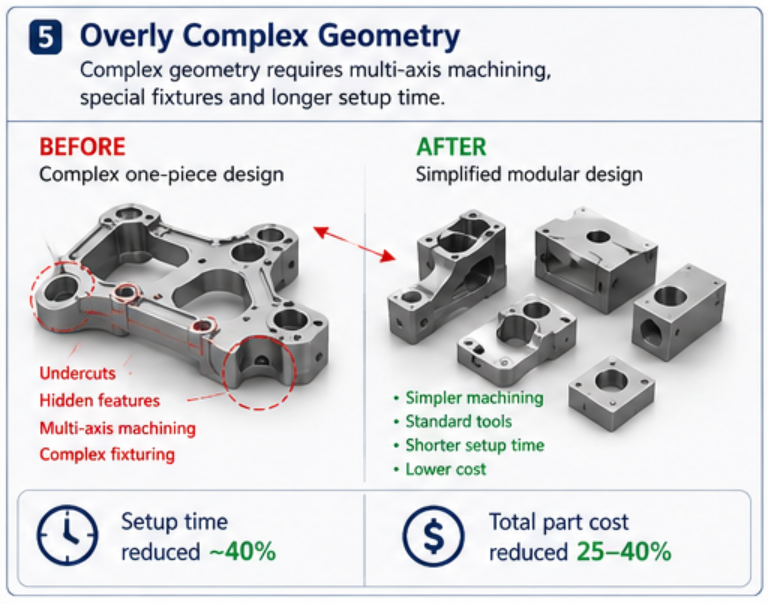
5. Overly Complex Geometry That Increases Setup and Programming Cost
Modern CAD tools allow engineers to design highly complex geometries with ease. However, not all designs are equally easy to manufacture.
Features such as:
- Undercuts
- Hidden internal structures
- Multi-axis surfaces
Require advanced machining techniques.
These parts often need:
- Multiple setups
- Complex fixturing
- 5-axis CNC machining
Each additional setup increases production time and introduces the risk of alignment errors.
Programming complexity also increases significantly, especially for multi-axis machining, which requires more advanced CAM strategies.
As a result, complex geometry can increase total production cost by 25% to 40% or more.
How to Avoid
To simplify production:
- Reduce unnecessary geometric complexity
- Avoid features that require special tooling or setups
- Consider modular design instead of one-piece structures
Designing with manufacturability in mind can dramatically reduce both cost and lead time.
How to Know If Your Design Has These Cost Issues
You may already be experiencing these problems if:
- Your quotation is significantly higher than expected
- Different suppliers provide very different pricing
- Suppliers recommend design changes
- Lead time is longer than similar parts
- Multiple machining processes are required
If any of these situations apply, your design likely includes hidden cost drivers that can be optimized.
Conclusion
In robot part machining, cost is not determined by material alone—it is largely driven by design decisions.
Many expensive parts are not inherently difficult to manufacture. They are simply not designed with manufacturability in mind.
By avoiding common design mistakes such as deep cavities, sharp internal corners, excessive tolerances, thin walls, and overly complex geometry, you can significantly reduce machining cost and improve production efficiency.
Get a Free DFM & Cost Optimization Review
If you are currently designing robot parts or preparing for production, we can help you identify hidden cost drivers before they become expensive problems.
Send us your drawings and receive a free DFM (Design for Manufacturability) and cost optimization review within 24 hours.
Our engineering team will help you:
- Identify high-cost features
- Optimize your design for CNC machining
- Reduce production cost and lead time
Start optimizing your robot part design today.