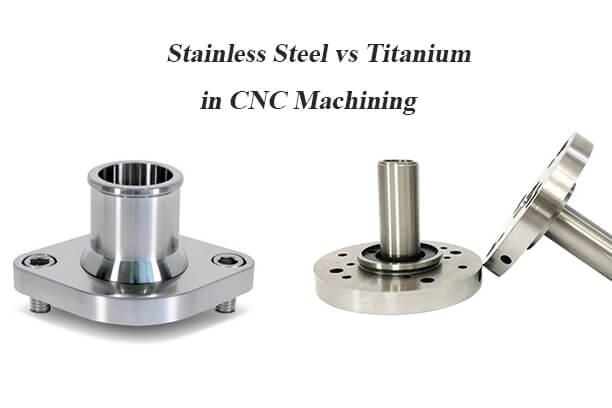
CNC machining is a manufacturing process that is highly compatible with a wide variety of metal materials. Among these materials, stainless steel and titanium are two of the most commonly used when creating custom parts or prototypes. Both of these materials are versatile and have a similar appearance. You can find products made from stainless steel and titanium in many different applications all around us. Stainless steel is frequently used in cookware, consumer goods, construction, ships, and more. On the other hand, titanium is much lighter in weight and is often used in medical devices, sporting goods, bicycles, automobiles, and aerospace industries. But which one of these two popular metals should you choose for your CNC machining project?
In this article, we will thoroughly analyze the differences between stainless steel and titanium in the CNC machining process from various perspectives to guide you in choosing the best material for your project.
Comparative Table of the Difference between Titanium & Stainless Steel
Titanium and stainless steel possess distinct and superior qualities that discern one from the other. To help clarify this comparison, we will expound on a vast array of properties that sets these two metals apart from each other. These properties encompass diverse aspects such as their elemental composition, their ability to resist corrosion, conduct electricity and heat, their melting point, their degree of hardness, their weight, and other facets worth exploring.
| Property | Titanium | Stainless Steel | Conclusion |
| Durability | It’s a lighter and more corrosion-resistant metal and also more resistant to high temperatures and thermal shock than stainless steel | It’s more resistant to scratches and dents than titanium, and is easier to maintain due to its non-porous surface | Both titanium and stainless steel are highly durable metals, the choice between them up to the specific application |
| Cost/Price | It tends to be more expensive than stainless steel due to its higher processing and production costs | It’s generally a cost-saving solution widely used in manufacturing industries | Titanium is ideal for crucial applications such as medical and aerospace, stainless steel is preferred when budget is the prerequisite |
| Hardness | It forms a hard oxide layer that resists most forces with high strength-to-weight ratio | Its hardness depends on the alloy composition and manufacturing process used | Both titanium and stainless steel are strong and durable metals used for rough environments |
| Weight | Its density is approximately 4.51 g/cm³ | Its density is around 7.9 g/cm³ | Titanium is roughly 40% lighter than steel of the same volume |
| Corrosion Resistance | It’s known for its excellent corrosion resistance in a wide range of natural and artificial environments due to the formation of an oxide layer | It has moderate corrosion resistance due to its chromium content which forms a passive film | Stainless steel is more susceptible to corrosion than titanium in certain environments and conditions |
| Electrical Conductivity | Its electrical conductivity is about 3.1 x 10^6 siemens/meter | Range from 1.45 x 10^6 to 2.5 x 10^6 siemens/meter depending on the specific grade of stainless steel | Stainless steel is generally a better conductor of electricity than titanium |
| Thermal Conductivity | Its thermal conductivity is about 22 W/(m*K) | Varies depending on its composition and can range from 14.4 W/(m*K) to 72 W/(m*K) for austenitic stainless steels | Generally, stainless steel has a lower thermal conductivity compared to titanium due to its greater resistance to heat transfer |
| Melting Point | It has a melting point of 1,668°C (3034°F) | It typically has a melting point of 1,400-1,500°C (2,552-2,732°F) | Titanium has a higher melting point compared to stainless steel |
| Machinability | It’s difficult to machine as its elastic modulus is low, indicating that it flexes and deforms easily | It has a higher elastic modulus and a lower tendency to stick to cutting tools, making it easier to machine | In general, stainless steel can be easier to machine than titanium due to its lower strength and hardness |
| Formability | It has a lower formability than stainless steel due to its lower ductility and work hardening tendency | It’s a ductile and malleable metal, so it can be easily formed into various shapes without breaking or cracking | Usually, stainless steel is easier to work with and has better formability than titanium |
| Weldability | It has a high melting point and high reactivity to oxygen, which can make it difficult to weld | It has lower reactivity to oxygen, and its weldability depends on the specific alloy used | Overall, the weldability of titanium is more challenging than that of stainless steel |
| Yield Strength | It’s considered one of the strongest metals per unit mass, as it exhibits similar strength to stainless steel at half the density | Depending on the alloying elements, the yield strength of stainless steel varies from 25 MPa to 2500 MPa | Stainless steel is a better choice for projects that require overall strength, while titanium is preferred when strength per unit mass is necessary |
| Tensile Strength | Commercially pure titanium has a tensile strength ranging from 240-410 MPa (megapascals), while some high-strength alloys can have a tensile strength of up to 1,400 MPa | The tensile strength of stainless steel typically ranges from 515-827 MPa depending on the grade and type of stainless steel | The tensile strength of stainless steel is generally higher than that of titanium |
| Shear Strength | The shear strength of titanium ranges from about 300 to 580 MPa (43,500 to 84,000 psi) | The typical shear strength of stainless steel ranges from 400 to 800 MPa (58,000 to 116,000 psi) | Stainless steel is higher than titanium in resistance against shear load |
| Appearance/Color | Titanium is a silver-gray colour in its natural state | Stainless steel has a more silver-like or grayish-white hue | Stainless steel will still have a metal-like shine to it after being coated or finished, whereas titanium’s natural colour will always be visible |
| Applications | High strength-to-weight ratio Excellent corrosion resistance Highly resilient to extreme temperatures |
Highly versatile Great corrosion resistance High strength Good durability |
Titanium: Aerospace, Industrial, Architectural, Consume, Jewelry, Medical Industry, Storage of Nuclear Waste; Stainless steel: Architecture, Paper, pulp, and biomass conversion, Processing of Chemicals and Petrochemical, Food & Beverage, Energy, Firearms, Automobiles, Medical, 3D printing |
How to Choose the Right One for Your CNC Machining Project: Stainless Steel or Titanium?
A variety of titanium and stainless steel alloys have found widespread usage in the field of CNC machining. For an in-depth analysis of how these two materials fare in machining processes, you may refer to the comparative table presented herein. You can also head over to our page detailing Stainless Steel Machining and Titanium Machining services to acquire more comprehensive details.
| Titanium | Stainless Steel | |
| Alloys | Titanium Grade 1 Titanium Grade 2 Titanium Grade 5(TC4, Ti6Al4v) |
Stainless steel 303 Stainless steel 304 Stainless steel 316 Stainless steel 416 Stainless steel 17-4PH Stainless steel 15-5 |
| Advantages | High strength-to-weight ratio Excellent corrosion resistance High operating temperatures Low thermal expansion Nontoxicity |
Good heat resistance Great corrosion resistance High strength and toughness |
| Disadvantages | High cost Difficult to machine Low elasticity Readily deformed |
Magnetism limits their use Difficult to shape or bend Heavier than other materials with similar properties |
| Tolerances | It is determined by the desired effect and the titanium used. A tolerance of ±0.005”(±0.13 mm) is achievable. | It is determined by the desired effect and the exact alloy used. A tolerance of ±0.005”(±0.13 mm) is achievable. |
| Wall Thickness | A minimum wall thickness of ±0.03”(±0.8 mm). | A minimum wall thickness of ±0.03”(±0.8 mm). |
| Part Size | It’s mostly decided by the available machine and part geometry. | It’s mostly decided by the available machine and part geometry. |
| Finishes | As machined, Case hardening, Anodizing. | As machined, Powder coating, Bead blasting. |
Conclusion
Stainless steel and titanium are frequently used materials in CNC machining. They can be found in various industries, and their numerous alloys all have remarkable qualities. These alloys can endure practically every CNC machining method once suitable equipment and parameters are utilized. Utilizing the appropriate stainless steel and titanium alloy necessitates a comprehensive grasp of their properties, the machining environment, their intended function, and other significant factors.
At Ransom Precision, we offer CNC machining services that cater to over 50 material options, ranging from metals to plastics and other special materials. Our team of skilled engineers conducts in-depth analysis to ensure that the machining process meets the specific requirements and the tolerance limits for creating accurate components for various applications across different industries. We have a highly proficient team of experts who utilize the latest CNC technology to bring your designs to life with maximum efficiency, accuracy, and precision.
Get an instant quote to start your CNC machining project now!
Other Articles You May be Interested in:
Passivation of Stainless Steel Parts

Titanium CNC Machining Tips