Introduction
Underwater robots, including Remotely Operated Vehicles (ROVs), Autonomous Underwater Vehicles (AUVs), and subsea exploration robots, operate in some of the most challenging environments on Earth. They are subject to extreme conditions, such as high water pressure, corrosive saltwater, and fluctuating temperatures. These harsh environments significantly impact the performance and reliability of their components, which, in turn, affects the success of missions and the longevity of the robots.
For these underwater robots to function effectively in such demanding conditions, it’s essential that the components used are designed with these factors in mind. Many CNC machining providers focus primarily on the basic requirements of dimensional accuracy and general machining standards, neglecting specialized needs such as sealing integrity, corrosion resistance, and pressure tolerance. At Ancastings Precision, we provide CNC machining services that are specifically tailored to meet the challenges posed by subsea applications, ensuring reliability and performance in underwater environments.
Industry Gaps
The CNC machining industry for underwater robotics is not without its challenges. The common issues faced in machining parts for underwater robots include material limitations, sealing surface precision, and pressure tolerance oversights. Addressing these gaps is critical to ensuring that components can perform reliably under extreme underwater conditions.
1. Material Limitations
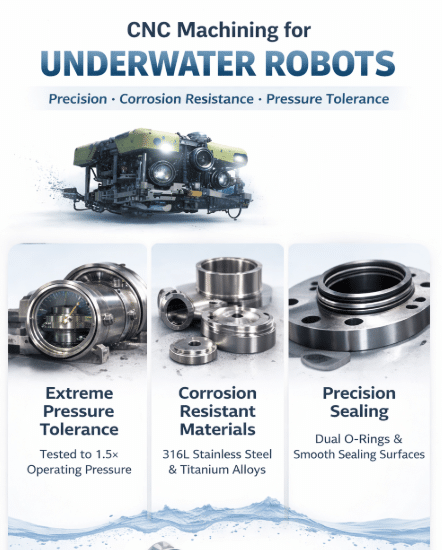
A significant problem is the use of generic metals, such as standard aluminum or carbon steel, which fail to perform under the high pressure and corrosive saltwater found in subsea environments. These materials corrode over time, leading to mechanical failures, leaks, and potential loss of mission-critical equipment. At Ancastings Precision, we focus on using marine-grade materials such as 316L stainless steel, titanium Grade 5, and 6061/7075 aluminum. These materials have superior corrosion resistance and pressure tolerance, making them ideal for underwater applications.
Unfortunately, these materials are often overlooked or avoided by many machining providers due to their higher cost and the specialized knowledge required to work with them effectively. This results in components that are not optimized for underwater environments, leading to premature failure and costly downtime.
2. Sealing Surface Precision
Another common issue is poor sealing surface precision, which is vital to ensure the integrity of underwater robot components. Rough sealing surfaces or poor flatness can lead to leaks, compromising the effectiveness of the robot and potentially leading to mission failure. For underwater applications, components require a high level of precision with a surface roughness (Ra) of ≤0.4μm and flatness within ±0.003mm. Many CNC machining providers fail to meet these stringent requirements, typically achieving only Ra >0.8μm and flatness >±0.005mm.
Sealing components such as O-rings and gaskets play a crucial role in preventing water ingress and maintaining the integrity of sensors, electronics, and other critical systems. At Ancastings Precision, we focus on achieving the tightest possible tolerances to ensure that all sealing surfaces are optimized for performance and reliability in demanding subsea environments.
3. Pressure Tolerance Oversights
Subsea robots are often required to operate at extreme depths, where pressure can exceed 1000 meters. Standard machining practices may result in components that are not optimized to withstand these high-pressure environments. In deep-sea operations, components that have not been pressure-tested or optimized for structural integrity risk deformation, collapse, or failure. At Ancastings Precision, we use advanced engineering techniques, such as CAD simulations and pressure testing, to ensure that every component is pressure-resistant and capable of withstanding the extreme forces of deep-sea environments.
CNC Machining Solutions
Ancastings Precision offers a range of CNC machining solutions specifically designed to address the challenges of underwater robotics. Our solutions focus on the three critical factors: material selection, precision machining for sealing, and pressure engineering and testing.
1. Material Selection
To ensure the highest level of performance and reliability, we carefully select materials based on their properties, such as corrosion resistance, strength, and pressure tolerance. We offer the following materials for subsea applications:
- Marine-Grade Aluminum (6061-T6, 7075-T7451): These materials are lightweight, strong, and ideal for shallow to mid-depth robots. We also employ stress relief treatments to prevent deformation during operation.
- 316L Stainless Steel: Known for its exceptional corrosion resistance, 316L stainless steel is ideal for components that will be exposed to saltwater, such as sensor housings, flanges, and manifolds.
- Titanium (Grade 2/5): Titanium alloys provide high strength, excellent corrosion resistance, and pressure tolerance, making them perfect for deep-sea robots. We use advanced 5-axis CNC machining techniques to ensure precision.
- Engineering Plastics (PEEK, EPX 150): These materials are used for non-structural components that require chemical resistance and tight tolerances. We often combine these materials with 3D printing to achieve complex geometries.
2. Precision Machining for Sealing
Sealing integrity is paramount in underwater robotics, and at Ancastings Precision, we employ the highest standards of precision machining to ensure that all sealing surfaces are flawless. Our machining capabilities include:
- Surface Roughness: We achieve a surface roughness of Ra ≤0.4μm, with critical components requiring Ra ≤0.2μm.
- Flatness and Tolerances: We maintain tight tolerances, including flatness within ±0.005mm, perpendicularity, and concentricity to ensure proper sealing.
- Redundant Sealing: To further reduce the risk of leakage, we incorporate dual O-ring grooves in sealing components, offering an extra layer of protection.
3. Pressure Engineering & Testing
To ensure that components can withstand the extreme pressures encountered during deep-sea operations, we incorporate pressure engineering and testing into our design and machining process. This includes:
- Structural Optimization: Using CAD simulations, we optimize the wall thickness, fillets, and reinforcements of components to ensure they can withstand high pressure without deforming.
- Stress Relief: We use annealing or tempering processes to relieve stress in materials and prevent deformation under pressure.
- Pressure Testing: Each component is tested at 1.5 times the maximum operating pressure to ensure its reliability and structural integrity.
Customer Value
Our CNC machining services provide significant benefits to customers, including:
- Reduced Downtime & Maintenance: By using corrosion-resistant materials and well-sealed components, we help prevent costly failures and reduce maintenance needs.
- Extended Lifespan: Our high-quality materials and precision machining processes extend the lifespan of components, often doubling or tripling their life expectancy.
- Mission Success & Safety: Reliable components minimize the risk of mission failure, ensuring that underwater robots can perform their tasks safely and effectively.
- Compliance & Documentation: We adhere to international quality standards such as ISO 9001:2015, and provide full material certificates and test reports to ensure compliance.
Why Ancastings Precision
At Ancastings Precision, we bring more than 10 years of experience in underwater robotics, material science, and subsea challenges. We offer:
- Expertise: Our team of engineers is highly experienced in the unique challenges of subsea robotics, ensuring that we deliver solutions that meet the highest standards of performance.
- Advanced Equipment: We use state-of-the-art CNC machines, including 3-, 4-, and 5-axis machines, as well as CMM (Coordinate Measuring Machines), pressure chambers, and a temperature-controlled workshop.
- Strict Quality Control: Every component undergoes rigorous quality checks to verify its dimensional accuracy, corrosion resistance, and pressure tolerance.
- Global Support: We offer fast lead times, technical consultation, and 24/7 customer support to ensure that our clients receive the best possible service.
Contact
For inquiries, quotes, or technical consultation:
Our team is ready to assist with material selection, CNC machining solutions, and subsea component optimization.