
In the aerospace industry, precision is critical when crafting parts like turbine blades and aircraft structural components. Wire EDM allows manufacturers to create these complex parts with high accuracy and minimal material waste.
As such, this article will delve into the fundamentals of Wire EDM, including how it works, its key components, and tips for achieving optimal results. Additionally, we’ll explore how wire EDM compares to other EDM techniques, its benefits, limitations, and common applications across industries. Whether you’re new to EDM or looking to refine your skills, this guide will provide valuable insights.
What is EDM?
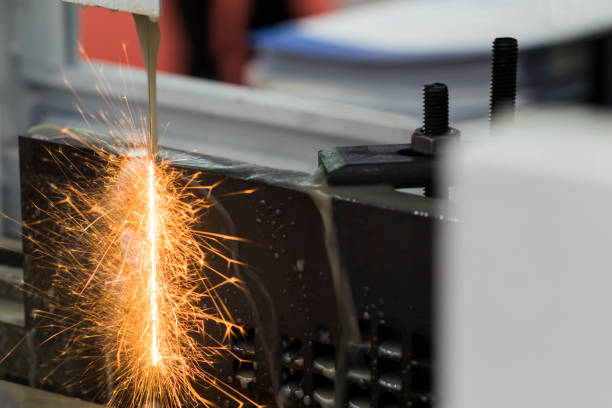
EDM is a non-traditional machining process. It removes workpiece material by generating a controlled spark discharge between the workpiece and the electrode. In this process, the workpiece and electrode are immersed in a dielectric liquid, helping control and guide the spark discharge. There are two main types of EDM, involving wire-cut EDM and immersion EDM (Die-Sinking EDM).
What is Wire EDM?
Utilizing an electrically charged thin wire and a dielectric fluid, wire EDM is a process that cuts materials, such as metal parts, into various shapes. Moreover, This method is known by various names in the industry, including spark erosion, wire erosion, wire cutting, and others. Given that this process generates fine chips and accurate cut lines through melting or vaporizing the material, it is more suitable for electrically conductive parts.
How Does Wire EDM Work?
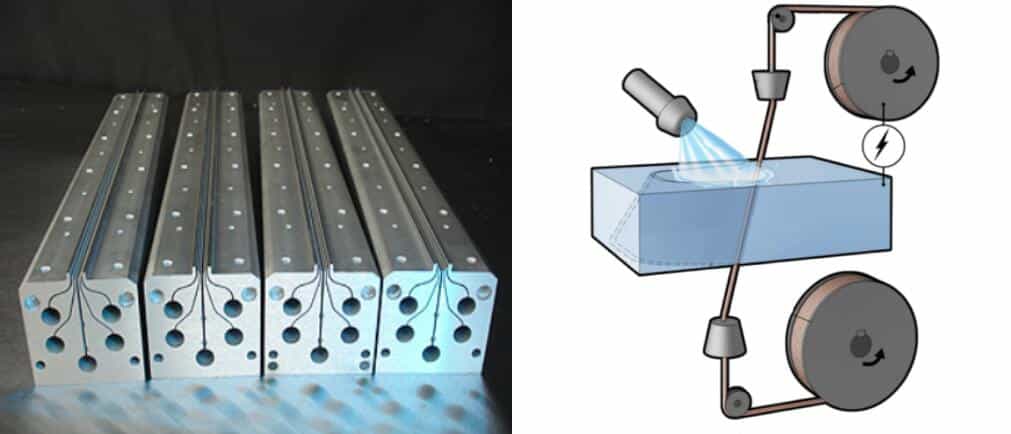
The wire-cut EDM process operates on a straightforward mechanism. Wire EDM uses electrolytic machining principles to cut complex shapes on metal workpieces. In this process, a slender charged copper or brass wire is used as a cutting tool.
Moreover, the spark discharge is generated by controlling the charge difference between the wire and the workpiece. In addition, the spark energy dissipates as heat at a tiny point, reaching temperatures up to 12,000°C, vaporizing both the wire and workpiece. As such, this will lead to local melting and evaporation of the workpiece to achieve high-precision material removal. Additionally, this process ensures that the wire cutting machine moves accurately along a preset path.
Components of Wire EDM Machine
The wire EDM machine consists of multiple components that collaboratively function to mold materials into specific shapes. Some main common parts are as follows:
1. Dielectric Fluid System
The dielectric fluid System, commonly utilizing deionized water, functions as a coolant to remove metal particles. It also acts as an insulator between the wire and the workpiece to control the electrical discharges.
2. Power Supply
It provides the controlled electrical voltage, ranging from 100V to 300V, to generate the necessary sparks for machining. It also regulates the power intensity and duration of the electrical discharges.
3. Work Tank
The Work Tank contains the wire electrode and workpiece submerged in dielectric fluid. Additionally, it facilitates the effective management of the dielectric fluid and provides a controlled environment for the cutting process.
4. Flushing System
It includes pumps and nozzles that direct the dielectric fluid over the cutting area. In addition, it enhances the efficiency by removing heat and debris.
5. Filtering System
With filters within the dielectric system, it cleans the fluid by removing metal particulates. Moreover, it ensures effective insulation and cooling during the cutting process.
6. Wire
The wire electrode is typically made of brass, stratified copper, zinc-coated wires, and more, with diameters ranging from 0.05 to 0.25 mm. Usually, it also functions as a cutting tool by generating electrical discharges.
- Brass: Provides good electrical conductivity and durability.
- Stratified copper: Combines the high electrical conductivity of copper with the structural strength of the base metal.
- Zinc-coated wires: Provides corrosion resistance, improving the wire’s lifespan and performance in various environments.
- Diffusion-annealed wires: Creates a more homogeneous and stable material composition.
Materials Available for Wire EDM
Wire EDM can create intricate shapes and patterns on a wide range of electrically conductive materials. Below are some common materials employed in wire EDM.
Metals
The wire EDM cutting process relies on the controlled erosion of the workpiece material by electrical discharges. Therefore, conductive metals are the primary materials employed in this process.
- Steel: carbon steel, alloy steel, stainless steel
- Copper and copper alloys: brass, bronze
- Titanium and titanium alloys
- Aluminum and aluminum alloys
- Nickel and nickel-based alloys
- Tungsten and tungsten carbide
Non-metals:
Although wire EDM primarily processes metallic materials, this technology can also process certain non-metallic conductive materials.
- Graphite
- Silicon
- Conductive ceramics
- Hard plastics and composites
Wire EDM Tips & Tricks
Here are some useful tips and tricks for optimizing the performance of Wire EDM.
1. Wire Selection:
Choose the optimal wire diameter and material
2. Parameter Optimization:
Carefully adjust voltage, current, pulse, flushing
3. Wire Tension & Guidance:
Maintain proper wire tension to prevent vibration
4. Workpiece Clamping & Positioning:
Securely clamp to prevent movement and minimize setups and wire threading
5. Flushing & Debris Removal:
Ensure efficient flushing to remove debris
6. Maintenance & Monitoring:
Regularly inspect and maintain the machine and monitor wire condition and replace before wear
Types of EDM Machining
The key differences between Wire EDM and other EDM techniques lie in the workpiece geometry, material suitability, cutting speed, and the level of precision and complexity that can be achieved.
- Wire EDM (WEDM)
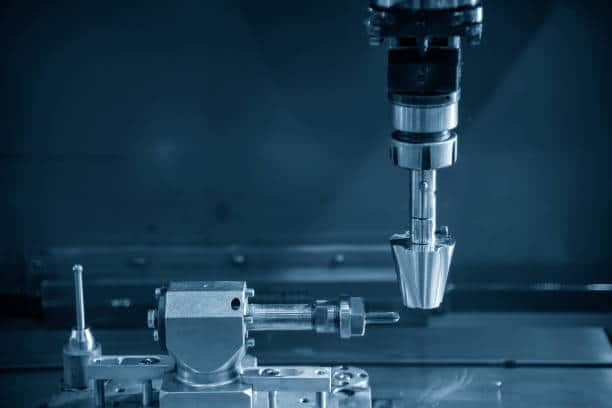
As we mentioned before, wire EDM uses a thin, electrically charged wire to cut through conductive materials with high precision. The wire moves along a programmed path, eroding the material in a controlled manner. This process excels in creating complex shapes and intricate designs, making it ideal for industries like aerospace, automotive, and medical device manufacturing. In particular, it’s effective for cutting thin or delicate parts with tight tolerances. - Sinker EDM (Die Sinker EDM)
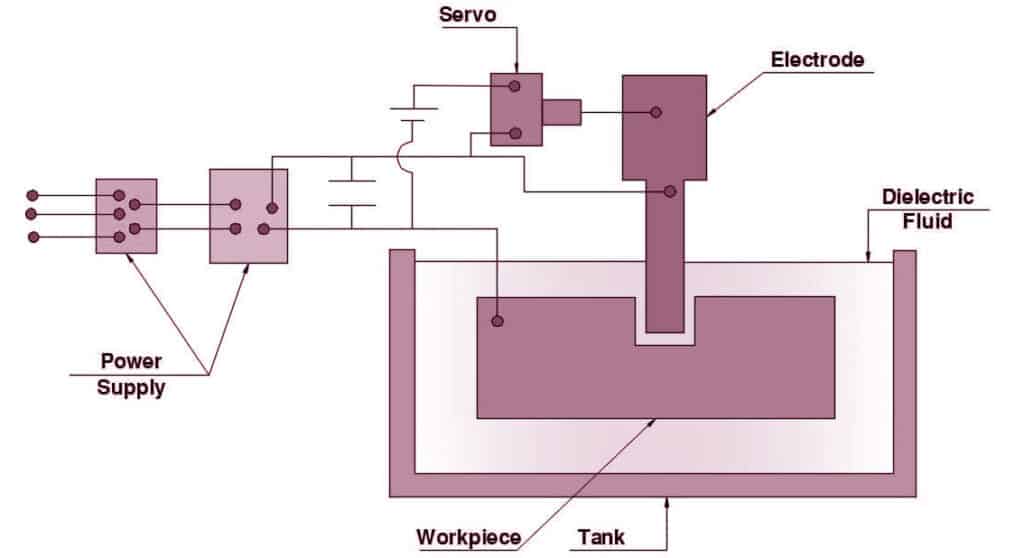
Sinker EDM, on the other hand, utilizes a shaped electrode that is submerged into the workpiece to erode material and form precise cavities or contours. This method is commonly used for creating molds, dies, and tooling with complex 3D shapes. Unlike Wire EDM, the electrode is shaped to match the exact contours needed, allowing for high-precision results in industries such as die casting, injection molding, and tool making.
- Fast Hole EDM
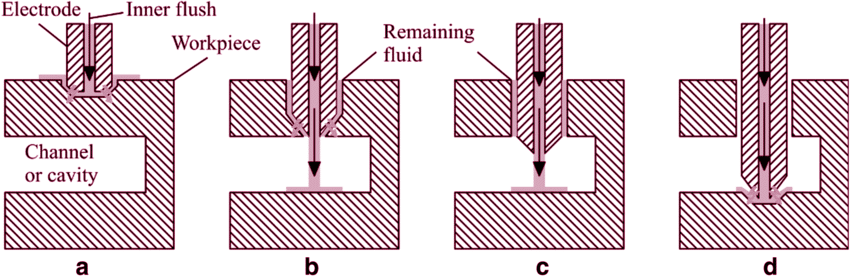
Fast hole EDM focuses on creating deep, small-diameter holes in hard materials. It uses a hollow electrode to continuously flush away debris during the machining process. Typically, this process is used in applications like drilling cooling holes in turbine blades in the aerospace industry or producing tiny holes for medical devices and electronics. It offers precision for high-aspect-ratio holes where traditional drilling methods may not be effective.
- Micro-EDM
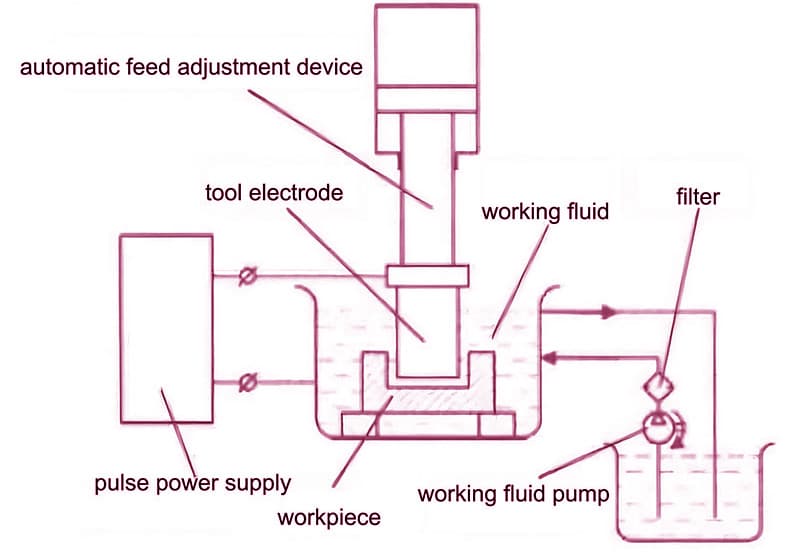
Micro-EDM creates extremely small and intricate parts with high precision. It employs the same principle of electrical discharges but at a much smaller scale, allowing for the creation of micro-sized features, such as tiny holes, fine grooves, and intricate 3D structures. Typically, micro-EDM is employed in industries where miniature components are required. It is especially valuable in applications where traditional machining methods cannot achieve the desired precision or where material hardness presents a challenge.
In summary, the key difference between these EDM types lies in their specific applications and material removal methods. While wire EDM is best suited for cutting intricate 2D and 3D shapes with high precision, sinker EDM excels in creating detailed cavities and 3D contours using a shaped electrode. Meanwhile, fast-hole EDM specializes in drilling deep, precise holes in hard materials, often for aerospace and medical applications. On the other hand, micro-EDM is suitable for producing extremely small, high-precision components for industries like microelectronics and medical devices.
Benefits and Limitations of Wire EDM Cutting
Wire EDM technology yields a number of benefits through its specialized machining approach. However, there are also some limitations in this process.
Benefits:
- Precision: It can achieve extremely accurate tolerances, typically within ±0.01 mm.
- Versatility: Additionally, it can process a wide range of conductive materials, from metals to composites.
- Surface Finish: The non-contact nature of Wire EDM results in a smooth, burr-free surface finish, typically in the range of Ra 0.2-0.8μm.
- Eco-Friendliness: Unlike some traditional machining technologies that utilize cutting fluids or lubricants, EDM is more environmentally friendly.
Limitations:
- Cost: The regularly replaced wire electrode and dielectric fluid add to the operating costs.
- Material Compatibility: EDM is only compatible with electrically conductive materials, limiting its application to certain materials.
- Removal Rate: The material removal rate in Wire EDM is relatively slow, which can impact productivity.
- Wire Breakage: Wire breakage can occur during the cutting process, leading to downtime and potential part damage.
Applications of Wire EDM
Wire EDM technology has proven to be extensively useful across various industries due to its incredible efficiency and versatility. Let’s explore some of the key applications:
- Orthopedic Implants in the Medical IndustryMedical Industry
EDM machine plays a crucial role in medical manufacturing. It offers the accuracy needed for producing intricate instruments, from dentistry to orthopedic implants. Furthermore, it also can meet strict requirements guaranteeing the compatibility of these instruments within the human body. - Aerospace Industry
It enables the crafting of complex shapes for critical components like landing gear and aircraft engines. Additionally, the precision and complexity inherent in aerospace manufacturing necessitate fabrication techniques that can meet these exacting standards. - Automotive Industry
In the automotive industry, the wire EDM process is particularly well-suited for creating customized holes and cavities. It also involves a wide range of automotive components, such as car doors, bumpers, dashboards, and more. - Electronic Industry
Manufacturers usually employ this technique to produce microelectronics for sensors and circuitry. In addition, it also helps to create connector pins and lead frames utilized in integrated circuit packaging.
Conclusion
Wire EDM machining is integral in fields requiring high precision and intricate detailing. Its ability to accommodate complex shapes and fine-cut qualities makes it invaluable in advanced manufacturing environments, especially where traditional cutting methods fall short.
At Ancastings, you can rely on its rich professional experience, the use of high-quality materials and CNC machining technology, as well as strict quality control processes to ensure that the produced parts meet the industry standards. If you have any questions about wire EDM cutting, please feel free to contact our experts or ask for an instant quote.